


Are Core Values Uncovered or Assigned?
I often get asked by executives when we’re starting the Vision, Mission, and Core Values process how we come up with the words. Or, as one executive asked, “Do you already have this stuff written down somewhere and you’re just making us go through these exercises?”
The short answer is no; we don’t already have predetermined answers. We work hard to uncover and discover the values within each company.
I often get asked by executives how we come up with the words when we start the Vision, Mission, and Core Values process. Or, as one executive asked, “Do you already have this stuff written down somewhere, and you’re just making us go through these exercises?”
The short answer is no; we don’t already have predetermined answers. We work hard to uncover and discover the values within each company.
There are two types of organizational drivers to consider when thinking of crafting core behavior language:
Start-Ups and Assigning Values
It would be a mistake to say you assign values to new companies. You don’t, really, because companies are started by people with prior experience. And that experience is a launching point for the future company’s core behaviors.
If we’re working with executives starting a company, we dig deep to understand their vision for the future and what kinds of people can help them reach their goals. Similar to working with existing companies, we ask founders to describe the best people they’ve worked with in the past. Many founders may have a tough time articulating pithy strategy and value statements, but most can give you an idea of the kinds of behaviors they think will help their company and brand stand out in the marketplace.
Those behaviors rarely sound like, “We’d like people with integrity, who are accountable, and who feel empowered to do smart things.” Why? Because everything I just mentioned is common sense and fairly obvious. Stating the obvious isn’t differentiating.
Many startups need to have a speedboat mentality. They need to be nimble, responsive, able to take action quickly, try new ideas, and adjust on the fly. And so their core behaviors should reflect those needs to help ensure they recruit the kinds of people who embrace that kind of culture.
As a new company grows, founders need to demonstrate the behaviors in how they operate and treat people each day; then, new employees can embrace the core behaviors as simply part of the operating system. The key here is demonstration. If it’s just leaders telling people how to behave, that’s worst case assigning (imposing) values … and it rarely goes well.
Uncovering Values in a Change Initiative
Vision, Mission, and Core Values are standard fare in many organizational change initiatives. A trick here is understanding what’s driving the company to change. Are you fixing a problem? Restructuring? Changing business strategy? Coming out of a merger or acquisition?
If we’re starting from a positive position, uncovering the positive values can be a simple experience. We unpack the behaviors of the best employees, compare those to the behaviors of the worst employees, factor in executive goals and company vision, and articulate the values already present in the company.
If we’re starting from a negative position, we first have to understand how broken the culture is. Some cultures need to be healed before the new language can be introduced. If negative behaviors have been the norm for a while, no amount of positive thinking and well-crafted attributes will stand a chance. So, we fix the culture while talking about the behaviors that would set the company up for success.
In this case, it can be helpful to get the employees involved in discussions of the kind of culture they want to be a part of, how they’d like people to act, and how they’d like to be treated. By engaging employees and not just executives, people at varying levels within the organization can play a role in the change initiative.
Then, when the new core behaviors are introduced to the company, they won’t feel like something assigned to everyone out of the blue. It’s worth saying again: if the company culture has been broken, it MUST be mended before new language can be introduced. Otherwise, management is asking for a rebellion.
Values aren’t something to be assigned or imposed—they emerge from the lived experiences, aspirations, and demonstrated behaviors within an organization. Whether working with a speedboat company needing values that enable rapid innovation, or an established tanker organization, the key is uncovering and articulating authentic behaviors that will drive success. This requires careful attention to context and alignment between stated values and demonstrated behaviors, between leadership actions and company culture, and between the organization’s past experiences and future aspirations. When this alignment is achieved thoughtfully and authentically, values become a powerful force for positive change.

Core Values or Core Behaviors. What's the difference?
A 2020 MIT Sloan Review study found that more than 80% of large companies published their core values online. Other studies place the number of companies with stated core values as high as 92%. This simply says that companies embraced the concept of stated core values.
But employee satisfaction scores tell a story of broken cultures. A Fond study of HR execs found that "only 22% responded that 60% or more of their employees know their company’s core values." A Gallup poll found that "just 23% of U.S. employees strongly agree that they can apply their organization’s values to their work, and only 27% strongly agree that they “believe in” these values." And a Leadership IQ study showed that "only 20% of respondents say their company always hires people who fit well with their company values."
Back in 1994, Jim Collins and Jerry Porras identified core values as fundamental beliefs and guiding principles that helped the best companies keep everyone on the same page. But did they really?
A 2020 MIT Sloan Review study found that more than 80% of large companies published their core values online. Other studies place the number of companies with stated core values as high as 92%. This simply says that companies embraced the concept of stated core values.
But employee satisfaction scores tell a story of broken cultures. A Fond study of HR execs found that "only 22% responded that 60% or more of their employees know their company’s core values." A Gallup poll found that "just 23% of U.S. employees strongly agree that they can apply their organization’s values to their work, and only 27% strongly agree that they “believe in” these values." And a Leadership IQ study showed that "only 20% of respondents say their company always hires people who fit well with their company values."
If people can’t articulate what the values are, how can they be expected to be influenced by those values?
If leaders don’t demonstrate the desired behavior, why would they expect employees to act any differently?
This is why I believe that one-word values don’t resonate with people. They’re empty words. No one needs another poster with an eagle soaring over a canyon with the word “Respect” in giant Times New Roman. I’m pretty certain that no one has ever walked down a hall thinking disrespectful thoughts, seen a poster, and then changed their way of thinking.
Random statements don’t help, either. One company I worked with had a core value of “Fly Your Freak Flag.” What they meant, I think, was for everyone in the company to be themselves, uniquely, and build a better culture through intellectual diversity. That’s not what they got. When they asked employees to write their “freak flag” on large cards that could be hung outside offices, one male leader wrote, “I like to pee sitting down.” Another wrote, “I can burp in three different languages.” Funny, but I’m sure HR couldn’t use any of that for cultural enrichment.
Here are some examples of companies that have gone beyond one-word core values to create more nuanced and actionable core behaviors:
Zappos:
Deliver WOW Through Service
Embrace and Drive Change
Create Fun and A Little Weirdness
Be Adventurous, Creative, and Open-Minded
Pursue Growth and Learning
Build Open and Honest Relationships With Communication
Build a Positive Team and Family Spirit
Do More With Less
Be Passionate and Determined
Be Humble
Google:
Focus on the user and all else will follow
It’s best to do one thing really, really well
Fast is better than slow
Democracy on the web works
You don’t need to be at your desk to need an answer
You can make money without doing evil
There’s always more information out there
The need for information crosses all borders
You can be serious without a suit
Great just isn’t good enough
Zillow:
Customers Are Our North Star
Turn On the Lights.
Do the Right Thing.
Own It.
ZG Is a Team Sport.
Include and Empower.
Think Big, Move Fast.
Deliver Quality on Time, Every Time.
Tesla:
Do the impossible
Constantly innovate
Reason from “first principles”
Think like owners
We are all in
These examples stand out in their simplicity and ability to inspire while clarifying the kind of culture the company wants. Employees can understand what the company wants from them. Executives can model the behaviors. HR can recruit individuals who WANT to live these values.
If you’d like help discovering the core behaviors within your organization and crafting the language, let’s talk.

What’s wrong with your core values?
One-word values can be ambiguous and interpreted differently by different people. When that happens, you get inconsistent applications across the organization.
They're also hard to represent in hiring and firing decisions. Would you hire someone who doesn't act with integrity? Of course not. Do you want your employees to feel empowered? Probably. But empowered to what degree?
Thinkhaus Idea Factory works with companies each year to define their vision, mission, and core values. Almost immediately, someone steps forward with a list of one-word values they found after a quick Google search.
You've seen them: integrity, accountability, empowerment, inclusion, passion, teamwork, respect ... the list can go on for a while. What's wrong with these?
For starters, they're vague. How do you define when someone has made an integrity breach? You'd have no problem firing an employee who padded their expense report by $500. But would you fire another employee for taking a couple of company legal pads and pens home for their kids? Both are technically stealing from the company. If you'd fire one but not the other, "integrity" is on a sliding scale at your company.
One-word values can be ambiguous and interpreted differently by different people. When that happens, you get inconsistent applications across the organization.
They're also hard to represent in hiring and firing decisions. Would you hire someone who doesn't act with integrity? Of course not. Do you want your employees to feel empowered? Probably. But empowered to what degree?
Let me give you a quick example of why one-word values are challenging. Enron, one of the poster children for organizational dysfunction, unethical practices, and accounting fraud, had four simple core values: Communication; Respect; Integrity; and Excellence. You could argue that some people in the company used these as behavior guides. But leadership clearly didn't.
A method I was taught early in my career is still one of my favorites: working with leadership, unpack the behaviors of the best people in the company. You know, those you'd hire in bunches if they were available. What do they do that makes them stand out? How do they act? How do they treat clients and teammates? Conversely, do the same exercise on the behaviors of the worst employees. What gets them on the bottom of the list? Why?
When you go through this exercise, you rarely end up with single-word answers. Instead, you'll hear things like, "I can count on her to do the right thing even when no one else is around," or "He lifts others up around him so the team becomes stronger," or "She's action-oriented and gets things done."
All of these can be used to represent Core Behaviors that will help with recruiting and evaluations and will ultimately help the organization stand out among its competition.
What do you think? What's your favorite example of a core value statement? Which one stands out as the worst?

Are You Solving the Right Problem?
In the fast-paced world of business and brand management, it’s easy to feel trapped in a cycle of addressing symptoms rather than root causes. As leaders, it’s crucial to step back and ask: “What problem are we really solving?”
In the fast-paced world of business and brand management, it’s easy to feel trapped in a cycle of addressing symptoms rather than root causes. As leaders, it’s crucial to step back and ask: “What problem are we really solving?”
Are you creating a better band-aid or addressing why the wound occurred in the first place? Both approaches have merit, but understanding which one you’re pursuing is critical for strategic alignment. This dilemma isn’t new. In 1919, Edward Bullard invented the hard hat to prevent head injuries from falling objects. This addressed the root cause, revolutionizing workplace safety. In contrast, others were focused on the symptomatic solutions of creating better bandages and painkillers.
Sometimes, addressing symptoms can be lucrative. The pharmaceutical industry often focuses on creating faster-acting, more effective painkillers rather than tackling the underlying causes of pain. As a brand manager, you might develop the best meal-replacement shakes while another team addresses poor eating habits. You might create a better energy drink while another team focuses on the issues of sleep deprivation. While challenging, both strategies can coexist within the same company, targeting different aspects of the same overarching issue.
Here are some steps to consider on your innovation journey:
Start by clearly defining whether you’re addressing symptoms or root causes. This clarity will guide your innovation strategy and resource allocation.
Consider developing parallel approaches—one for immediate relief (symptom) and another for long-term solutions (cause).
Regularly engage with your audience to understand their underlying needs, not just their immediate wants.
Foster partnerships between teams focused on short-term solutions and those working on long-term innovations. This cross-functional collaboration can yield powerful insights and more comprehensive strategies.
Develop KPIs that reflect both immediate results and progress towards solving fundamental issues, ensuring you’re measuring impact holistically.
Finally, future-proof your approach by regularly reassessing your problem-solving strategy. Ensure it aligns with evolving market needs and technological advancements.
Remember, there’s no one-size-fits-all solution. The key is to be intentional about your approach and ensure it aligns with your brand’s vision and values. By thoughtfully considering whether you’re putting out fires or preventing them, you’ll position your brand for sustainable success and meaningful impact. In doing so, you're not just solving problems—you’re creating a legacy of innovation that addresses both immediate needs and long-term challenges.

Do you suffer from the "better mousetrap" syndrome?
It's easy to get laser-focused on creating things. But those ideas need to be grounded in something more than personal preference. Before launching your next big idea, your better mousetrap, ask yourself: Does your audience even realize they have a mouse problem?
Here are six steps to consider to make sure your concepts are grounded in insights so you increase your chances for success in the marketplace.
I've dealt with many brands through the years that had interesting ideas and products and yet couldn't imagine why people weren't beating down their doors to get to those amazing ideas.
It's pretty easy to get laser-focused on creating things. Thinkhaus Idea Factory does plenty of innovation and strategy workshops to help companies develop new ideas to take to market. In some ways, this is where better mousetraps are born. But those mousetraps need to be grounded in something more than personal preference.
Before launching your next big idea, your better mousetrap, ask yourself: Does your audience even realize they have a mouse problem?
Here's a simple way to approach the issue:
1. Start by gathering consumer insights to drive innovation. This doesn't have to be some exhaustive study. It can be some simple engagements where the team turns observations into actionable insights that the innovation team can leverage for better ideas. Consumers are lousy at telling you what product they need.
The average house is filled with products people love today but would have never asked for prior to invention. No consumer said they needed a microwave oven before they were introduced to microwave ovens. People didn't ask for refrigerators, televisions, dishwashers, or even lightbulbs, either. The insights around convenience are what led to the breakthrough ideas.
This is why I make the distinction between observations and insights. You could observe someone washing dishes by hand. That's a task getting done. The insights come from the dishwasher's frustration with the soap, sponge, scrub brush, volume of dishes, dirty water, and more. From those insights, you can create solutions that will have an audience.
2. Check out the marketplace in the areas you're considering. What are you going to be competing against? For blue ocean strategies, you're looking for holes you can fill where there are no competitors.
3. Ideate freely.
4. Engage with your target audience to validate your concept and make necessary refinements.
5. Refine, iterate, and keep checking.
6. Solve the mouse problem.
Need help with your better mousetrap? Let's talk.

Forget About Age. Just Stay Relevant. Why Companies and Careers Now Pivot on Continued Relevancy
The business world loves stereotypes, where old-line companies (we call them tankers) boast about their age, stability, and staying power while young startups (we call them speedboats) scream about their pace, out-of-the-box thinking, and innovation. Seasoned workers at tanker organizations get cast as rigid and resistant while their speedboat counterparts are hailed as adaptable and tech-savvy.
There is a need for both tanker and speedboat organizations. But let’s be clear here: the only thing you get with age is older. Age isn’t an indication of wisdom, sophistication, or savvy. Age alone does not determine ability to deliver.
The business world loves stereotypes, where old-line companies (we call them tankers) boast about their age, stability, and staying power while young startups (we call them speedboats) scream about their pace, out-of-the-box thinking, and innovation. Seasoned workers at tanker organizations get cast as rigid and resistant while their speedboat counterparts are hailed as adaptable and tech-savvy.
There is a need for both tanker and speedboat organizations. But let’s be clear here: the only thing you get with age is older. Age isn’t an indication of wisdom, sophistication, or savvy. Age alone does not determine ability to deliver.
Companies and employees of all vintages must constantly prove their relevance. Those who remain vitally engaged in evolving buyer needs, marketplace shifts, and emerging best practices can thrive across generations.
Why? As disruption accelerates, customer loyalty and industry standing mean less and less on their own. Brand trust must be re-won daily through execution—and expertise constantly recharged as new challenges arise.
In this environment, the question is not "how long has this company been around?" but rather "how are they innovating right now?"
The key is nurturing a culture and ethos of perpetual relevance across the enterprise.
For companies, this includes:
Evaluating and optimizing their product/service mix based on real-time customer data, not legacy assumptions
Maintaining an innovation pipeline to continually improve and pilot future offerings
Tracking shifts in demographics, attitudes, and industry dynamics to get ahead of changes
Breaking down outdated bureaucracy and silos slowing responsiveness
Ensuring branding and messaging aligns with emerging buyer preferences
Forging win-win partnerships with those driving disruption
Empowering all levels to rapidly sense changes and solve problems
For individuals, it requires:
Clearly understanding your differentiating value—where your strengths and passions intersect with critical problems to solve
Proactively acquiring skills and knowledge that will retain relevance as the field evolves
Expanding your network to gain new perspectives and potential collaborations
Demonstrating adaptability and quick-study abilities that reduce the perceived risk of irrelevance
Mastering new tools, processes, and systems before they go mainstream
Establishing thought leadership by sharing forward-thinking insights
Quantifying your impact through measurable contributions to goals
Staying curious and engaged as the fresh face, not jaded or change-averse
In essence, continued relevance must be earned, not assumed—regardless of age or experience level. This holds true across disruptive startups and legacy giants, seasoned veterans and emerging talent.
The companies and careers that will thrive are those taking a relevance mindset into the future. One that embraces flexibility, innovation, and delivering enduring value as the only path to sustained success.

Healthy Arguments Can Lead to Healthy Companies
In a healthy executive culture, executives have the freedom to express their ideas and are encouraged to challenge norms. They must have protection from the cliquish trolls. They must be encouraged, to a person, to bring something new to the table and argue for and against the merits of the ideas.
How good is your organization at having healthy arguments? If you're like most companies, the answer is probably not that great. And that's probably a bad thing.
I've worked with dozens of leadership teams to define their company purpose, vision, mission, organizational strategies, and more. And almost all of them were bad at having healthy arguments. Much more common was bullying behavior and passive-aggressive stabs at the other executives, especially after key meetings instead of during them.
I believe healthy arguments start with a healthy executive culture, where executives feel free to express their honest opinions without punishment. Wait. Shouldn't executives already feel free to express their ideas? Yes. But too many company cultures allow executive cliques, or a CEO plays favorites and has "untouchables" who can do no wrong even as they torch the business.
In a healthy executive culture, executives have the freedom to express their ideas and are encouraged to challenge norms. They must have protection from the cliquish trolls. They must be encouraged, to a person, to bring something new to the table and argue for and against the merits of the ideas.
It takes time and patience, and it takes courage from the C-suite. But building a culture where healthy arguments can take place can positively change the trajectory of any company.
If you need help with organizational health and strategy, let's talk.
Want more resources? Check out this MIT Sloan article

8 Lessons I Learned Waiting Tables That Apply to All Business
Every job, every role, every company has lessons to teach if you’re willing to learn. These are my top lessons from food service.
I think everyone should work in some form of hospitality at least once in their lives to get a taste of dealing with people in a service environment. For me, the chance came when our first child was born and we needed extra money to pay off medical bills. Waiting tables became the most viable option as a second job because the shifts started after I got off from my day job and still allowed me to pick up enough hours to earn real money.
At the time, I thought waiting tables was merely a means to an end. But as the years have passed, I have found that the lessons I learned have helped me navigate all kinds of relationships and business engagements.
Eight Timeless Lessons:
Greet your guests quickly and sincerely. I was taught to acknowledge guests in person and at their table within the first 45 seconds of them entering the restaurant. There are three parts to this: quickly; in-person and; where they are. We all want to be acknowledged and for others to recognize who we are. We don’t want to be yelled at from across the room, and we don’t want to be generally passed over. This applies to any engagement with people, personal or professional.
Get on the level of your audience. The chain I worked for taught us to kneel or crouch by the tables so we were at eye level with our customers, not towering above them and looking down. This seems like a mindless point, but it has stood out to me over time. When talking to children, get on your knees so they see you eye to eye. If wearing sunglasses and talking with someone, take them off so they see your eyes. Make the other person comfortable and make it easy for them to communicate with you.
Get the big things right, but pay attention to the little things. When you place your order at a restaurant, you have every right to expect your order to be correct and delivered in a timely fashion. That’s the big thing. But your experience at the restaurant is made up of dozens of small details that can make or break your time there, from getting drinks right and refilled without you asking, to silverware, napkins, condiments, bread, chips and salsa … all coming and going in a seamless choreography. Business is this way, too. Customers expect the big things to get done. But it’s the hundreds of small details and levels of service that make the experience worth repeating.
Your attitude makes a difference. Ever had a waiter show up to your table with a bad attitude and act like it was somehow your fault they were working that shift? It happens in business, too. When waiting tables you get immediate feedback about whether you did well or not in the form of tips (not always true, but let’s stay positive here). You learn very quickly that a positive attitude can influence your performance and thereby impact how much money you make in a shift. In business, people bring their bad attitudes to work with them and drag down their teammates, their clients, and their companies. The feedback loop is longer, so it may take a while to see the damage, but the damage will show itself eventually.
Consolidate and look out for others. In food service, this means leaving the kitchen with full hands taking things out to your table or helping a teammate, and coming back in with full hands as you grab dirty items off tables you pass by so the restaurant can turn the tables faster. In a well-run restaurant, the tables turn very fast because everyone is working together. In business, the best teams move seamlessly and have ideas going to the customer while bringing new challenges back from each visit. They are problem solvers always searching for ways to surprise and delight others. When business groups act as individuals and not as a team, the company is sluggish, inefficient, and likely to struggle with the details.
Suggestive sell with an eye on delighting your customers. When you have a great waiter, you are guided through your dining experience with timely suggestions, hints, and tastes of options you might like—and you likely have no idea you’re on a journey. That’s what great service is like across most platforms. The sales coach, Zig Ziglar, said “people love to buy, they just hate to be sold”. When done well, the user experience is so delightful that customers want to return for more.
Deal with issues quickly and directly. Ever had your order show up undercooked or overdone and then either have to search for your waiter or listen to him or her ramble on about how someone in the back was having a bad day and just couldn’t get it right tonight? It’s infuriating. Business is like that, too. When things are off or poorly delivered it’s best to address them quickly, acknowledge the miss, and map out the solution asap. No extra words or additional promises. Just fix the original issue and keep moving. But make sure you don’t screw up things again with that customer because you already burned through your grace period.
Worry about what you can control and not about what you can’t. This lesson shows up across a lot of platforms for me. In hospitality it was the reminder that sometimes you can do everything right and things can still go wrong, the kitchen could burn the food, someone could spill a drink on your customers, your customers could have a fight with each other and scream at the staff or run from the building. All of those things are beyond your control. Business is a lot like that, too. You can do everything right and still have things end badly. It happens. Take a deep breath, shake off the dust, and move on. Your other customers still deserve your best.
Every job, every role, every company has lessons to teach if you’re willing to learn. These are my top lessons from food service. I’d love to hear about other experiences that have stuck with you.
Feel free to add them in the comments section below.

How a Backyard Treehouse Can Teach Us to be Better Leaders
Remember when you were eight years old and wanted a treehouse in your backyard more than anything in the world? You pleaded with your dad, your mom, your grandfather, your uncle, and anyone who would listen. You had seen one at a friend's house, or on the television, and a ‘fort’ was the answer to all of your dreams.
Now if you grew up in a solidly middle-class or lower family, you knew there was no custom-built treehouse in the budget. If, after much pleading and all the sales acumen a preteen could offer, you got approval for said treehouse, you got to work. You would start scrounging the neighborhood for scrap 2X4s, milk crates, old plywood, anything that could be used to build your dream. You promised that you would do a myriad of chores to make as much money as possible: clean your room, feed and walk the dog, take out the neighbor’s trash each week, leave your sister alone, not fight with your little brother … whatever it would take.
When the day finally arrived for the building to start, you were there for every nail, helped with every measurement, sometimes even twice, and tried to cut every board. You and your father/grandfather/mother/uncle spent countless hours, countless weekends making sure your treehouse was just the way you wanted. It might not have been the best treehouse ever built, but it was yours and you helped build it.
As you played with friends in your treehouse over the next few weeks, fighting mock battles, sleeping below the stars, or just enjoying the wind blowing and the tree swaying back and forth, you first understood what it meant to make a dream come to life.
The lessons you learned in the building of that treehouse apply to your business life.
Dream big. Jim Collins called it the BHAG, or Big Hairy Audacious Goal. Treehouses are big dreams. Kids can dream big. Get back in touch with that ability.
Do your research. Find out what else is out there that you can model. Once you knew you were getting a treehouse you looked at every treehouse-related concept you could find and made notes on what you liked about some, and what didn’t work about others. You learned early on what you could live with and without.
Plot your plan of action. As with the building of the treehouse, this is about bringing your dream to life. What supplies do you need? Who do you need to help you make it happen? What are your biggest barriers and how can you overcome them?
Choose your team. No one wants to be in a treehouse by themselves. It takes a crew to make a treehouse come to life, hoist the baskets of snacks, defend against intruders, and keep watch over the area. Your treehouse crew was made up of friends you could trust. They watched out for you, you watched out for them, and everyone was better off for it. You need the same in business: people you can trust and who share your passion for achieving and living your dream.
Build and adjust along the way. When you were a kid building a treehouse you built the best you could at the time. You didn’t build the perfect treehouse. That would have taken too long and cost money you didn’t have. You built and adjusted as you learned what worked for you. The same holds true in business. Don’t let perfection get in your way. Build and adjust.
Celebrate the lessons and successes. Treehouses are easy to enjoy. Sometimes we forget that business can be enjoyable as well. Once you’re done, even if just done with a stage, celebrate the progress, invite others to the party, and keep the positive energy going.
As kids, we’re hardwired to use our imaginations and chase dreams that seem too big. Somewhere along the way many of us learn to tamper our creativity and keep our ideas to ourselves. Maybe it’s time for you to get back in touch with that kid with the imagination and the willingness to fight to make the dream a reality. Chances are you’ll be a better leader, a better teammate, and have things you’re proud to share as a result.
How is your treehouse these days? Let’s start a conversation.

7 Ways Resourceful Companies Navigate Turbulence
In turbulent times, companies must discover what kind of adjustments are right for them to stay relevant. It can seem overwhelming. But there are a few ways to think about resourcefulness to help companies of any size manage through stressful environments.
In turbulent times, companies must discover what kind of adjustments are right for them to stay relevant. It can seem overwhelming. But there are a few ways to think about resourcefulness to help companies of any size manage through stressful environments.
In our Dandelion Strategy model, resourcefulness is key. Dandelions send down a taproot first and go deep so the plant can hang out all winter and wait for the perfect time to emerge. This foundation gives them some stability for the battle ahead. By the time you see what's going on the dandelion is way ahead of you. The dandelion has a plan for survival—but it also looks out for the surrounding ecosystem. They bring up nutrients that help surrounding plants. They loosen and aerate the soil in some places and hold on to it in others to fight erosion. They even fertilize the ground around them ... and people rave about the iron and Vitamins A, C and K, Folate, Calcium, and Potassium dandelions add to salads.
How would you rate your brand on resourcefulness? How do you take advantage of the opportunities around you? How are you using what you learn?
Dial up your resourcefulness with these seven steps:
Embrace the chaos. Business and life are rarely linear. When you plan for the chaos and build teams that can adjust on the run, challenges are just puzzles to be solved. And you can hire good puzzle solvers.
Computer programmers and mathematicians use chaos theory, instead. This says that instead of keeping to a predictable pattern, we’d be better off—and find solutions faster—by moving in non-linear ways. The author and economist Tim Harford put it this way: “When everything is perfect, when everything is tidy, we're on autopilot. And we're not necessarily living in the moment, we're not necessarily paying attention. And that's a problem for us.” Embrace the chaos, live in the moment, and thrive in the turbulence.
Listen to the people on the front lines. That’s where people are making real-time adjustments to the market and customer and supply chain issues to keep things rolling.
Plenty of companies put up posters or engage in employer branding campaigns to motivate staff or remind employees that their ideas matter. Those can be effective. They can also be vacuous and empty. What we’re talking about here is really listening to the people who see and hear the needs, frustrations, wishes every day. I’m always surprised at how many amazing—and amazingly simple—solutions come out of conversations with the teams on the ground. Management can’t see it all and should never think it is their job to solve every issue. Get on the ground, listen, and act on the information provided.
Expand your market. You may need to change your game a bit. Some say if your organization is not evolving, it is dying! How are you evolving to meet new, emerging demands?
Uber launched UberEats in 2016 in mostly large markets. By 2018 they were expanding into smaller markets and competing with challengers like DoorDash and GrubHub. Adoption wasn’t hitting the numbers everyone wanted in part because consumers saw food delivery as a solution to a problem they didn’t have, and restaurant owners saw the costs as too high. Then the pandemic happened and restaurants were effectively shut down. This put UberEats, DoorDash, GrubHub, and the rest of the delivery industry in the spotlight as viable and necessary solutions to both consumer demand and restaurants staying in business. To put this expansion into perspective, consider that Uber made $10.4 billion in 2019 from its legacy business, but only $7.3 billion in 2021. Over that same time, Uber Eats grew from $1.9 billion to $8 billion in revenue.
Consider new ways to deliver your product or service. If customers can’t get to you, how do you get to them? How can you meet them halfway? If you can’t stock what you had before, how can you still deliver delight and surprise for your customers?
For example, there are all kinds of rumblings about looming toy shortages this Christmas. That’s going to be a problem but it’s not top of mind yet. It will be. If Christmas is part of your game, how could you change the game and be the hero?
Partner with other businesses. Dandelions don’t just look out for themselves. And neither should you. Who else could help you thrive? How could you help them? How could you link arms with companies offering adjacent services so your combined services solve even more challenges for your customers?
During a past recession I worked with a company that specialized in community waste services dominated by mom and pop operations. We found their customers couldn’t afford to take a week off to attend elaborate trade shows in Vegas. We interviewed a number of these business owners and found they wanted the information and exposure to new ideas, but all of that had to be more convenient for them. Our solution was to partner with adjacent companies and conduct regional shows so customers could drive over—not fly—get the information they needed and get back home the same day. It solved a number of issues for the manufacturers and their customers.
Stay connected with your customers. What’s your feedback loop? Who’s keeping their finger on the pulse? Make sure the person or people you put in charge of monitoring customer feedback are in the right seat. Look for someone who thrives on collecting information (good and bad), mining for insights that can make a difference, and then turning those insights into actionable data.
I once worked with a start-up company that had a senior leader in charge of monitoring customer response. According to reports inside the company, customers were in great shape and loved everything about the brand. By contrast, a little social listening indicated the company was far behind on deliveries, didn’t return phone calls, and was quickly building a reputation for bait and switch. It turned out that the executive was only responding to good news from customers. He was ignoring the complaints. And those complaints were piling up. The company had to put another exec in place fast to save and rebuild the company’s reputation.
Celebrate the lessons. I encourage you to build a learning culture, not just a good news culture. In good news cultures, executives make it clear that all they want to hear is what worked, the good news. Bad news is punished as are the people responsible for it. As a result, people learn to avoid risk because taking chances means you might fail. And failure of any type could get you fired. That’s never the case in resourceful and innovative companies. They stretch, they stumble, they bump into things. Take 3M, for example. Scotch tape and Post-it Notes are just two of the many products that came to life because 3M empowered their people to tinker outside of their box. Scotch added adhesive to cellulose strips for an auto body paint masking solution while Post-it repurposed a light adhesive that didn’t have a reason to exist into a tool used all over the world.
Resourceful companies do exactly that. Like 3M, they give people permission to try new things and stray from their normal course of work. Sure, some of those things won’t work, some will underperform, and some might take off into outer orbit.
That’s why it’s important to celebrate the lessons learned and share the highs and lows as a group. Google’s former Head of People Operations Laszlo Bock stated in his book, Work Rules!, “it’s also important to reward failure” so as to encourage risk-taking. Scott Cook, co-founder of Intuit, said, “At Intuit, we celebrate failure. Literally: Intuit has a Greatest Failure Award. Because every failure teaches something important that can be the seed for the next great idea.”
Resourcefulness requires being able to imagine solutions that don’t exist yet. That kind of thinking happens best when people feel safe from prosecution within the company. Build a culture that enables courageous thinking and exploration. Celebrate what you learn and grow from them.
What ways have you found to be resourceful in these turbulent times? Let us know by commenting below.

Foundations are Critical for Resilient Companies
Dandelions put out a taproot from the very beginning to give themselves every advantage possible in journey ahead—because they don’t know if that journey will be easy or tough.
Unfortunately, too many companies don’t operate with the basic principles of dandelions and as a result, start with weak foundations, don’t plan for adversity ahead, and falter when the economic winds change. If we’ve learned anything from history it should be that change is inevitable. It can be sudden and unpredictable or like a slow-moving glacier.
Dandelions put out a taproot from the very beginning to give themselves every advantage possible in journey ahead—because they don’t know if that journey will be easy or tough.
Unfortunately, too many companies don’t operate with the basic principles of dandelions and as a result, start with weak foundations, don’t plan for adversity ahead, and falter when the economic winds change. If we’ve learned anything from history it should be that change is inevitable. It can be sudden and unpredictable or like a slow-moving glacier.
What are you doing to give yourself a shot at success even against all odds?
Establishing Your Organizational Foundations

At Thinkhaus, we work with companies to build strong foundations. Depending on where you are as a company, this may be defining your purpose, vision, mission, values. You might use all of these or only a couple. These are your taproots.
Some companies never bothered to write these down, or maybe they did but the language was off. Some companies discovered that somewhere in the pandemic their foundations shook loose and didn’t hold up that well. One of my personal favorites here was created by the brilliant writers for the show The Office and their fictional Dunder Mifflin Paper Company. Their Mission Statement reads:
“Dunder Mifflin Incorporated provides its customers quality office and information technology products, furniture, printing values, and the expertise required for making informed buying decisions. We provide our products and services with a dedication to the highest degree of integrity and quality of customer satisfaction, developing long-term professional relationships with employees that develop pride, creating a stable working environment and company spirit.”
The statement is purposefully packed with corporate babble that is neither clear nor differentiating. It worked great for a comedy show, but you can find similar statements in organizations across the globe.
Generalizing foundational language can also lead to shaky cultures. For example, all those companies that promised their employees that they worked like a family had some soul searching to do when things got tough and they laid off half the “family”. Because that’s not really what we do to family. We don’t push our kids out the door when things get tough. We tighten our belts a little, maybe cut back on extracurricular activities, take fewer trips, etc. But the family stays the family.
It's one thing to say you want a culture that treats people equitably and does everything possible to maintain a collegial environment, but a little clarity goes a long way, especially in difficult discussions and markets.
In mid-2022, Netflix sent out a memo to their staff saying they are not like a family. They are like a high-performance team. And they evaluate based on performance, move people in and out as needed, and optimize to keep the machine performing.
“The thing we most value is working with talented people in highly creative and productive ways,” the statement read. “That’s why our core philosophy is people over process, and why we try to bring great people together as a dream team. Of course, any growing business requires some process and structure. But with our people-first approach, we can be more flexible, creative, and successful in everything we do.”
Further, Netflix went on to say, “As employees, we support the principle that Netflix offers a diversity of stories, even if we find some titles counter to our own personal values. Depending on your role, you may need to work on titles you perceive to be harmful. If you’d find it hard to support our content breadth, Netflix may not be the best place for you.”
It’s a much more honest approach: You matter to us. You bring a lot to the table. But don’t forget what we all agreed to build together when we joined.
You don’t have to agree with Netflix. And that’s exactly the point. If their foundations aren’t right for you, choose another place to work that matches who you are.
Is it time for you to take another look at what your company stands for?
Clarifying Brand Foundations
Maybe for you it’s at the brand level. In brand strategy, we use the equity pyramid as a framework to clarify the elements of the brand. The model itself isn’t that important. I want to focus on the bottom two sections for a minute: Points of Parity and Points of Difference. Points of Parity are those things you need to do to be seen as credible in your category but aren’t all that unique. Points of Difference are things that only you do and a fast follower would have a tough time matching within six months.

Something we run into all the time is companies that are shouting their Points of Parity and wondering why people don’t understand what makes them unique. Dandelions do NOT do this. The dandelion doesn’t worry whether they’re like everyone else. They are not. They know their purpose and what makes them unique, what separates them from the competition, and they go on to proudly do their own unique thing.
Why Worry About Foundations?
If you were to construct a building and didn’t quite finish the foundation before putting up the walls, you would expect things to get shaky when it came time to build the second floor. It makes logical sense when talking about a physical space. But companies launch on shaky business principles every day and wonder why they can’t hold on when times get tough.
Establishing a dandelion strategy and getting the foundations right from the start won’t keep recessions, pandemics, or competitors away. But they will help you be best prepared to weather the storms when they happen.
Tell us your thoughts on building strong foundations.

Stop Calling All Groups of People Teams!
Managers often place high performing individuals together and expect them to work well together. Then they are usually disappointed when those same individuals fail to reach even basic goals and objectives. But this shouldn’t come as a surprise. There are countless examples of high performing individuals fighting one another to reach the top of some mountain while happily sacrificing others around them.
Every year I work with companies on organizational health and building strong teams. One of the fundamental issues is distinguishing between groups and teams.
Managers often place high performing individuals together and expect them to work well together. Then they are usually disappointed when those same individuals fail to reach even basic goals and objectives. But this shouldn’t come as a surprise. There are countless examples of high performing individuals fighting one another to reach the top of some mountain while happily sacrificing others around them.
Welcome to the dynamic of a group versus a team.
The late motivational speaker and sales guru, Zig Ziglar, liked to share a story about Belgian Draft Horses. As he told it, one Belgian Draft Horse can pull around 7,000 pounds (think high performing individual). Harness him to another Belgian Draft Horse and together they can pull over 15,000 pounds (think a group of two high performing individuals). But—and this is the difference between groups and teams—teach them to work together and the team can pull up to 25,000 pounds.
Teams leverage individual strengths and work with agreed upon operating procedures to accomplish a common goal.
How teams work versus groups:
Leverage individual strengths—I often tell people it’s important to embrace the OCD in others. Let them obsess in their own areas while you obsess in yours. Groups of people tend to try to establish their boundaries and gain positional advantages. Great teams don’t do this. They work to the strengths of those around them and outproduce their counterparts by exponential factors.
Agreed upon operating procedures—Strong teams are clear what’s expected, how they are supposed to conduct themselves, and who is responsible for getting things done. I’ve run into plenty of companies that seem to believe groups will make up their own rules and somehow those rules will work out. That hasn’t been my experience.
Accomplish a common goal—The best teams know what they are trying to accomplish together. I have found that good teams can fall apart when the goals aren’t clear. It’s as if you lined everyone up on a starting line, fired the starter’s pistol and everyone ran to a different destination. That’s chaos. Make the goals clear.
Building strong teams is critical to building healthy organizations that can consistently tackle big challenges and change the world. They don’t happen by accident, and they often don’t happen by themselves. The deliberate guidance of executives and managers to leverage their strongest players can have a profound impact on how well their company performs—or whether their best performers decide to leave the company for greener pastures.
Need help building healthy teams and a company culture? Let’s talk.

If You Do Only One Thing, Do Great Work!
The one unifying aspect of affecting your current situation or enabling you to change for the better comes down to three simple words: Do Great Work!
The one unifying aspect of affecting your current situation or enabling you to change for the better comes down to three simple words: Do Great Work!
Over the past few weeks I've had conversations with college near-graduates, recent hires, people searching for what's next in their current situation, a few people who have lost or left jobs, and a couple who are ready to jump shops. With very rare exception, the theme remains the same: do great work!
Vince Lombardi once said "Practice does not make perfect. Only perfect practice makes perfect." Which is exactly the point, though it's not what people really want to hear. Let's break this down.
Do great work where you are
Almost every manager and employer wants and needs impassioned employees who throw all of who they are in to what they do. Look around the typical work space and you'll find loads of people wading through their day, shuffling paper or moving widgets from one shelf to the next. These same people tend to be the ones who complain that they never get noticed, they never get promoted, they never get a raise or a bonus or the good office or (fill in your choice of frustration here).
Want to get noticed? Get a raise? Get a bonus or a good office or a better shot at doing what you really want to do? Do great work! Take the initiative and make a difference. Understand how to compromise without settling for forgettable. Upper management is looking for people who rise above. You can do that. Do that.
What if no one notices you where you are? Do great work, and network. You may very well be in a space where people just can't see the value in what you do. But someone will. And someone else will be glad to have you on their team doing exactly what you're doing.
Fear losing your job? Do great work!
In times of tight economies and business fluctuations, tough decisions have to be made on who stays and who goes. If you really want to be one of the ones who stay, you need to do great work. It's the differentiator. No company wants to see the best talent walk out the door, and if it comes down to you versus your neighbor, the one who's getting it done most often gets to stay.
Sure there are exceptions, so let's say you do find yourself in the firing line. I've been there a number of times. It's not fun. But here's a key nobody ever seems to talk about: it's incredibly hard to join a new company and kick into a higher gear if you left your last job stinking up the place. Your next employer is going to evaluate you based on where you've been and what you accomplished while there. Do great work!
If you get laid off and have an amazing track record of successes, you're already in a better position than the next guy who coasted and got laid off, too. There are other companies that need someone like you. Do great work!
Bad bosses are out there. I've known a few. Even if you're the top performer in the company you could be fired. Fine. Chances are good that your next interviewer had a bad boss or two as well. You have an excellent track record of successes that will play out very well in your interview. And they need someone like you. Do great work!
Newly hired? Do great work!
Once you land that new role, assess the landscape and the people around you, join the community, find others who want to make a difference in the world and do great work together. Seriously. Pour your passion into what you do and make it count.
I challenge people to find one thing each month that they worked on that makes them proud. One thing. You'd be amazed at how many people struggle to find one. I then ask them to identify the top one or two things they accomplished for each quarter. For the calendar challenged, that's three months of effort that far too often blows by us because we get caught up in doing work, but not great work. Break that habit!
Make it a point to find at least one thing each quarter that stands out for you. One per quarter is just four per year. Stay at your job for three years and you'll have twelve great stories to tell in your next interview. Every HR manager on the planet will tell you that number puts you ahead of the game. And every HR manager is looking for people who do great work.
At the end of the day, it all boils down to one simple idea: Do great work!
You'll make a difference where you are and could seriously impact where you're going. It takes effort. It takes courage. It takes looking at the world in whole new ways. But the world is looking for people willing to make a difference, for people who will change the trajectory. The world needs you to do great work.

The Importance of Being Present
It is easy to get focused on the destination or goal and race to a perceived finish line and miss the simple beauty of the people and places around us.
Little Purple Flowers
When my oldest daughter was little, she and I were walking together on our way to someplace. Where doesn’t really matter except that I wanted to get there and my daughter kept pausing to crouch down and look at the grass. At first it wasn’t a big deal but she kept at it, letting go of my hand and bending down to pick at the weeds. I had places to go, things to do and … really no time to hand trim the landscape. Finally, I had to ask her what was so special about the grass today, using a love language dripping in sarcasm. She looked up, held out her hand and said “the pretty purple flowers.”
Purple flowers?
From where I stood, I couldn’t see any purple flowers.
But when I bent down to get on the same level as my daughter, I was surprised to find dozens of tiny purple flowers mixed in with the green leaves. They were lovely. But you had to be close to the ground to even notice they were there.
This lesson has stuck with me for many years. It is easy to get focused on the destination or goal and race to a perceived finish line and miss the simple beauty of the people and places around us.
The trick is to stay present in the moment, to breathe and enjoy what’s here, now, and bring everything you are to where you are. For some people that sounds like a bunch of nonsense. Others totally get it, take a deep breath and re-center themselves.
I’m probably closer to the first group than the second, so let’s see if I can make this a little more palatable.
The trick is to stay present in the moment, to breathe and enjoy what’s here, now, and bring everything you are to where you are.
Six Steps You Can Try Today
1. Take a deep breath
We tend to take shallow breaths when we get nervous or stressed. And that’s a bad thing in a variety of ways. There’s a considerable amount of science that says shallow breathing can negatively affect the functions of your brain, sleep patterns, immunity and much more.
Seriously. Do yourself a favor and take a deep breath right now.
It causes you to pause and gives your brain and body some of the tools needed to stay in the moment. Meditate if it helps. But give yourself a break throughout the day and just take a nice, deep breath.
2. Think fast and slow
In his ground-breaking book, Thinking, Fast and Slow, the Nobel-winning psychologist Daniel Kahneman covered in great depth how our emotional, intuitive system—the one that kicks in automatically for fight or flight—unfortunately often kicks in when the more reasoned, logical and considered system should be in control.
That means if we’re not careful, we can jump to the conclusions our gut feels are right when we really should pause for a bit and let what Kahneman called system two do some of the heavy lifting.
It also means we create problems for ourselves by reacting when we should be responding. Not every problem is a crisis. But sometimes it’s hard to convince our intuitive system of that truth. This is a good time to reconsider the first point above: Breathe.
3. Stay present in the moment
Being present means focusing on what’s here and now, as appropriate. I hear parents talk in terms of “can’t wait until …” when discussing their kids. As in, “I can’t wait until he’s 10, so he can pitch a curve ball to me” or “I can’t wait until she’s 16 and can drive herself.” That’s focusing on the future. What about all the amazing things your child is doing at whatever age they are right now? Stay there for a while. Enjoy those moments. They’ll be gone soon enough.
4. Stay present in the room
One of the rules I use in facilitating workshops is to require attendees to stay present in the room. I explain that if they need to take a phone call or check email, leave the room, take care of business and return to the meeting. Don’t try to do both because you compromise both conversations. Commit to one discussion or the other and reengage when you are done.
I have friends who require everyone at the dinner table to put their cell phones in a basket in the middle of the table. Why? So everyone at the table stays present in the room. No half paying attention to the discussion and half on whatever is happening on social media. That’s staying present in both the room and the moment.
5. Worry about what you can control, not about what you can’t
I’m a big fan of having a plan and a contingency plan. Sometimes I have contingency plans for my contingency plans, just so I’ve thought through the range of options and can adjust as needed, should anything come up. This is great in some cases but it can be debilitating in others because so many factors are often beyond our control.
When I find myself getting stressed about all the things that “could” happen I have to take a deep breath and consider what’s in my control and what’s not. For example, when flying on an airplane I could get all worked up about the number of things that could go wrong with the plane, the chances of crashing or having mechanical issues. I could. But me getting all worked up over the possibilities won’t have much impact on when the plane leaves, whether the engines work, or whether the pilot will take off or land well. Those things are beyond my control. So, I have no issue sitting in my seat and resting comfortably as we jet through the air at several hundred miles an hour. As soon as I agree to get on the plane I accept that someone else has this part under control.
6. Make better choices
In their excellent book Decisive: How to make better choices in life and work, authors Chip and Dan Heath discuss at length why people make bad decisions—and how to improve the general process. They describe the usual decision process as having four steps: 1) You encounter a choice; 2) You analyze your options; 3) You make a choice; 4) You live with that choice.
But there are all kinds of flaws in this way of thinking: we narrowly frame our choices, we’re horribly biased in finding support or conflicting opinions, and we believe we know the future so we reinforce our own views of that future.
The Heath brothers offer an alternative approach and use the WRAP acronym to make it easy to remember. It stands for: Widen your options; Reality-test your assumptions; Attain distance before deciding; Prepare to be wrong.
A key idea in the WRAP process is that you think broadly and add a healthy dose of reality to your assumptions. Most of us don’t do that. We settle on what we think is a good idea and get to work convincing anyone who will listen that we are right. But the Heath brothers finish their process with “prepare to be wrong.” Avoid your own biases and breathe a little easier. Instead of adding pressure, I’ve found this actually removes much of it.
Choose to be present, every day.
Why would I end a discussion about presence with decision making? Because every day is one giant, constantly evolving algorithm of irrational, emotional decisions about things in and out of our control. You can choose to worry about the future or live in the moment. You can choose to keep little issues little and break big decisions into manageable parts. You can choose to be present and celebrate today.

We Fix Broken Brands
We didn't start out that way. We started on the premise of doing great work from the ground up to help brands stand out from all the noise in the marketplace. There is a lot of noise out there. And it's getting worse.
We fix broken brands.
We didn't start out that way. We started on the premise of doing great work from the ground up to help brands stand out from all the noise in the marketplace. There is a lot of noise out there. And it's getting worse.
But we recognized a trend in the work our shop was doing in 2020—people asking us to fix issues with their brands caused by agencies and consultants promising things they couldn't deliver. Let's be clear: there are a huge number of incredibly talented people and agencies out there working hard to do great work. What surprised us was just how many people are actively or accidentally scamming their clients. It's this lack of integrity that gets me.
Maybe I shouldn't complain. It's been good for business. Brochures, websites, naming, packaging, ads, brand strategy ... we've fixed them all.
It's 2021. If you have a broken brand, or are tired of broken promises, we can help. If we can't take care of you we will happily refer you to someone or some company who can.
Let's bring integrity back to brand building.
Let's be amazing together this year.

How Resilient Brands Thrive in Challenging Times
Every generation has to face its own rounds of brand challenges related to the economy, public attitudes, world events, and more. Especially when things go bad, it’s easy to think that in the crisis of the moment there are no parallels to reference for a way forward. This is where despair sets in. But there are almost always examples we can look to for how to thrive in challenging times.
“He who is best prepared can best serve his moment of inspiration.”
― Samuel Taylor Coleridge
Every generation has to face its own rounds of brand challenges related to the economy, public attitudes, world events, and more. Especially when things go bad, it’s easy to think that in the crisis of the moment there are no parallels to reference for a way forward. This is where despair sets in. But there are almost always examples we can look to for how to thrive in challenging times. Let’s take a look back at the 1980’s Tylenol recall.
Deal With The Challenge Directly
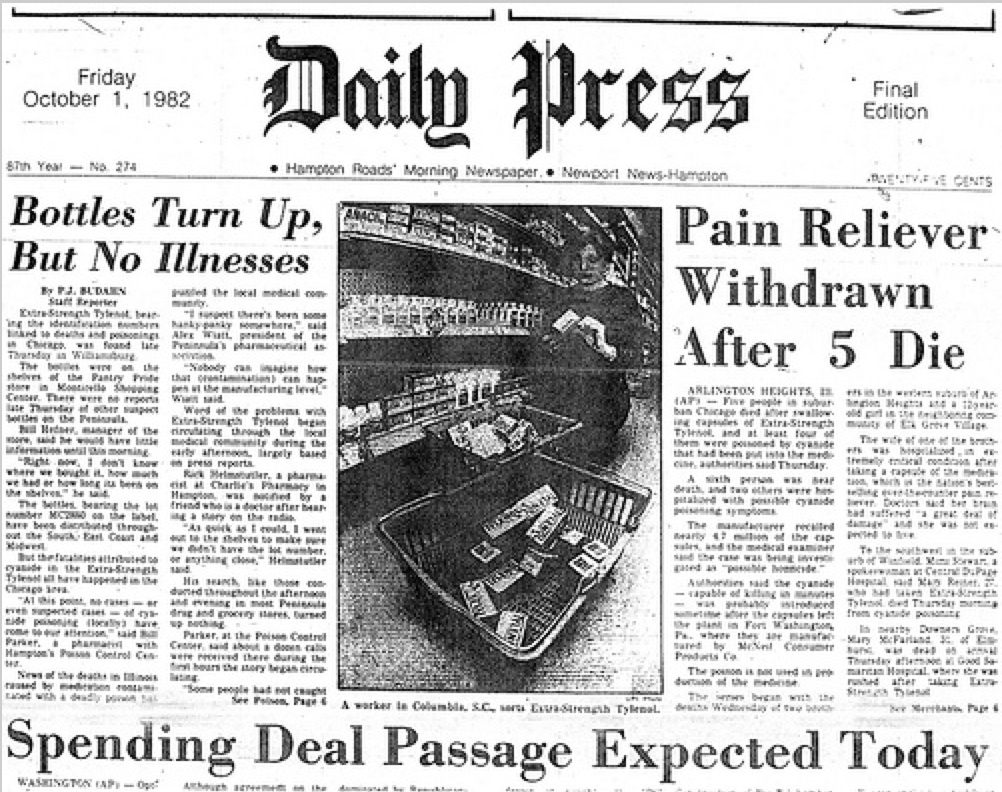
Through no fault of their own, Tylenol found themselves facing an unimaginable nightmare when a crazed person tampered with products and killed people.
For those who don’t know the story: In 1982 Chicago, people started dying of cyanide poisoning. Random people with no connection with each other, except that officials quickly discovered someone was lacing Tylenol with cyanide. It induced panic in the community to the degree that police and rescue vehicles were driving through neighborhoods announcing to people to toss out their Tylenol.
Think about that for a moment: police and rescue vehicles were driving through neighborhoods announcing to people to toss out Tylenol. Samsung went through a recall in 2016 when their Galaxy Note 7 products generated too much heat and the products caught on fire or exploded. At the time, in every airport gate in the U.S., gate attendants announced that Samsung Galaxy products were prohibited from the planes. It’s one thing for a product to perform badly. It’s another thing for a product to perform so badly that airlines make announcements against your brand prior to every U.S. flight for three months.
The Tylenol problem was worse, still.

Through no fault of their own, Tylenol had a major crisis on their hands. In all, 7 people died.
Johnson & Johnson, Tylenol brand owners, decided to pull all Tylenol products from the shelf. ALL of it, or 31 million bottles, since they didn’t want anyone else to die, and no one could be sure what products were affected.
Then they went to work, as resilient brands do.
Adjust Based On The New Reality
The buzz word these days is “pivot”. But companies have been adapting and adjusting for years without having a buzzword.

What I love about the Tylenol story is that the brand found themselves in a situation far beyond their control—and gained control again by sheer force and creativity. Most companies would have withered under these circumstances. But J&J put their best people to work on the challenge.
A short while later they reintroduced the world to Tylenol. To make sure people knew Tylenol was a safe brand, they launched with innovations consumers could see. Innovations that are so common today that new generations just accept that their products will be “Safety sealed three ways!”:
Glued boxes so consumers could tell at a glance if someone had gotten in first.
Bottle caps wrapped in plastic. So even if the box had issues, the plastic was a quick indicator of tamper-free products.
Foil-sealed lids as the final barrier against bad things happening without your knowledge.
Build On The New Reality
The Tylenol brand hasn’t looked back in ages. It’s mostly people like us who keep bringing up the story—or people who study crisis management. It’s an amazing study in how to deal with a brand collapse that’s beyond your control. But in the end, it’s what a brand chooses to control that makes the difference. J&J had the kind of culture that enabled them to take on a catastrophe head-on and thrive by making tough choices, adjusting in the new reality, acting with purpose, and building on the new reality.
There will always be crises. It’s how brands choose to deal with them that will determine what brands survive and which ones fade away.

How Do Resilient Companies Thrive?
There are winners and losers in every economy. Some people and companies collapse under the weight of changes and uncertainty while others seem to thrive. Same conditions, similar circumstances, but one group withers away while others not only survive the challenge but go on to do great things. What makes the difference?
There are winners and losers in every economy. Some people and companies collapse under the weight of changes and uncertainty while others seem to thrive. Same conditions, similar circumstances, but one group withers away while others not only survive the challenge but go on to do great things. What makes the difference?
What is Resilience?
Before we break down what resilient people and companies do differently, it might be helpful to define what we’re talking about. What does it mean to be resilient? According to Merriam-Webster, resilience means “able to become strong, healthy, or successful again after something bad happens.”
Seems simple enough. But being able to bounce back when bad things happen is largely related to the foundations laid prior to those bad things happening … and then building on the foundations as needed.
So what do healthy organizations do that help them survive the crises that take down their competitors?
Prepare: Build a Healthy Company Culture
Just as a healthy person is better able to fight off illness and injury, healthy organizations give themselves the upper hand in both good and bad times. In his excellent book “The Advantage”, organizational health guru, Patrick Lencioni, outlines four disciplines of healthy companies:
Build a cohesive leadership team—the people at the top understand why the company exists, what challenges are top priority, their roles and responsibilities, and how to work together to make things happen;
Create clarity—the leadership team is intellectually aligned and committed to the same fundamental values and actions. There can be disagreements at the top, but not dissension.
Over-communicate clarity—healthy organizations make sure everyone is on the same page, working together from top to bottom to accomplish their goals. People know why the company exists, how they’re changing the world, and how their particular role factors into that goal.
Reinforce clarity—“in order for an organization to remain healthy over time, its leaders must establish a few critical, non-bureaucratic systems to reinforce clarity in every process that involves people. Every policy, every program, every activity should be designed to remind employees what is really most important.”
Just being in business isn’t good enough to withstand real economic challenges. Companies that know what they’re about, why they exist, have leaders who are aligned and able to guide employees to the future, and help people link arms in the struggle give themselves incredible advantages in the marketplace.
Act with Discipline and Purpose
Discipline is key to resiliency at personal, brand, and organizational levels. Healthy organizations move with a sense of purpose in good times and bad. Because they establish their foundations early and understand why the exist, they can align their teams on disciplined pursuits of their goals.
In his book, “Great by Choice”, author Jim Collins details the 20-mile march concept used by explorer Roald Amundsen to successfully reach the South Pole. To summarize: “Enterprises that prevail in turbulence self-impose a rigorous performance mark to hit with great consistency—like hiking across the United States by marching at least 20 miles a day, every day. The march imposes order amidst disorder, discipline amidst chaos, and consistency amidst uncertainty.”
Does preparation build resiliency? In many ways, yes. Because it helps people not collapse when faced with uncertainty.
To quote Collins again, “Having a clear 20 Mile March focuses the mind; because everyone on the team knows the markers and their importance, they can stay on track. Financial markets are out of your control. Customers are out of your control. Earthquakes are out of your control. Global competition is out of your control. Technological change is out of your control. Most everything is ultimately out of your control. But when you 20 Mile March, you have a tangible point of focus that keeps you and your team moving forward, despite confusion, uncertainty, and even chaos.”
Collaborate or Die
There are many advantages to creating a collaborative work environment for organizations, from attracting better employees, and retaining your best people, to improving productivity and getting better ideas out of everyone involved. So why isn’t every company already committed to collaboration?
It starts with leaders—but it isn’t just leaders by title. I like the way Liz Wiseman’s talks about a better grade of leaders. In her book “Multipliers”, Wiseman defines multipliers as “genius-makers who bring out the intelligence in others. They build collective, viral intelligence in organizations.”
It’s important to make the distinction between leaders who are multipliers and people who are what Wiseman calls “diminishers”, or those who “are absorbed in their own intelligence, stifle others, and deplete the organization of crucial intelligence and capability.”
The multipliers in your organization help foster the kind of environment where people feel they are free to collaborate and share their best ideas because they feel valued, energized, challenged in positive ways, and therefore enthusiastically lean into helping the team and organization thrive.
How people feel is really important here. Organizations that post empty values about empowerment and authenticity, and then run people over when they express those values, are doomed to having an empty staff—people who come to work to get paid, not to give 110% of who they are.
Multipliers worry less about getting people in the right seats and accountability charts. They instill a sense of ownership, “provide the necessary resources for success, and hold people accountable for their commitments.”
By bringing out the best in everyone in the company, and leveraging a collaborative culture, organizations gain flexibility, agile work styles, become more adaptable and seem to have the ability to see around corners—not because their people are better or smarter than any other work force, but because every employee is fully engaged and fully utilized.
Worry About What You Can Control, Not About What You Can’t
Resilience is largely focused on companies controlling the right things and getting the right people and processes in place so they can capitalize on opportunities or shift away from issues faster. Success isn’t guaranteed, but resilient companies give themselves a better shot at success than their less prepared counterparts.
In their HBR article “A Guide to Building a More Resilient Business”, co-authors Martin Reeves and Kevin Whitaker identified four significant benefits of resilience at a corporate level:
Anticipation—the ability to recognize threats faster.
Impact—the ability to better resist or withstand the initial shock. This can be achieved through better preparation or a more-agile response.
Recovery speed—the ability to rebound from the shock more quickly by identifying the adjustments needed to return to the prior operating level and implementing them swiftly and effectively.
Outcomes benefit—increased fitness for the new post-shock environment.
In summary, resilient companies prepare for the days ahead and give themselves the advantage of a healthy culture, act with a sense of purpose and move at a steady pace, encourage collaboration in, around, and through their people and bring out the best in every individual, and take care of what they can control.
As a result, healthy companies are better prepared to enjoy the fruits—even in a down economy or turbulent environment—when their competitors struggle to survive.
Tell us your thoughts on what resilient companies are doing better and differently than others.

What’s Your Dandelion Strategy?
Dandelions don't need perfect conditions to flourish. No, they don't mind if the soil is bad, the water inconsistent, or even if they have to go it alone against all odds ... like taking root in a small crack in concrete. They accept the conditions given and find a way to succeed.
Your brand should perform like a dandelion: resilient, resourceful, prolific in output, delivering impressive results year after year.
Every spring my yard and I do battle. When the snow melts and the grass starts to turn green again I have visions of a deep, thick, healthy lawn stretching to soak up the sun and welcoming in the warm air. Instead, I get about 20 different varieties of grass left over from the previous owner, clover and dandelions. Lots of dandelions. I hate dandelions. Or at least I did until I started studying up on my adversary.
Now I'm thinking maybe we could learn a few things from the lowly dandelion.
Resilience
Dandelions don't need perfect conditions to flourish. They don't mind if the soil is bad, the water inconsistent, or even if they have to go it alone against all odds ... like taking root in a small crack in concrete. They accept the conditions given and find a way to succeed.
Ever try to kill a dandelion by pulling it out of the ground? Go ahead, try. It'll be back tomorrow or the next day, or the next. That's because dandelions put down a taproot up to 10 inches long which allows it to flourish in some really nasty conditions. Even better, the taproot is brittle, so when you yank hard parts of the root break off and that last little bit left in the ground is all the dandelion needs to grow again. It's not going away until you make life impossible.
How resilient is your brand? Do you need the perfect environment to thrive, or can you take it on the chin and stand up again? What are you doing to give yourself a shot at success even against all odds?
Resourcefulness
Let's look at that taproot again. It hangs out in the ground all winter long and waits for the perfect time to emerge. By the time you see what's going on, the dandelion is way ahead of you. You don't stand a chance of winning this battle, and it knows.
But dandelions don't just look out for themselves. They bring up nutrients that help surrounding plants. They loosen and aerate the soil in some places and hold on to it in others to fight erosion. They even fertilize the ground around them ... and people rave about the iron and Vitamin A they add to salads.
How would you rate your brand on resourcefulness? How do you take advantage of the opportunities around you? What do you contribute to the community?
Prolific Output
Dandelions put on a show, no doubt about it. Legend has it that hundreds of years ago people yanked out the grass so the dandelions had more room to grow. But even with just a little room, each plant produces a handful of bright yellow flowers. Each flower may bear 100 or more seeds. Each seed is laser focused on taking root and thereby continuing the cycle. And since it can take just six to eight weeks to go from seed to maturity, dandelions do everything in their power to make sure their legacy continues.
How prolific is your brand output? What are you doing to spread the tribe and make sure more people have a chance to embrace your brand?
Deliver Impressive Results Year After Year
Producing seeds in spring and fall, sending down deep roots to endure the cold winter and murderous attempts of landscapers and gardeners, dandelions return each year to prosper, grow and share. They'll happily find a home in a new neighborhood with great conditions, or replenish the area in bad soil. How about your brand?
Are you building a brand that will last, one that has the ability to keep growing and changing each year, or are you consumed with the now? What should you do to change your trajectory and give you a better chance of survival?
We can spend time debating the merits of challenger brands versus leader brands, legacy versus start up, entrepreneurs versus intrapreneurs, etc. Or, we can simplify the conversation even further and ask: what's your dandelion strategy?

In the marketplace of COVID-19, company leaders need to think like founders.
Much has been written about the difficulty of successful companies thriving in the second and third generations. The same logic holds true for the age of COVID-19. Companies would do well to revisit the founder mentality and get back to their entrepreneurial roots.
Much has been written about the difficulty of successful companies thriving in the second and third generations. The same logic holds true for the age of COVID-19. Companies would do well to revisit the founder mentality and get back to their entrepreneurial roots.
Many successful founders intuitively reinvent their business as they grow. They work crazy long hours to make their ideas come to life. They sacrifice of themselves. They're scrappy and scramble to take advantage of changes in the marketplace. And they jettison ideas that don't work in order to focus on what does.
Second and third generation leaders are often not scramblers. They focus on managing versus growing, they try to cut their way to profit when things get bad and, worse, believe that the one or two big clients that saved them in years past will save them forever. They feel a sense of entitlement to the spoils of success and blame others for the lack of growth or development. Soon enough the company crashes, fades away, or capitulates to a buyout.
In these days of quarantines, company leaders need to think like founders. Because we're all reinventing the future in real-time.
If you need help rethinking your future, let's talk.

The executives who got you here might not be able to get you out.
Leaders who excelled in guiding the company along historic routes can struggle with change. Agile organizations are the ones who are able to weather the storm and redefine their paths forward while fixed companies struggle with the change.
As this pandemic has taught us, agile organizations are the ones who are able to weather the storm and redefine their paths forward while fixed companies struggle with the change. Why?
In psychological terms it's called plan-continuation bias or, as the American Psychological Association defines it, "the tendency of people to continue with an original course of action that is no longer viable."
It's the kind of mindset that leads ship captains to run into icebergs, and airline pilots to crash in storms they should avoid. People who feel intense pressure to get the job done or who feel social stresses to not appear weak make stupid choices even when there is every indication that staying the course will end badly.
I meet executives with this tanker mentality. They believe their role is to keep the machine rolling on the course they set long ago. They argue that staying the course has always worked in the past, so why change now? Why? Because the world has changed and so, very likely, should the company.
This may call for new executives who can flex in the moment and guide the company to new types of success. They may not be tankers, but speedboats.
If you need help with company or brand change, let's talk.