

Are You Solving the Right Problem?
In the fast-paced world of business and brand management, it’s easy to feel trapped in a cycle of addressing symptoms rather than root causes. As leaders, it’s crucial to step back and ask: “What problem are we really solving?”
In the fast-paced world of business and brand management, it’s easy to feel trapped in a cycle of addressing symptoms rather than root causes. As leaders, it’s crucial to step back and ask: “What problem are we really solving?”
Are you creating a better band-aid or addressing why the wound occurred in the first place? Both approaches have merit, but understanding which one you’re pursuing is critical for strategic alignment. This dilemma isn’t new. In 1919, Edward Bullard invented the hard hat to prevent head injuries from falling objects. This addressed the root cause, revolutionizing workplace safety. In contrast, others were focused on the symptomatic solutions of creating better bandages and painkillers.
Sometimes, addressing symptoms can be lucrative. The pharmaceutical industry often focuses on creating faster-acting, more effective painkillers rather than tackling the underlying causes of pain. As a brand manager, you might develop the best meal-replacement shakes while another team addresses poor eating habits. You might create a better energy drink while another team focuses on the issues of sleep deprivation. While challenging, both strategies can coexist within the same company, targeting different aspects of the same overarching issue.
Here are some steps to consider on your innovation journey:
Start by clearly defining whether you’re addressing symptoms or root causes. This clarity will guide your innovation strategy and resource allocation.
Consider developing parallel approaches—one for immediate relief (symptom) and another for long-term solutions (cause).
Regularly engage with your audience to understand their underlying needs, not just their immediate wants.
Foster partnerships between teams focused on short-term solutions and those working on long-term innovations. This cross-functional collaboration can yield powerful insights and more comprehensive strategies.
Develop KPIs that reflect both immediate results and progress towards solving fundamental issues, ensuring you’re measuring impact holistically.
Finally, future-proof your approach by regularly reassessing your problem-solving strategy. Ensure it aligns with evolving market needs and technological advancements.
Remember, there’s no one-size-fits-all solution. The key is to be intentional about your approach and ensure it aligns with your brand’s vision and values. By thoughtfully considering whether you’re putting out fires or preventing them, you’ll position your brand for sustainable success and meaningful impact. In doing so, you're not just solving problems—you’re creating a legacy of innovation that addresses both immediate needs and long-term challenges.

Do you suffer from the "better mousetrap" syndrome?
It's easy to get laser-focused on creating things. But those ideas need to be grounded in something more than personal preference. Before launching your next big idea, your better mousetrap, ask yourself: Does your audience even realize they have a mouse problem?
Here are six steps to consider to make sure your concepts are grounded in insights so you increase your chances for success in the marketplace.
I've dealt with many brands through the years that had interesting ideas and products and yet couldn't imagine why people weren't beating down their doors to get to those amazing ideas.
It's pretty easy to get laser-focused on creating things. Thinkhaus Idea Factory does plenty of innovation and strategy workshops to help companies develop new ideas to take to market. In some ways, this is where better mousetraps are born. But those mousetraps need to be grounded in something more than personal preference.
Before launching your next big idea, your better mousetrap, ask yourself: Does your audience even realize they have a mouse problem?
Here's a simple way to approach the issue:
1. Start by gathering consumer insights to drive innovation. This doesn't have to be some exhaustive study. It can be some simple engagements where the team turns observations into actionable insights that the innovation team can leverage for better ideas. Consumers are lousy at telling you what product they need.
The average house is filled with products people love today but would have never asked for prior to invention. No consumer said they needed a microwave oven before they were introduced to microwave ovens. People didn't ask for refrigerators, televisions, dishwashers, or even lightbulbs, either. The insights around convenience are what led to the breakthrough ideas.
This is why I make the distinction between observations and insights. You could observe someone washing dishes by hand. That's a task getting done. The insights come from the dishwasher's frustration with the soap, sponge, scrub brush, volume of dishes, dirty water, and more. From those insights, you can create solutions that will have an audience.
2. Check out the marketplace in the areas you're considering. What are you going to be competing against? For blue ocean strategies, you're looking for holes you can fill where there are no competitors.
3. Ideate freely.
4. Engage with your target audience to validate your concept and make necessary refinements.
5. Refine, iterate, and keep checking.
6. Solve the mouse problem.
Need help with your better mousetrap? Let's talk.

Use “Tell” Stories to Capture Your Brand’s History
“Tell” stories are historical in nature because they address things that happened along the company’s journey to the present. They come in a variety of forms, often starting with a company or brand origin story and growing from there. Because they deal with the past, Tell stories are typically editorialized to get those unseemly rough spots out of the narrative. And they can be revisionist in the sense that history is often rewritten by those who come later, scrubbed of things we might find offensive, and enhanced to make them more exciting.
There are plenty of storytelling models out there that break down the elements of how to tell a good story. Before getting into the weeds of the hero’s journey, antagonists, twists, issues overcome, etc.—which is where too many people and good brand stories go astray—it might help to consider two simple vectors that frame the types of stories being told: Tell and Make stories.
In this post, we will focus on Tell stories and cover Make stories in the next post.
Tell Stories
Tell stories are historical in nature because they address things that happened along the company’s journey to the present. They come in a variety of forms, often starting with a company or brand origin story and growing from there. Because they deal with the past, Tell stories are typically editorialized to get those unseemly rough spots out of the narrative. And they can be revisionist in the sense that history is often rewritten by those who come later, scrubbed of things we might find offensive, and enhanced to make them more exciting.
Something to keep in mind with marketing writing is that it is not generally held to the same standards that journalism once was. So, many narratives can seem more like historical fiction than a biographical telling of the events as they happened. For the most part, this is fine.
Origin Stories
All companies and brands have an origin story, whether they choose to leverage it or not, which is why they are so common. A classic example is Hewlett Packard getting its start in a Palo Alto garage in 1939. Or maybe you’re an Apple fan and can recite the details of how Steve Jobs and Steve Wozniak created a new way to think about the personal computer.

Have a Cup of Pequod
The Starbucks logo has gone through a number of evolutions since its origin in 1971 to match the growth and personality of the brand.
Origin stories can be short and to the point or longer, epic tales. Most brands opt for brevity. Consider Starbucks. The Starbucks origin story includes the brand almost being named Pequod, the whaling ship in Moby Dick, until clearer heads prevailed and the name of the first mate in the Moby Dick tale (Starbuck) won the day. Howard Schultz joined the brand about 11 years after it was founded and was inspired to bring a little bit of Italy’s classic coffeehouse warmth to Seattle. With this new position in place, Starbucks grew to become a household name and coffee aficionado must-have all around the world.
It’s a nice, clean, simple story. As it should be. If you want all the sordid details of the naming struggles and times before Schultz joined, his trips overseas to find the perfect experience, Schultz starting his own Il Giornale brand before merging the two companies together to form what became the model of today’s Starbucks, etc., find a biography, curl up with a nice cup of coffee and read away.

Shoes for Good
The TOMS name is derived from Blake Mycoskie’s concept of Shoes for Tomorrow. Shorten Tomorrow, add an S, and you get TOMS. Tomorrow’s Shoes.
The TOMS brand was founded in 2006 by Blake Mycoskie, pioneering, as the company website says, “the One for One® model—giving away one pair of shoes for every pair sold, supporting larger health, education, and community development programs through strategic partnerships.” The first shoes were based on the Argentinian Alpargata designs. Consumers caught wind of the concept, embraced the idea and the shoes, and the TOMS brand was off and running.
We could go on with dozens of brands such as Tesla, Purple, Dollar Shave Club, Airbnb, Warby Parker, Netflix, GoPro, Yeti, and many more.
The importance of origin stories is that they provide a cultural foundation for the brand. They help ground the company on what happened in the early days and remind people of the inspiration, determination, and hard work that helped get the company started—even if the company changes course over time and produces things far outside of their origin.
One additional thought to point out here is that origin stories are often updated over the life of the brand. Some details that might have seemed relevant or important in one generation can fall out of fashion for the next generation. When that happens, the story gets tweaked and everybody keeps moving.
Key EventS
Key events are important aspects of every brand narrative. As you might expect, they capture the key moments that happened in the life of the brand. They can be good, great, bad, or catastrophic. They are almost never the forgettable chatter that makes up the noise of everyday life.
For clarity, when key events happen in real-time they are “Make” stories instead of “Tell” stories. We’ll talk more about that in the next post. Sometimes brands celebrate their moments when they happen. Sometimes the moments take a little while to come together well enough to get the story right.

Made for Dunking
According to Mondelez International, factories in 18 countries around the world produce 40 billion Oreo cookies every year. That’s enough to circle the earth five times.
For Mondelez International, maker of the Oreo cookie brand, a key event came during the 2013 Super Bowl game being played in New Orleans. For those who don’t remember the details, the Mercedes Benz Superdome, where the game was hosted, experienced a 34-minute power outage. Like many brands, the Oreo team was already prepared for social media interactions with fans during the game. But what do you do when the power goes out?
Oreo used Twitter and Instagram to remind fans, “you can still dunk in the dark.” While everyone else screamed about the inconvenience of the blackout, Oreo found its groove and its voice. Social media loved the play. They gained 8,000 Twitter followers that night and another 34,000 Instagram followers, with somewhere near 16,000 photos posted from fans.
Obviously, this was a huge Make story in the moment. As the days and weeks passed, more details were added, statistics updated, and sources cited. It’s in the passing of time that it became a Tell story.
Brand Trivia
More often than not, there is a wide range of interesting bits of information that find life in the narrative arc because the stories that get told at parties slip out and become part of the lore. This is the trivia that not only makes for great games, but also keeps the brand story alive in the culture.
What Motivates You?
Nike’s logo and the story behind it are well-known in branding lore. The story behind the equally iconic tagline is less well known but just as interesting.
Sometimes it’s hard to know which version of the story is true. For example, the official version of how Nike’s iconic Just Do It tagline came to be has been shared by Dan Wieden who wrote the line and was a co-founder of Wieden and Kennedy, the agency behind the work. In a Creative Review article, Wieden says “In reviewing the work the night before the client presentation, I felt we needed a tagline to give some unity to the work, one that spoke to the hardest hardcore athletes as well as those talking up a morning walk.” The article goes on to say, “Wieden drew on a surprising source for inspiration. In Doug Pray’s 2009 documentary about advertising, Art & Copy, he confesses that the idea for the line was sparked by the last words of convicted murderer Gary Gilmore, who said “Let’s do it!” to the firing squad before his execution.”
It’s an amazing tale with a deep and inspiring source. But there are other versions of the story as well.
In a presentation in the mid-1990s, art director David Jenkins, who was the other half of the creative team working on that night before the client presentation shared the story from a different view. As he told the story, he and Wieden were frustrated by their inability to nail the last details of the campaign they’d be showing the next morning, including the tagline both agreed they needed. Well into the long night, they took a break, visited the bar next door for a drink, some food, and a chance to clear their minds, and got back to the work with Jenkins on the layouts and Wieden on the tagline. After a short while an irritated Wieden showed up with an idea. “What if we say something like ‘Just get off your a** and do it?’” he supposedly asked partly in frustration and partly in jest. Jenkins replied with something along the lines of, “I don’t think that will fly.” Wieden walked off grumbling under his breath that he agreed. A short while later Wieden returned with a piece of paper with three words written on it. He held it up and asked, “What if it’s ‘Just Do It’?” Jenkins said they both smiled and knew they had something good. How good was to be determined later.
Which version do you believe? Does it matter? One version gets cleaned up and goes into the history books, creative journals, and company websites. The other gets shared amongst friends. That’s what happens with Tell stories. They get told to others, the edges get polished, and the versions that seem to be best received go into the archives for future generations.
Connecting WITH the Past
Something that gets overlooked in brand storytelling is the ability to use Tell stories to connect the dots in the brand’s past, make sense of some random events, and rationalize or explain away behaviors.

More Than Just Bubble Wrap
Sealed Air Corporation gets its name from the company’s original product: Bubble Wrap. The name is a literal interpretation of air sealed in plastic. The company is now a global leader in packaging and food protection.
While working with Sealed Air Corporation in the mid-2000s for a major corporate rebrand and turnaround, the newly appointed CEO was challenged with finding the language to help Wall Street understand why a traditional packaging company with a division focused on food protection would purchase a large industrial cleaning chemical company. The acquisition had been made by the previous CEO, doubled the size of the company and the debt, and investors were hammering the company because of it. Our team dug into the archives and found a line from Sealed Air’s 1973 Annual Report (well before the acquisition in question) that said, “selection of packaging products which are more efficient are a positive step toward meeting all three sides of a crucial triangle: Energy, Environment, and Economy.” Three sides of a crucial triangle matched the three companies and the direction the new CEO was trying to go and gave us a hook we could use to tie the story together. It had been there all along but nobody knew it was there.
It became a classic Tell story and was very effective in helping investors see that though the company had lost its way for a while, it was back on course and on a trajectory to change the game. The company made significant changes, investors bought in, and the stock price tripled in value in just over 15 months.
Connecting with the present
As we’ve discussed, Tell stories are great for covering the start of the company, significant events, capturing bits of trivia and insider information, and helping rationalize things that happened in the past and are only now coming into clarity. Most companies are bad at capturing the events as they happen, which is why Tell stories are often written and revised by the people who come afterward. It’s a natural flow. The important part is to capture the stories. Keep them alive. They are critical to each brand and company and should be woven into the fabric of the culture.
In our next post, we will break down Make stories and why it’s so important to make something of the catalyst moments as they happen.
What about you? Have any great Tell stories to share?
If you would like some help in telling your brand stories, let’s talk.

Understanding the Narrative Chain for Brand Storytelling
Brand storytelling doesn’t follow a linear path. It never has. A linear model doesn’t allow for the chaos that comes with dealing with real, living, breathing humans and constantly changing markets. It certainly doesn’t take social media into consideration.
If you’re not careful, you could fall into the trap with some narrative arc models that, though they account for some issues with the brand, often do so with the issues in the rearview. As if the challenges the brand has faced in the past will somehow predict what the brand will face in the future.
Instead, look at brand storytelling as a narrative chain made up of many stories in “S” curves.
If you’ve been watching the Bud Light conversation in recent weeks you’ve gotten a master’s class example of how brand storytelling isn’t always under the control of the brand. At least in the ways people like to believe it is. Social media has only accelerated the public’s ability to derail the grand schemes of brand managers all over the world.
There are lots of ways to talk about storytelling and the principles of what makes a good story: protagonist, antagonist, hero, tragedy or issue to overcome, twist, outcome, etc. Those are all extremely valuable and it’s good to understand what it takes to create an epic story. But far too many brand storytelling models put the brand squarely at the helm. As we’ve seen lately, it’s not that simple.
Brand storytelling doesn’t follow a linear path. It never has. A linear model doesn’t allow for the chaos that comes with dealing with real, living, breathing humans and constantly changing markets. It certainly doesn’t take social media into consideration.

The Brand Narrative Arc Isn’t Linear
Brand storytelling doesn’t follow a linear model. Because all of the variables are not controlled by the brand.
If you’re not careful, you could fall into the trap with some narrative arc models that, though they account for some issues with the brand, often do so with the issues in the rearview. As if the challenges the brand has faced in the past will somehow predict what the brand will face in the future.
Instead, look at brand storytelling as a narrative chain made up of many stories in “S” curves.
The Opening Stage
At the beginning of every brand story, the brand is in complete control. This is the story the brand intends to bring to the market and use to attract audiences. It’s the new baby ready to be presented to the world.

The Narrative Phase Begins
At the beginning of every brand narrative, the brand is in complete control. This is the story the brand intends to bring to the market to attract audiences.
The Swell Stage
Next, the brand enters into the Swell stage or stages. Sometimes these are guided by the brand. Think of Dove’s Real Beauty campaign. The brand chose to go against the tropes of the beauty category and celebrate real women in all shapes, sizes, colors, and personalities. The campaign was embraced by consumers, the press, investors, and has allowed Dove to enjoy a steady wave of positive press and sales.

The Swell
During the Swell, the narrative builds whether by design or reaction.
What Bud Light is experiencing is the other side of the Swell, when the brand loses control of the narrative by contrasting forces. This isn’t unique to AB InBev.
For those old enough to remember, and for those who want to know the story, J&J and Tylenol went through a horrendously negative Swell event in the 1980s.
A brief recap of the events: In 1982 Chicago, people started dying of cyanide poisoning. Random people with no connection with each other. Except that officials quickly discovered someone was lacing Tylenol with cyanide. It induced panic in the community to the degree that police and rescue vehicles were driving through neighborhoods announcing to people to get rid of their Tylenol.
In all, seven people died. J&J had a crisis on their hands and decided to just pull all Tylenol products from shelves. ALL of it, since they didn’t want anyone else to die, and no one could be sure what products were affected.
That someone would put poison in a consumer product was well beyond anything J&J could have predicted. It was out of the brand’s control. What came next was where the brilliance happened.
J&J went to work and took control of a shocking event and a little while later reintroduced the world to Tylenol. But to make sure people knew this edition of Tylenol was significantly better and safer, they launched new innovations including sealed boxes, tamper-proof bottles with a shrink-wrapped outer barrier, and a foil seal glued to the top of the bottle. All of these are commonplace today but were huge innovations at the time. They were great examples of a brand guiding the story through the downside of a Swell event.
J&J’s response ended the Swell stage for this event. It didn’t end the overarching narrative, and that’s the important part of how to think of the narrative chain. Brands don’t have control over everything that happens in the Swell, but they do have a responsibility to manage it. J&J chose to pull all products and rethink their approach. Yes, it took a while, but they also took control of the situation.
Some stories, like Dove’s Real Beauty, catch the right cultural wave and enjoy a long, healthy, positive ride. Their Swell has been stretched for years, with most of those years under the control of the brand.
For other brands, the misery is self-inflicted which makes it harder to overcome. Examples include Volkswagen’s rigged emissions testing scandal and Samsung’s exploding Galaxy 7 batteries, but there are dozens of others we could talk about.
At some point the story changes. When that happens, we conclude that narrative story phase and start a new one.

Closing the Swell
The Swell stage may go quickly or last for years. When the story changes, that marks the conclusion of that narrative phase.
Writing the Next Chapter
Thankfully, every brand gets chances to start a new story. Depending on the circumstances, it may start off with “we screwed up, we apologize, and we’ve changed.” In the case of Tylenol, J&J effectively said, “we didn’t start this and could have never seen it coming, but we are changing to try to ensure this can never happen again.”
If the brand fails badly enough, the narrative may shift to the new owners who see the value in the brand and have a chance to tell audiences “the previous owners stumbled and we’re fixing those issues.”

The True NarraTive Chain
The total brand narrative isn’t one, long, continuous story. It is made up of dozens and sometimes hundreds of stories.
Linking the stories
Over time, brands link a wide range of stories, some very positive and others not so much. It’s the natural result of ongoing brand building. And it’s a reminder of why shepherding brands is so important at the executive level. It doesn’t take much these days to turn your once-loyal audiences against you and find yourself rebuilding your brand. In the end you worry about what you can control and adjust to things you can’t.
If you would like help building your brand story, let’s talk.

7 Ways Resourceful Companies Navigate Turbulence
In turbulent times, companies must discover what kind of adjustments are right for them to stay relevant. It can seem overwhelming. But there are a few ways to think about resourcefulness to help companies of any size manage through stressful environments.
In turbulent times, companies must discover what kind of adjustments are right for them to stay relevant. It can seem overwhelming. But there are a few ways to think about resourcefulness to help companies of any size manage through stressful environments.
In our Dandelion Strategy model, resourcefulness is key. Dandelions send down a taproot first and go deep so the plant can hang out all winter and wait for the perfect time to emerge. This foundation gives them some stability for the battle ahead. By the time you see what's going on the dandelion is way ahead of you. The dandelion has a plan for survival—but it also looks out for the surrounding ecosystem. They bring up nutrients that help surrounding plants. They loosen and aerate the soil in some places and hold on to it in others to fight erosion. They even fertilize the ground around them ... and people rave about the iron and Vitamins A, C and K, Folate, Calcium, and Potassium dandelions add to salads.
How would you rate your brand on resourcefulness? How do you take advantage of the opportunities around you? How are you using what you learn?
Dial up your resourcefulness with these seven steps:
Embrace the chaos. Business and life are rarely linear. When you plan for the chaos and build teams that can adjust on the run, challenges are just puzzles to be solved. And you can hire good puzzle solvers.
Computer programmers and mathematicians use chaos theory, instead. This says that instead of keeping to a predictable pattern, we’d be better off—and find solutions faster—by moving in non-linear ways. The author and economist Tim Harford put it this way: “When everything is perfect, when everything is tidy, we're on autopilot. And we're not necessarily living in the moment, we're not necessarily paying attention. And that's a problem for us.” Embrace the chaos, live in the moment, and thrive in the turbulence.
Listen to the people on the front lines. That’s where people are making real-time adjustments to the market and customer and supply chain issues to keep things rolling.
Plenty of companies put up posters or engage in employer branding campaigns to motivate staff or remind employees that their ideas matter. Those can be effective. They can also be vacuous and empty. What we’re talking about here is really listening to the people who see and hear the needs, frustrations, wishes every day. I’m always surprised at how many amazing—and amazingly simple—solutions come out of conversations with the teams on the ground. Management can’t see it all and should never think it is their job to solve every issue. Get on the ground, listen, and act on the information provided.
Expand your market. You may need to change your game a bit. Some say if your organization is not evolving, it is dying! How are you evolving to meet new, emerging demands?
Uber launched UberEats in 2016 in mostly large markets. By 2018 they were expanding into smaller markets and competing with challengers like DoorDash and GrubHub. Adoption wasn’t hitting the numbers everyone wanted in part because consumers saw food delivery as a solution to a problem they didn’t have, and restaurant owners saw the costs as too high. Then the pandemic happened and restaurants were effectively shut down. This put UberEats, DoorDash, GrubHub, and the rest of the delivery industry in the spotlight as viable and necessary solutions to both consumer demand and restaurants staying in business. To put this expansion into perspective, consider that Uber made $10.4 billion in 2019 from its legacy business, but only $7.3 billion in 2021. Over that same time, Uber Eats grew from $1.9 billion to $8 billion in revenue.
Consider new ways to deliver your product or service. If customers can’t get to you, how do you get to them? How can you meet them halfway? If you can’t stock what you had before, how can you still deliver delight and surprise for your customers?
For example, there are all kinds of rumblings about looming toy shortages this Christmas. That’s going to be a problem but it’s not top of mind yet. It will be. If Christmas is part of your game, how could you change the game and be the hero?
Partner with other businesses. Dandelions don’t just look out for themselves. And neither should you. Who else could help you thrive? How could you help them? How could you link arms with companies offering adjacent services so your combined services solve even more challenges for your customers?
During a past recession I worked with a company that specialized in community waste services dominated by mom and pop operations. We found their customers couldn’t afford to take a week off to attend elaborate trade shows in Vegas. We interviewed a number of these business owners and found they wanted the information and exposure to new ideas, but all of that had to be more convenient for them. Our solution was to partner with adjacent companies and conduct regional shows so customers could drive over—not fly—get the information they needed and get back home the same day. It solved a number of issues for the manufacturers and their customers.
Stay connected with your customers. What’s your feedback loop? Who’s keeping their finger on the pulse? Make sure the person or people you put in charge of monitoring customer feedback are in the right seat. Look for someone who thrives on collecting information (good and bad), mining for insights that can make a difference, and then turning those insights into actionable data.
I once worked with a start-up company that had a senior leader in charge of monitoring customer response. According to reports inside the company, customers were in great shape and loved everything about the brand. By contrast, a little social listening indicated the company was far behind on deliveries, didn’t return phone calls, and was quickly building a reputation for bait and switch. It turned out that the executive was only responding to good news from customers. He was ignoring the complaints. And those complaints were piling up. The company had to put another exec in place fast to save and rebuild the company’s reputation.
Celebrate the lessons. I encourage you to build a learning culture, not just a good news culture. In good news cultures, executives make it clear that all they want to hear is what worked, the good news. Bad news is punished as are the people responsible for it. As a result, people learn to avoid risk because taking chances means you might fail. And failure of any type could get you fired. That’s never the case in resourceful and innovative companies. They stretch, they stumble, they bump into things. Take 3M, for example. Scotch tape and Post-it Notes are just two of the many products that came to life because 3M empowered their people to tinker outside of their box. Scotch added adhesive to cellulose strips for an auto body paint masking solution while Post-it repurposed a light adhesive that didn’t have a reason to exist into a tool used all over the world.
Resourceful companies do exactly that. Like 3M, they give people permission to try new things and stray from their normal course of work. Sure, some of those things won’t work, some will underperform, and some might take off into outer orbit.
That’s why it’s important to celebrate the lessons learned and share the highs and lows as a group. Google’s former Head of People Operations Laszlo Bock stated in his book, Work Rules!, “it’s also important to reward failure” so as to encourage risk-taking. Scott Cook, co-founder of Intuit, said, “At Intuit, we celebrate failure. Literally: Intuit has a Greatest Failure Award. Because every failure teaches something important that can be the seed for the next great idea.”
Resourcefulness requires being able to imagine solutions that don’t exist yet. That kind of thinking happens best when people feel safe from prosecution within the company. Build a culture that enables courageous thinking and exploration. Celebrate what you learn and grow from them.
What ways have you found to be resourceful in these turbulent times? Let us know by commenting below.

Foundations are Critical for Resilient Companies
Dandelions put out a taproot from the very beginning to give themselves every advantage possible in journey ahead—because they don’t know if that journey will be easy or tough.
Unfortunately, too many companies don’t operate with the basic principles of dandelions and as a result, start with weak foundations, don’t plan for adversity ahead, and falter when the economic winds change. If we’ve learned anything from history it should be that change is inevitable. It can be sudden and unpredictable or like a slow-moving glacier.
Dandelions put out a taproot from the very beginning to give themselves every advantage possible in journey ahead—because they don’t know if that journey will be easy or tough.
Unfortunately, too many companies don’t operate with the basic principles of dandelions and as a result, start with weak foundations, don’t plan for adversity ahead, and falter when the economic winds change. If we’ve learned anything from history it should be that change is inevitable. It can be sudden and unpredictable or like a slow-moving glacier.
What are you doing to give yourself a shot at success even against all odds?
Establishing Your Organizational Foundations

At Thinkhaus, we work with companies to build strong foundations. Depending on where you are as a company, this may be defining your purpose, vision, mission, values. You might use all of these or only a couple. These are your taproots.
Some companies never bothered to write these down, or maybe they did but the language was off. Some companies discovered that somewhere in the pandemic their foundations shook loose and didn’t hold up that well. One of my personal favorites here was created by the brilliant writers for the show The Office and their fictional Dunder Mifflin Paper Company. Their Mission Statement reads:
“Dunder Mifflin Incorporated provides its customers quality office and information technology products, furniture, printing values, and the expertise required for making informed buying decisions. We provide our products and services with a dedication to the highest degree of integrity and quality of customer satisfaction, developing long-term professional relationships with employees that develop pride, creating a stable working environment and company spirit.”
The statement is purposefully packed with corporate babble that is neither clear nor differentiating. It worked great for a comedy show, but you can find similar statements in organizations across the globe.
Generalizing foundational language can also lead to shaky cultures. For example, all those companies that promised their employees that they worked like a family had some soul searching to do when things got tough and they laid off half the “family”. Because that’s not really what we do to family. We don’t push our kids out the door when things get tough. We tighten our belts a little, maybe cut back on extracurricular activities, take fewer trips, etc. But the family stays the family.
It's one thing to say you want a culture that treats people equitably and does everything possible to maintain a collegial environment, but a little clarity goes a long way, especially in difficult discussions and markets.
In mid-2022, Netflix sent out a memo to their staff saying they are not like a family. They are like a high-performance team. And they evaluate based on performance, move people in and out as needed, and optimize to keep the machine performing.
“The thing we most value is working with talented people in highly creative and productive ways,” the statement read. “That’s why our core philosophy is people over process, and why we try to bring great people together as a dream team. Of course, any growing business requires some process and structure. But with our people-first approach, we can be more flexible, creative, and successful in everything we do.”
Further, Netflix went on to say, “As employees, we support the principle that Netflix offers a diversity of stories, even if we find some titles counter to our own personal values. Depending on your role, you may need to work on titles you perceive to be harmful. If you’d find it hard to support our content breadth, Netflix may not be the best place for you.”
It’s a much more honest approach: You matter to us. You bring a lot to the table. But don’t forget what we all agreed to build together when we joined.
You don’t have to agree with Netflix. And that’s exactly the point. If their foundations aren’t right for you, choose another place to work that matches who you are.
Is it time for you to take another look at what your company stands for?
Clarifying Brand Foundations
Maybe for you it’s at the brand level. In brand strategy, we use the equity pyramid as a framework to clarify the elements of the brand. The model itself isn’t that important. I want to focus on the bottom two sections for a minute: Points of Parity and Points of Difference. Points of Parity are those things you need to do to be seen as credible in your category but aren’t all that unique. Points of Difference are things that only you do and a fast follower would have a tough time matching within six months.

Something we run into all the time is companies that are shouting their Points of Parity and wondering why people don’t understand what makes them unique. Dandelions do NOT do this. The dandelion doesn’t worry whether they’re like everyone else. They are not. They know their purpose and what makes them unique, what separates them from the competition, and they go on to proudly do their own unique thing.
Why Worry About Foundations?
If you were to construct a building and didn’t quite finish the foundation before putting up the walls, you would expect things to get shaky when it came time to build the second floor. It makes logical sense when talking about a physical space. But companies launch on shaky business principles every day and wonder why they can’t hold on when times get tough.
Establishing a dandelion strategy and getting the foundations right from the start won’t keep recessions, pandemics, or competitors away. But they will help you be best prepared to weather the storms when they happen.
Tell us your thoughts on building strong foundations.

Brand Storytelling: The art of conversation
We love to talk about what we’ve done, who we’ve seen, the hurdles we’ve crossed and triumphs we’ve realized. If we’re not careful, we can talk about how amazing we are and leave our guest completely out of the discussion.
Brands do this all the time. Agencies do this all the time. All this chest thumping and self promoting leaves consumers and customers on the outside looking in … if they even stay around long enough to keep looking.
They say great conversationalists are first really great listeners.
The communications master Dale Carnegie put it this way: “If you aspire to be a good conversationalist, be an attentive listener. To be interesting, be interested. Ask questions that other persons will enjoy answering. Encourage them to talk about themselves and their accomplishments. Remember that the people you are talking to are a hundred times more interested in themselves and their wants and problems than they are in you and your problems.”
Keep in mind that Mr. Carnegie wrote these words in the mid-1930s. This is not new material. The not-so-subtle jab at the general populace is this: we love to talk about ourselves. We love to talk about what we’ve done, who we’ve seen, the hurdles we’ve crossed and triumphs we’ve realized. If we’re not careful, we can talk about how amazing we are and leave our guest completely out of the discussion.
Brands do this all the time. Agencies do this all the time. All this chest thumping and self promoting leaves consumers and customers on the outside looking in … if they even stay around long enough to keep looking.
So how can brands master the art of conversation in their storytelling?
Stop talking about you
As a young copywriter I was taught to talk about the benefits of each product feature because the benefit is what the consumer/customer is actually looking for. It’s the solution provided by the feature.
But many companies want to talk about their accomplishments, size, scale, equipment … features. This is a TELL approach, as in, “let me tell you about me.” It almost makes sense. After months and years of product and brand development, people want to get credit for their hard work. The problem is that no one wants to listen to you talk about you.
Start listening to them
I have a friend named Karen who is amazing at this. Karen is the kind of person who circles a room meeting people and comes back within a few minutes knowing personal details on every single person. People open up to her and share their inner thoughts, goals, and challenges as if she’s the therapist they never knew they needed. It’s magical to see in person.
So what’s her secret? Karen asks great questions and doesn’t interject her own stories while other people are talking. People open up to her because she is genuinely interested in them. If the other person doesn’t ask about Karen, she’s fine to leave those details out.
Obviously brands can’t work a room in their daily communication. But they can spend a lot more time listening to the wants and needs of their customers. Those wants and needs often show up as frustrations.
In an earlier post I talked about Command™ Brand hanging solutions. The brand had tried for years to talk about the superiority of their technology over other options but consumers didn’t care. It was the better mousetrap no one wanted. But in research consumers talked about their frustrations with punching holes in walls and having to repair them, about not being able to move things around, about wanting to hang some things for the holidays and take them down later without making it a big deal. Those frustrations opened up new opportunities for the brand. By repositioning the brand as “Damage-Free Hanging Solutions” that can let you change the position of your hanging as quickly and easily as you change your mind, the Command™ Brand found audiences who couldn’t live without the brand.
Be nice. Be real.
You might think that being nice should be a given in brand storytelling, but it’s not. Brands should choose their tone of voice and brand personality with purpose, teach the fundamentals to everyone who interacts with customers, and reinforce the principles on a regular basis.
When helping organizations launch or rebrand, we spend a healthy amount of time on brand personality and how that will come to life in the marketplace. That may include call center scripts, ad copy guidelines, online content guidelines, etc. Everyone on the brand team must be clear how the brand communicates and what tone of voice is supported. Wendy’s might be able to get away with snarky tweets, but your brand might not. And you should know before you damage the brand.
Let them be the hero
Dale Carnegie said people “are a hundred times more interested in themselves and their wants and problems than they are in you and your problems.” Essentially, we’re all fascinated by ourselves. Think you’re different? Find a group photo you’re in and see who you look for first. Yup. You look for you first. We all do. Then we look at our friends and enemies (hoping they look horrible in the shot), and filter out everyone else as visual noise.
In the brand storytelling world, we must let the customer be the hero. The brand’s position is to help solve their issues and take their pain away. That means helping them be better cooks, better at lawn management, better at home repair, cleaning, office work, workouts, weight management, and many more.
Brands exist to help make the world a better place. They do that by enabling and empowering their customers to take on new challenges and be amazing in their efforts. That means the customer is the hero.
No, really, it’s all about them
We’re only focusing on four steps to brand conversations here because it shouldn’t be that complicated:
Stop talking about you
Start listening to them
Be nice. Be real.
Let them be the hero
There are times when brands need to cover details about themselves, but more often than not, the focus should be on the customers and how the brand can help solve their challenges.
If you’re in the market for storytelling help, let’s chat to see how we can support you.

Brand Storytelling: When in doubt, be Q
James Bond is always on the run, always getting himself into unexpected situations in his quest to save the planet from the evil of the hour. He desperately needs someone looking out for him and creating solutions Bond doesn’t even know he needs yet.
One of the most common mistakes in brand storytelling is making the brand the hero. It’s an easy mistake to make. Companies work hard on their brands and products, dig to understand what differentiates the brand from its competitors, how it connects with target consumers, etc. After all that work, one naturally wants the brand to get all the credit.
But that would be a mistake.
No, most consumers/customers don’t think of themselves as James Bond. They see themselves living life and facing a wide range of challenges that get in the way of their ultimate goals. When I say wide range, I mean it stretches from cleaning floors and bathrooms, to shaving and grooming, to financial products, to medical devices. People aren’t looking for a brand or product to come in and take over. They are looking for help solving their challenges so they can go on with their lives. This means that the brand needs to act less like James Bond and more like his problem-solving counterpart, Q.
Let’s look at a couple examples:
1. Cleaning products: Many consumers know Mr. Clean for his handsome good looks, confident smile, and cleaning strength. It would be easy to position Mr. Clean as the guy who comes to the rescue and does all the hard work, but that’s not how consumers see it. When it comes to removing rings around the bathtub, it isn’t Mr. Clean who rolls up his sleeves and scrubs away. That’s mom’s (and dad’s) job. Mr. Clean has permission to be the guy who helps make her job easier by giving her the best solution to cut through grime. He is Q to her James Bond.
2. Hanging solutions: 3M’s Command brand is an incredibly convenient way to hang just about anything around the house. The adhesive strips apply easily and remove just as quickly once you’re done. This is a classic Q solution. The frustration consumers faced before Command strips showed up was having to punch a hole in the wall to hang something, which required tools, the willingness to damage a wall, and the need to patch a hole if you missed the first time or changed your mind. James Bond in this case was trying to make her space more functional and beautiful but was frustrated by the hole in the wall problem. Then came Q with “damage-free hanging solutions”. Now Bond could change the location of a hanging as quickly and easily as changing her mind.
The model holds true across endless categories. In banking, the financial products offered are tools that enable consumers to succeed. In the kitchen the disposer is the magical device that enables homeowners to clean up in a hurry. In surgical devices, the devices are specialized tools that enable surgeons to perform amazing feats in the operating room. In heavy industry, the valve actuators enable the engineers to route their chemicals to create products that will solve industrial-sized issues.
One CEO of a large multi-national company we worked with liked to say that everything his company did was to help their customers win. He understood that even though his company made some incredible products, the reason his customers bought those products from him was because his entire company functioned as Q. Their job was to deliver amazing solutions that enabled their customers to be the heros.
That’s exactly the right way to think about your brand.
James Bond is always on the run, always getting himself into unexpected situations in his quest to save the planet from the evil of the hour. He desperately needs someone looking out for him and creating solutions Bond doesn’t even know he needs yet. When brands get their position and story right, consumers and customers embrace the brand as part of the family. When the brand tries to be the hero, they compete with the consumer and are more likely than not to suffer a painful demise or, worse, languish in the world of the irrelevant.
When in doubt, be Q.

Making the 5 Consumer Segments Work for Your Brand
Somehow the notion that five consumer segments can cross channels and categories seems too simple. That may be partly because many people have been led to believe that understanding target audiences is hard and better left to the experts. It can be complicated. I don’t think it should be.
Part 2 of a 2-part series
This article builds on the previously-posted piece Five Consumer Segments Every Brand Should Understand.
Somehow the notion that five consumer segments can cross channels and categories seems too simple. That may be partly because many people have been led to believe that understanding target audiences is hard and better left to the experts. It can be complicated. I don’t think it should be.
I believe brands can make significant progress on company goals without overthinking or overspending on the concept of consumer segmentation.
As a reminder, the five segments I discussed in the past piece are: Value; Practical; Performance; Prestige and; Experiential. To make the most of these primal behaviors, we need to consider the language and activities as related to specific filters. I’ll only use a few here for example, but you can apply as many as necessary to help gain alignment on your brand.
Filters Add Depth To The Five Segments
Generation—A common misperception is that segmentation must be age-related, as in you must separate the Boomers, Gen-Y, Millennials and Gen-Z into individual pillars. You don’t. Why? Because there are a wide range of types of people in each group. That’s why I start with Primal Behaviors: they hold true regardless of age.
A Value consumer who is a Boomer will look for a good deal, but may use some more traditional means to get the information such as coupons, direct mail or word of mouth whereas a Millennial may be more likely to download an app and crowd source a deal from some niche Web site. The difference is HOW they look for a deal, not the fact that they look for a deal. Gen-X Practicals want products that work, but may use older brands as reference than their Gen-Z counterparts.
Income—Some marketers believe income determines how people make decisions. It can. But as behavioral economist Dan Ariely covers in his excellent book Predictably Irrational, most of us don’t make rational, cost/benefit analyses when we make purchases. Income is only a marker of how much money someone MIGHT have at their disposal to make a purchase. We all know people who have made great sacrifices, rationally or irresponsibly, to purchase things they want.
Category—Auto/Sports/Outdoor/Dining/ Beauty/ Family/Baby, etc. A key point to understand is that in categories that matter to them, people will make irrational purchases and spend whatever they need to accomplish their goal. If you’re in a different primal group than the one making the choice, their decisions may make absolutely no sense to you. The Value group has a really hard time comprehending why someone would pay full price for any item. But this doesn’t matter all that much to the other four groups—especially when it comes to passion areas. This can get confusing for some people.
One Guitar. Many Buyers.
Taylor Guitars manufactures guitars that cost from a few hundred dollars to upwards of $10,000 each. Now consider a 600-series model that costs roughly $4,200. At that price, you have to be pretty serious about buying a guitar. A guitarist who leans towards Value will look to get the guitar at a deep discount, maybe buy it used, or even barter for the deal. A Practical might evaluate the same guitar for how it is engineered, the woods used, and compare the reliability of the Expression pickup system with others on the market. If these pass the test, the Practical may pay full price without batting an eye. The Performance segment might love the green or blue designs because they would draw attention, plus the guitar’s acoustic abilities onstage would seal the deal. $4,200 might be a lot of money or not much at all. It’s not about whether you or I think any of these people can or should buy a guitar at this price. Each segment would evaluate the cost based on their own criteria. They could all buy the same guitar and fall in love with their choice, but for decidedly different reasons. You just can’t market to each segment using the same language and approach. What excites one segment can completely turn off the others.
Communicate WITH Your Audiences
No one wants to be talked AT, as in generic words meant for anybody. That’s not communication. That’s patronization.
When you try to speak to everyone you communicate with no one!
If your brand wants to focus activities on narrow bands, start with a primal segment or two, say Performance and Prestige for a high end beauty brand, and work from there. What other filters need to be applied to consider your Performance and Prestige consumers’ preferences in the beauty category? Whatever you do, don’t try to water down the message so some random Practical consumer might not be offended by your Prestige message. Please. If you want to add Practicals to your brand plan, talk to them separately.
Choose The Filters That Work For You
I prefer to NOT create additional pillars because pillars without a specific purpose become a dump zone of sorts. Brands that allow dump zones in their architecture or segmentation set themselves up for longer term confusion. At some point that dump zone data is going to have to be sorted. Why not start with an organized plan?
Start with the primal segments and use your filters to help you determine how each segment acts or reacts when considering other factors such as Quality (good, better, best); Involvement (beginner, aspiring, elite); Need state (Sensitive skin or dietary/health issues, family or individual, etc.).
Subdivisions Within Segments
You can subdivide the segment if it’s helpful to bring clarity to your brand and marketing efforts. For example, you might subdivide the Value group into four parts: Down & Out, Fixed Income, Life Events, Students. The difference is situational events that impact behavior change. So instead of becoming new pillars, consider these to be horizontal filters
The Down & Out group have limited purchasing abilities and blame the world for their situation. Unless you’re in the therapy business, this group usually doesn’t warrant a lot of your resources. The other three groups tend to have positive outlooks and are worth the calories it takes to understand them better. Fixed Income might be retirees who don’t have a lot of spending flexibility, but they’re okay with their situation. Life Events might be people who went through job loss or a divorce and have limited resources for a short period. They’re in the Value group now because some unusual circumstance caused them to be there. When they can, they’ll be back to their usual behaviors. The last group, Students, share a lot with the Life Eventers, in that they see their situation in life as temporary. They plan to have more resources in the near future and then they’ll have more options.
When In Doubt, Go Back To The Basics!
I recognize there is a lot of material to consider here. And if you’re not familiar with it the subject matter can become overwhelming. Don’t let it get to you. Start with the five primal behaviors: Value; Practical; Performance; Prestige and; Experiential. When you understand these core segments you might just be surprised by how easy it is communicate with people who fit into those segments. In workshops, I often hear clients say they know friends and family who match each segment. When we break down the similarities, this simple exercise can kick an innovation workshop into a higher gear.
That’s the hope with all of this: that more brands will find a way to target their innovation and communications to specific audiences in ways that change lives and maybe even change the world.
If you have questions or thoughts on this topic, add a comment here or send me an email.

The 5 Consumer Segments Every Brand Should Understand
Strategists and planners have long recognized the benefits of directing products and communication towards key audience segments. It’s no secret that aiming your message at the masses minus any key insight to help some group connect with your message is a good way to blow your budget without having anything to show for the effort. But how do you decide who to talk to?
Part 1 of a 2-part series
Strategists and planners have long recognized the benefits of directing products and communication towards key audience segments. It’s no secret that aiming your message at the masses minus any key insight to help some group connect with your message is a good way to blow your budget without having anything to show for the effort. But how do you decide who to talk to?
Paralyzing effect of too many choices
There are plenty of models to wade through. You could start with Jungian archetypes as a foundation and search for the balance between your brand archetype and your consumer archetypes. You could use a Myers-Briggs Type Indicator or DiSC profile, or maybe even the nine Enneagram types to deep dive into your audiences. You can dive into the behavioral subsets, or geographic, demographic, psychographic samples. You could add filters of age group, lifestyle, income, section of the country or world, background, life stage, shopping habits, and so much more.
You could. But should you?
Simpler may be better
I have found that when I’ve tried to discuss this kind of approach with the average brand or marketing manager not already well versed in the concept, they get frustrated and aim for something simpler. Worse still is when I’ve worked with a brand that insisted on spending the money on an expensive study only to get a report back that was so complicated that few in the company wanted to use the results in their daily activity.
Brand foundation tools that people don’t use are a waste of company resources and may actually cause well-intentioned staffers to go off on their own directions not out of any desire to damage the brand but to simply get something done.
I think there is a way to frame the audiences for almost any brand, whether B2B or B2C, so that internal groups can begin to make progress on how to innovate and communicate with people the brand personnel know intuitively.
I think we need to get to strategic tools brands will actually use.
Primal behaviors
After being involved in consumer and customer segmentation studies for more than 20 years and in dozens of categories, we took a look at unifiers and differentiators in the various studies and came to recognize that at the root of all the studies are five essential, what I’ll call primal, behaviors.
Think of these as how we each are hardwired and not necessarily influenced by external factors. The five primal behaviors are: Value; Practical; Performance; Prestige and; Experiential.
Before I break them down let’s set a few ground rules:
First, people may very well float between different behaviors depending on categories or balance two behaviors at the same time. That doesn’t create hazy profiles. Instead, it helps clarify the emotional continuum most of us move through seamlessly every day.
Second, these behavioral groups aren’t meant to be the exhaustive psychographic profiles. They serve as a base on which each brand can build common understanding of who they want to pursue and how to speak to that group. Run your volumetric, market size and market impact studies. Just don’t think you can’t make any progress with innovation and marketing communication without them. You can, and many brands do so every day.
Five Behavior Types
Value:
This group looks for a deal and considers themselves savvy shoppers. They can’t imagine paying full price for an item when they could just as easily get the same item or something very close to it for significantly less somewhere else. (think TJ Maxx’s Maxxinistas). It doesn’t mean they want to compromise on quality. They don’t. They would rather search for coupons and bargains for the kind of quality they would like to have instead of rushing to conclusions and spending money unnecessarily.
Practical:
Practicals want reliable products and services that live up to their promises. They look for function over form. They are willing to give up style points in favor of products that do a job very, very well. Many of my engineer friends and family fit in this category. They’re the first to check for manufacturing details and can tell me all about the product specs. For example, Practicals can tell you whether that Kenmore product you like is made by Bosch, Whirlpool, Samsung or Jenn Air. Why would this matter? Because Practicals pride themselves on knowing the details.
Performance:
This group can sometimes be the other end of the continuum for Practicals in that they look for function WITH form. They want products that work, but they also want the style points that can come with it. This is a big point for the Performance group: style matters. For example, while the Practicals might choose a Ford F-150 pickup truck for its towing capacity, durability and proven track record, they often draw the line on the extras that make the truck look or feel better to riders. Not the Performance group. They would also choose the F-150 for the durability and track record, but they would consider the upgrades, from 10-speed automatic transmission on a high output, twin-turbocharged, 450 horsepower, 3.5-liter EcoBoost engine to driver-assist technology and an integrated SYNC system to keep all their devices connected. All that technology just has to make the truck perform better.
Prestige:
Stepping up one more notch is the Prestige group. This group would prefer to stay out of discussions about F-150s because while Fords may have a proven track record, they don’t have the badge and talk value the Prestige group craves. They like having stories to share with others about the brands and products they choose. Why have a regular wristwatch when you could have a Breitling or Patek Philippe? Why just have shoes when you could have shoes by Jimmy Choo, Brian Atwood or Stuart Weitzman? This is a group who prefer the best of the best in categories that matter to them, from clothes to oral care, restaurants to technology.
One key note here is that having money isn’t always a big factor. The Prestige group are willing to compromise in some categories in order to have what they want in categories they care about. We all know people who have gone into debt to afford a lifestyle that fits their desire for the best.
Experientials:
Everyone has a friend who is an Experiential. They like variety, colors, textures and change because, well, why not? Style matters. A lot. Engineering matters, but not nearly as much. This is not to say they don’t like quality. They do. But they are willing to compromise a little on quality if that compromise means they could have two items for about the same price, as in having both a red and yellow handbag for $X+ versus only a red handbag for $X. In doing research for a pet food brand, we found this consumer group sought variety in diet for their dogs and cats because they found it hard to believe their pets would enjoy the same thing every day. In oral care, this consumer buys a different color toothbrush and with different textures each time because she gets bored with the one she’s used for the last three months and is now ready for a new color.
Upon this foundation we build
These five groups form the essential foundation of an actionable segmentation plan almost every company or brand can build from without waiting for the million dollar study. We use them in workshops to rapidly get executives, engineers, marketers, chemists, designers, biologists and plenty of others on the same page and universally understanding that we can’t talk to everyone and certainly can’t talk to them the same way if we ever hope to connect personally.
In my next article, Making the Five Consumer Segments Work for Your Brand, I’ll break down some of the influences you can use to narrow these primal behaviors to fit your category.

We Fix Broken Brands
We didn't start out that way. We started on the premise of doing great work from the ground up to help brands stand out from all the noise in the marketplace. There is a lot of noise out there. And it's getting worse.
We fix broken brands.
We didn't start out that way. We started on the premise of doing great work from the ground up to help brands stand out from all the noise in the marketplace. There is a lot of noise out there. And it's getting worse.
But we recognized a trend in the work our shop was doing in 2020—people asking us to fix issues with their brands caused by agencies and consultants promising things they couldn't deliver. Let's be clear: there are a huge number of incredibly talented people and agencies out there working hard to do great work. What surprised us was just how many people are actively or accidentally scamming their clients. It's this lack of integrity that gets me.
Maybe I shouldn't complain. It's been good for business. Brochures, websites, naming, packaging, ads, brand strategy ... we've fixed them all.
It's 2021. If you have a broken brand, or are tired of broken promises, we can help. If we can't take care of you we will happily refer you to someone or some company who can.
Let's bring integrity back to brand building.
Let's be amazing together this year.
What Makes a Good Brand or Product Name?
There is no such thing as a perfect name. Brand and product names are hugely impacted by the companies and brands that launch them. So a name that works for one brand in one industry may be a horrible fit for another brand in another category.
There is no such thing as a perfect name. Brand and product names are hugely impacted by the companies and brands that launch them. So a name that works for one brand in one industry may be a horrible fit for another brand in another category.
For example, people loved the iPod when launched by Apple in 2001. But many of those same people bashed the brand for naming their tablet iPad. iPod in and of itself isn’t necessarily a fantastic name, but wrapped in the totality of the Apple brand it works. Consider the same product name being launched by Dell, HP or Toshiba and suddenly the iPod, iPad and iPhone don’t sound as cool.
So what makes a good name?
It starts with better insights
I believe the path to smarter solutions begins with better insights. This applies to naming brands and products as well. It helps to know a little about the company, the products, the audiences who will use the product and the people who will purchase it (especially in the case of naming products for kids), the category, channel, product tier, etc.
When naming a fruit snack for Kellogg’s a few years back, the brief said the product would be a combination of chewy fruit flavor kids would love plus an outer coating of yogurt moms would like. We had to create a name that would appeal to moms and kids as young as three years old. Young kids can’t pronounce complex words or sounds, so our solution, Yogos, was simple enough for young kids to say while communicating a bigger story to moms.
Fit versus “like”
Like most naming agencies, we use a combination of filters to narrow broad lists of words and find viable names that fit. The key here is fit, versus names people “like”. Many people have a natural aversion for new things, including new product and brand names. So if you only pursue names people “like”, you can quickly find yourself painted into a corner with a name that sounds familiar, isn’t the least differentiating and may not even be available for trademark. But people will like it.
In the following, I’ll break down the seven filters we use to use to help understand whether the names you’re considering will fit the challenge:
Fit to organization
Fit to brand
Fit to the category
Fit to product
Fit to consumer
Visual fit
Fit to be owned
Filter for success
1) Fit to organization: Does the name match the character, positioning, aspirations and voice of the organization? When naming a company, we want to consider where the enterprise is headed, the industry they’re in and how we can help them stand out.
In naming a quick serve restaurant that wanted to stand out while still communicating the type of cuisine they served, we launched with the name Currito and followed with a tag line of “Burritos Without Borders” to help draw people in to a menu that include Bangkok, Mediterranean and Summer burritos.
2) Fit to brand: When naming a product within a brand we have to ask if the names we’re considering match the brand. Should they sound like a sister product to existing collections, or should they sound like a stand-alone?
For Apple, once Steve Jobs accepted the iPod construct, it made sense to continue with iPhone and iPad in the lineup. But not everything in the Apple family carries the i____ construct as evidenced by the Apple collections (Apple Watch, Apple TV) and the venerable Macintosh collections (MacBook, Mac Mini). Regardless, it’s hard to miss the connections back to the brand.
Try to find the consistency in the Dell portfolio that sports laptops including the Inspiron, XPS, Alienware and Chromebook. This starts to look suspiciously like an “I just want a cool name” brand architecture. Not horrible, but it’s harder to discern good versus bad names for Dell.
3) Fit to the category: Does the name sound like it naturally fits in the neighborhood? This can be good and bad. Sometimes the neighborhood needs a good shakeup. I like to ask my clients if they want to be a PC or an Apple in a PC world. It’s not so much that one approach is better than the other. But understanding how the brand wants to position themselves and/or their products can carry significant influence in which direction the names go.
At the time of its launch, the BlackBerry was revolutionary partly because the industry was bloated with PocketPCs and a fascination with numbers, including the Samsung 1710, Dell Axim x50 and Siemens SX56, to name just a few.
It’s difficult to find consumers who know and love their numbered products outside of a precious few industries. BMW gets away with it partly because they group their products by tier (300, 500, 700 series), Lexus tries hard, but Infiniti just doesn’t. Interestingly, Porsche stepped away from the numbers game a few years ago and began giving their models unique names. This approach wouldn’t have been a big deal in many categories, but in high-end automobiles it made a difference.
4) Fit to product: Good names match the products or services they promote. The auto industry uses evocative names to help consumers get into the head space of the automobile: Muscle cars get beefy names like Charger and Challenger; SUVs get outdoors with Yukon, Pathfinder and XTerra; while family vehicles evoke the journey with Odyssey, Quest and Voyager.
Many brand managers think this filter means they need a descriptive name. Descriptive names are good because they need very little support to help people understand what they are. But they can also blend in with everything around them and get lost in the mix. BlackBerry fit the product AND made a huge impact on the category.
5) Fit to consumer: Is the name something the target audiences would want to say out loud in a conversation with their friends? Some names look good on paper, but you have to say them out loud and use them in a sentence with words normal people use. These filters should change depending on the audience.
I mentioned the Yogos example earlier, where names had to be simple enough for young children to say. By contrast, when creating liquor names, we use a bar call filter. Because the audiences need to be able to confidently yell out the drink name in a crowded bar. Calling out for a Red Stag for a cherry-infused bourbon is a lot better than screaming ChaCha Cherrylicious. The second option just doesn’t fit the audience, or the bar.
6) Visual fit: Almost every designer on the planet will say shorter names are better for the simple reason that the name can be bigger on packaging. That’s not to say there isn’t a place for longer names, but you need to consider that many consumers, especially Americans, tend to abbreviate long names: Federal Express became FedEx; International House of Pancakes became IHop; Government Employees Insurance Company became GEICO. The list is long. Your name should probably be short.
7) Fit to be owned: Beyond just being available for trademark, can the name be owned in the marketplace? This one gets tricky because uniqueness is tough to sell in some organizations. But uniqueness needs to be managed.
Companies like P&G, Unilever and Colgate tend to spend most of their marketing capital on the master brand name and much less on sub-brands and versions. Tide, Cascade, Dawn and Bounty are evocative, unique names that stand out in the marketplace. Tide Plus Coldwater Clean is purposefully descriptive so consumers can shop quickly and easily at shelf. The brand just doesn’t have to work as hard to get the versioning information out there.
This also helps fight against a portfolio of random “cool” names that don’t hold together. As seen in the Dell example, collections of unique names can lead to confusion for consumers. So, while we always want names to stand apart in the market, we also recommend having a nomenclature strategy that can help manage the mayhem.
There are dozens of ways to filter and sort for good names. As a naming agency, we look for tools that can help us develop successful names for our clients on a regular basis and, just as importantly, weed out the options that won’t work. If you’re looking for naming help, let’s talk. If you’re going it alone, I hope these filters help you reach success.

Is It Time To Rename Your Company? Careful What You Wish For.
A few dozen times a year we get requests from companies looking for a change. Sometimes it’s to update an identity, which can lead to the question: should we consider changing the name, too? Other times it’s as simple as “we want something fresh and new.” Our questions start with why. Why do you want to change the company name? You might be surprised at how often the answer is a blank stare. For anyone wondering, that’s a bad answer for something as significant as changing the foundation of the company.
A few dozen times a year we get requests from companies looking for a change. Sometimes it’s to update an identity, which can lead to the question: should we consider changing the name, too? Other times it’s as simple as “we want something fresh and new.” Our questions start with why. Why do you want to change the company name? You might be surprised at how often the answer is a blank stare. For anyone wondering, that’s a bad answer for something as significant as changing the foundation of the company.
In another post I’ll cover what we think makes a good name. But before we get to that part of the discussion it makes sense to pause and consider why change in the first place. Here are some quick guides to help with the consideration.
Why should a company consider a name change?
The current name is tied to a single product or technology and/or the company is limited by the association. This happens all the time with small companies that started off with a brilliant product or technology and now want or need to expand. Think outside your product at launch and you may be able to avoid this one further down the line. But if you’ve painted yourself into a corner, you may have to bite the bullet and change the name to something with legs.
The current name has very little awareness and equity, even after years of marketing efforts to improve the situation. If people can’t remember a bad or boring name after substantial marketing and PR efforts, then it may be time to start fresh. We find this to be especially true in competitive categories where the company name is based on a founder no one knows or cares about, or when the company name essentially describes the category. For example, I personally like the name Smith. It has a familiar ring to it. But naming a company Smith Solutions isn’t going to help many people understand what my company does or remember me at the end of the day. That’s partly because there are somewhere around 2.8 million people named Smith in the U.S. alone. But if you’ve launched your company already and are just now coming to this conclusion, it’s probably best you consider a name change. The good news is that when you rename the company, you likely won’t repeat the same mistakes.
The current name has been fundamentally and irreparably damaged by a scandal, tragic event or crisis. Although the events that blew up around Enron and Arthur Andersen happened after the Andersen Consulting group changed their name to Accenture, the choice was timely. Not long after the change, the Andersen name was forever tarnished by the Enron scandal, but Accenture stood mostly clear of the damage and years later few people connect the two companies.
Sometimes you want a little separation in your portfolio. Phillip Morris is a legacy company known mostly for its tobacco enterprises. For many people, especially those outside the fan base of tobacco products, the Phillip Morris name became synonymous with all that is wrong with corporate America. Oh, and at the time of the rebrand, they owned an 84% stake in Kraft, a decidedly non-tobacco company. Renaming the company to Altria gave the enterprise separation in the corporate conversation from just tobacco when they needed it, yet allowed them to stay connected to Phillip Morris when that worked to their advantage.
(In rare cases) the current name was launched but is now being forced to change due to trademark infringement issues. Every once in a great while we get calls from companies that launched under a name without doing due diligence with the trademark attorneys and now find themselves in the unenviable position of being forced to rename. We tend to have to work pretty quickly on these. In one case the FDA was coming after the company fast and hard, so keeping the old name was not an option. Generally, when the attorneys say it’s time to change the name, it’s time to change the name.
Why not make the change?
You’re just tired of the old name. Boredom is not a good business case for change. Ever. Take a nap, get a hug, go for a walk. You might just need some exercise or sunlight instead of a name change.
It’s expensive. Especially for large organizations, name changes are colossal undertakings. After the name comes a new identity. And while digital interfaces can be changed quickly and seamlessly, physical properties must be accounted for, from signage to fleets, to shipping containers and packaging, to uniforms, business cards and even lapel pens. It all has to change, all over the world. And that costs money and time. Lots of both. Make sure you have budgeted accordingly and understand the timing needed. Otherwise the change can do as much damage as whatever drove you there.
You haven’t fixed the flaws. If the company was fundamentally flawed before and those behaviors haven’t been corrected, people fired or jailed, or offending divisions sold off or closed, the new name will be tarnished even faster than the last one. While consumers generally want good things to happen to most companies, they desperately want to punish the bad ones. As the idiom goes, it’s like putting lipstick on a pig (no offense to pigs).
There isn’t clarity at the top of the organization. The CEO must be aligned to the change strategy, otherwise it’s a wasted effort. Speaking from the branding agency side of things, getting caught in the middle of a CEO and his/her senior leaders on whether the company’s name should change or not is not much fun.
You might not need wholesale change. What may be needed is a name evolution to update the company name in the marketplace. While this can be considered a name change, it’s not as disruptive to legacy users and supporters (think National Biscuit Company >> NABISCO; Government Employee Insurance Company >> GEICO; Federal Express >> FedEx; International House of Pancakes >> IHop). Yes, the change can still be expensive, but you won’t have to educate the world on what you’ve done and why. They’ll just kind of get it. A little strategic PR effort wouldn’t hurt, but you’re not changing from Andersen Consulting to Accenture.

Product Naming is Easy ... Until You Try to Name a Product.
A naming process rarely includes gathering people in a room to brainstorm for an hour and call it a day. Every naming agency on the planet has a process generally for the same reason—to increase their chances of coming up with good material that will make it into the market on a regular basis. If you insist on naming products, brands or companies on your own, at least do yourself a favor and do what the naming agencies do.
When I was a kid growing up in Houston, Texas, one of the area pools had several diving boards plus a diving platform that towered above the water. In order to keep kids from randomly climbing up the ladders and causing a scene at the top, the standing rule was once you went up the ladder you had to go off the edge of the diving board or platform. So you needed to seriously consider the whole process, including the landing, before you started up.
The rule made sense to me. When you stand at the bottom of a diving platform looking up, the middle tower 25 feet (7.5 meters) above the water doesn’t seem all that high (this is supposing you don’t mind heights). However, somewhere around the middle of the ladder climb your brain starts to contemplate whether this is a good plan, whether you really want to carry through with this and whether you’ve got friends swimming nearby who can pull your battered body from the pool if things go badly.
Standing at the edge of the platform looking down is when you fully grasp that 25 feet in diving terms is closer to base jumping from the Empire State Building. Since walking back down the ladder is not an option, you take a deep breath, jump off and pray for the best.
I think product naming is the same experience for some people.
It looks easy from a distance. Seriously, how hard can it be to come up with a decent name? Like some of the kids at the pool in Houston, a handful of people take the plunge and make it into the water without drowning. The form might not be all that great, but as long as the goal was finishing the process, no one is worse for the experience.
But sometimes the stakes are higher, the exposure a little more severe, and just jumping off won’t cut it. That’s when the act of naming changes to the art of naming.
Why Have a Process for Naming?
The purpose of processes is generally the same regardless of category. They’re not there for the one-offs. They’re in place so you improve your chances of repeat success. A naming process rarely includes gathering people in a room to brainstorm for an hour and call it a day. Every naming agency on the planet has a process generally for the same reason—to increase their chances of coming up with good material that will make it into the market on a regular basis. If you insist on naming products, brands or companies on your own, at least do yourself a favor and do what the naming agencies do.
The Basic Naming Process
1. Briefing—This is where we all get on the same page. It’s led by the team/client with the business challenge. I recommend getting into the details here and not glossing over the little points. When done right, everyone can race off in different directions and yet still end up at the same finish line. Be sure to consider the success criteria for the work. It's always best to establish those here, so choosing the new name will be a bit easier later.
2. Immersion—We have clients every year ask if we can skip this stage. The short answer is yes, but generally I have found it extremely helpful to have the namers, writers, strategists and linguists all the way through to the attorneys well informed about the category, consumer, channels, products, brands, portfolio, etc. For a small client and project, this is pretty light. For a large company with global interests, it may take a little effort to get everyone up to speed. Without this step you run the risk of people generalizing solutions to a problem that may or may not exist.
3. Strategic Options—We have found it helpful to have some strategic aiming points before we send the team off to do great things. This helps ensure you don’t get a ton of name candidates in one, narrow area. For example: Dig-it, Digi-action, Digi-cell, Digi-D, Digi-Drive, Digi-life, Digi-Max and so on. Not horrible in an exploratory, but also not a great range to overcome biases. Some people focus purely on number, as if having 400, 600 or 1,000 names will guarantee success. I hate this kind of stuff. There is no magic number. Have fun with the strategy and use it to push boundaries. That’s where the great names come from.
4. Creative Development—This is where the names candidates get the biggest boost. Some people like to work in large teams, some with small teams, some just individuals holed away in a closet somewhere. I like to use a combination of approaches to generate a broad range of ideas and from different angles. I also use a number of namers and linguists around the world to bring fresh perspective and regional relevance to naming projects. Whether you send everyone down one path, use parallel paths, have a team or two consider wildly dissimilar approaches is your call.
5. Filtering—There’s a saying in songwriting that great songs aren’t written as much as they’re rewritten. The magic is in the rewrite. I think the same applies to naming. Just because you have some names people on the team “like” isn’t enough to make it great. You should take into consideration whether the name fits the company, the brand and product, etc. Does it fit the person who will use the product (or the person who might buy it for the user)? Can people pronounce the name? Does it sound right in context?
When we name for products aimed at kids, we make sure kids can say the name and would like to say the name. And don’t think that adding a Z to a name or cheating on spelling (Chipz or Krazy Kidz) will endear your product to kids anywhere. By contrast, if you’re naming liquor for hipsters, you should make sure the name sounds like something the audience can say out loud in a bar call. No one wants to shout out some awkward word in a crowded bar surrounded by their friends. And if you can't pass this basic test, you probably won't last long on shelf, either.
The point here is simple: names that seem right for some categories may be horrible misses in others. Health-oriented products probably shouldn’t sound like a cell phone, while a technology startup might not match with pharmaceutical names.
There are plenty of weighted scales, metrics and formulas to help quantify whether a name works or not. Find what works for you. But start with the basics and work outwards, not the other way around. You’ll make yourself and your team crazy if you make the solution about the complexity instead of the brilliant idea.
6. Trademark Clearance—My belief is that a name that isn’t cleared to use in the market is just an interesting word. It’s like holding a photo of someone else: no matter how much you like it, it’s still not you. This is one reason we check every name for trademark clearance before we share them with our clients. If we don’t, and people ask us to skip this step all the time, the people making the decisions seem to always fall in love with the name that can’t be used. So we just eliminated the chance for disappointment and now require all names get some form of clearance before the first presentation. No one ever regrets not having to sort through names they can't use.
7. Audience Exposure—Steve Jobs didn’t like focus groups and put a ton of great names into the market. You can, too. Since most of us fall an IQ point or two behind Steve, and don’t own the company, we’ve found it helpful to get an idea of what people think about the names we want to use. I prefer qualitative discussions first before quantitative because I like to understand what words people use to describe the name, product, brand, experience, etc. using their own words. Quant research means they have to choose between words I give them. It’s just not the same thing in my opinion, but you get to choose which way works for you.
My caution on any research is trying to combine too many things in one session. We get asked to design logos around wordmarks or product names so we can take the complete design with name options into one round of research. This is dangerous for the simple fact that people can and will kill good names because of the design or color and, conversely, choose weaker names because they like the look of the design.
8. Assess and Apply—If you make it all the way through the process with something that’s a fit for the challenge and can revolutionize the market, celebrate the success for what it is. If not, get back to work. Don’t get discouraged. Sometimes the best names come out of the third, fourth or fifth rounds of effort. Not always, but sometimes.
Like looking up at a diving platform, naming can look easy from a distance. But when you get into the details, it can seem like scary business. It doesn't have to be. That's when having a process, and maybe a good agency partner, can help you enjoy the journey from idea to product launch.

How Resilient Brands Thrive in Challenging Times
Every generation has to face its own rounds of brand challenges related to the economy, public attitudes, world events, and more. Especially when things go bad, it’s easy to think that in the crisis of the moment there are no parallels to reference for a way forward. This is where despair sets in. But there are almost always examples we can look to for how to thrive in challenging times.
“He who is best prepared can best serve his moment of inspiration.”
― Samuel Taylor Coleridge
Every generation has to face its own rounds of brand challenges related to the economy, public attitudes, world events, and more. Especially when things go bad, it’s easy to think that in the crisis of the moment there are no parallels to reference for a way forward. This is where despair sets in. But there are almost always examples we can look to for how to thrive in challenging times. Let’s take a look back at the 1980’s Tylenol recall.
Deal With The Challenge Directly
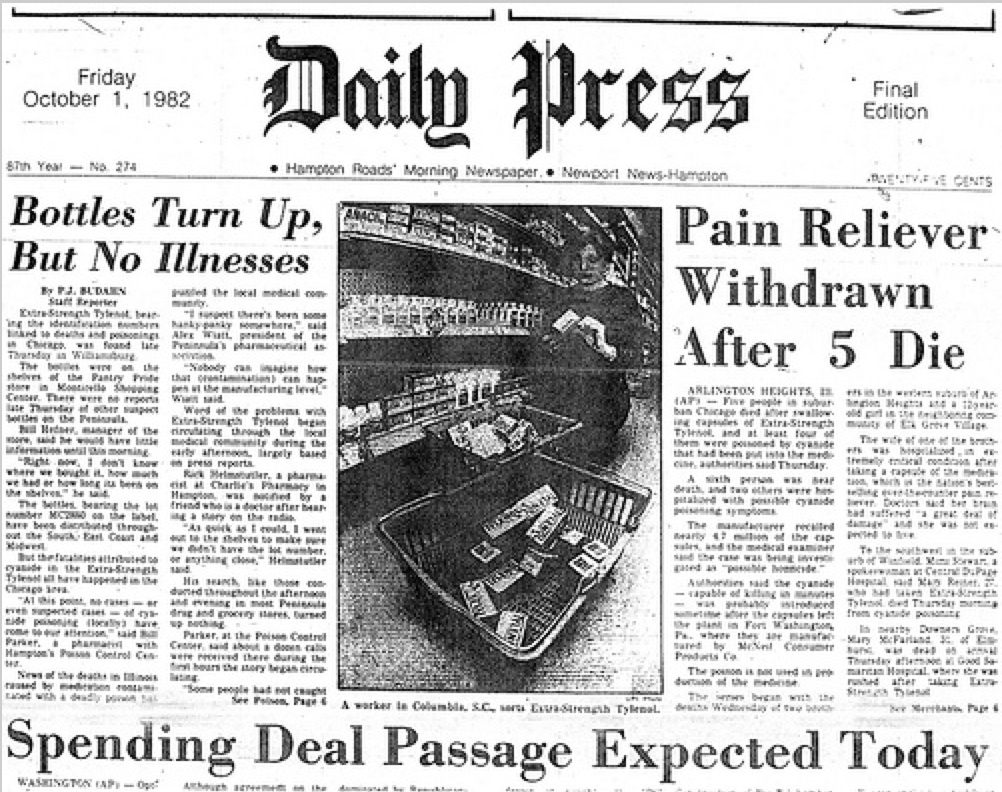
Through no fault of their own, Tylenol found themselves facing an unimaginable nightmare when a crazed person tampered with products and killed people.
For those who don’t know the story: In 1982 Chicago, people started dying of cyanide poisoning. Random people with no connection with each other, except that officials quickly discovered someone was lacing Tylenol with cyanide. It induced panic in the community to the degree that police and rescue vehicles were driving through neighborhoods announcing to people to toss out their Tylenol.
Think about that for a moment: police and rescue vehicles were driving through neighborhoods announcing to people to toss out Tylenol. Samsung went through a recall in 2016 when their Galaxy Note 7 products generated too much heat and the products caught on fire or exploded. At the time, in every airport gate in the U.S., gate attendants announced that Samsung Galaxy products were prohibited from the planes. It’s one thing for a product to perform badly. It’s another thing for a product to perform so badly that airlines make announcements against your brand prior to every U.S. flight for three months.
The Tylenol problem was worse, still.

Through no fault of their own, Tylenol had a major crisis on their hands. In all, 7 people died.
Johnson & Johnson, Tylenol brand owners, decided to pull all Tylenol products from the shelf. ALL of it, or 31 million bottles, since they didn’t want anyone else to die, and no one could be sure what products were affected.
Then they went to work, as resilient brands do.
Adjust Based On The New Reality
The buzz word these days is “pivot”. But companies have been adapting and adjusting for years without having a buzzword.

What I love about the Tylenol story is that the brand found themselves in a situation far beyond their control—and gained control again by sheer force and creativity. Most companies would have withered under these circumstances. But J&J put their best people to work on the challenge.
A short while later they reintroduced the world to Tylenol. To make sure people knew Tylenol was a safe brand, they launched with innovations consumers could see. Innovations that are so common today that new generations just accept that their products will be “Safety sealed three ways!”:
Glued boxes so consumers could tell at a glance if someone had gotten in first.
Bottle caps wrapped in plastic. So even if the box had issues, the plastic was a quick indicator of tamper-free products.
Foil-sealed lids as the final barrier against bad things happening without your knowledge.
Build On The New Reality
The Tylenol brand hasn’t looked back in ages. It’s mostly people like us who keep bringing up the story—or people who study crisis management. It’s an amazing study in how to deal with a brand collapse that’s beyond your control. But in the end, it’s what a brand chooses to control that makes the difference. J&J had the kind of culture that enabled them to take on a catastrophe head-on and thrive by making tough choices, adjusting in the new reality, acting with purpose, and building on the new reality.
There will always be crises. It’s how brands choose to deal with them that will determine what brands survive and which ones fade away.

How Do Resilient Companies Thrive?
There are winners and losers in every economy. Some people and companies collapse under the weight of changes and uncertainty while others seem to thrive. Same conditions, similar circumstances, but one group withers away while others not only survive the challenge but go on to do great things. What makes the difference?
There are winners and losers in every economy. Some people and companies collapse under the weight of changes and uncertainty while others seem to thrive. Same conditions, similar circumstances, but one group withers away while others not only survive the challenge but go on to do great things. What makes the difference?
What is Resilience?
Before we break down what resilient people and companies do differently, it might be helpful to define what we’re talking about. What does it mean to be resilient? According to Merriam-Webster, resilience means “able to become strong, healthy, or successful again after something bad happens.”
Seems simple enough. But being able to bounce back when bad things happen is largely related to the foundations laid prior to those bad things happening … and then building on the foundations as needed.
So what do healthy organizations do that help them survive the crises that take down their competitors?
Prepare: Build a Healthy Company Culture
Just as a healthy person is better able to fight off illness and injury, healthy organizations give themselves the upper hand in both good and bad times. In his excellent book “The Advantage”, organizational health guru, Patrick Lencioni, outlines four disciplines of healthy companies:
Build a cohesive leadership team—the people at the top understand why the company exists, what challenges are top priority, their roles and responsibilities, and how to work together to make things happen;
Create clarity—the leadership team is intellectually aligned and committed to the same fundamental values and actions. There can be disagreements at the top, but not dissension.
Over-communicate clarity—healthy organizations make sure everyone is on the same page, working together from top to bottom to accomplish their goals. People know why the company exists, how they’re changing the world, and how their particular role factors into that goal.
Reinforce clarity—“in order for an organization to remain healthy over time, its leaders must establish a few critical, non-bureaucratic systems to reinforce clarity in every process that involves people. Every policy, every program, every activity should be designed to remind employees what is really most important.”
Just being in business isn’t good enough to withstand real economic challenges. Companies that know what they’re about, why they exist, have leaders who are aligned and able to guide employees to the future, and help people link arms in the struggle give themselves incredible advantages in the marketplace.
Act with Discipline and Purpose
Discipline is key to resiliency at personal, brand, and organizational levels. Healthy organizations move with a sense of purpose in good times and bad. Because they establish their foundations early and understand why the exist, they can align their teams on disciplined pursuits of their goals.
In his book, “Great by Choice”, author Jim Collins details the 20-mile march concept used by explorer Roald Amundsen to successfully reach the South Pole. To summarize: “Enterprises that prevail in turbulence self-impose a rigorous performance mark to hit with great consistency—like hiking across the United States by marching at least 20 miles a day, every day. The march imposes order amidst disorder, discipline amidst chaos, and consistency amidst uncertainty.”
Does preparation build resiliency? In many ways, yes. Because it helps people not collapse when faced with uncertainty.
To quote Collins again, “Having a clear 20 Mile March focuses the mind; because everyone on the team knows the markers and their importance, they can stay on track. Financial markets are out of your control. Customers are out of your control. Earthquakes are out of your control. Global competition is out of your control. Technological change is out of your control. Most everything is ultimately out of your control. But when you 20 Mile March, you have a tangible point of focus that keeps you and your team moving forward, despite confusion, uncertainty, and even chaos.”
Collaborate or Die
There are many advantages to creating a collaborative work environment for organizations, from attracting better employees, and retaining your best people, to improving productivity and getting better ideas out of everyone involved. So why isn’t every company already committed to collaboration?
It starts with leaders—but it isn’t just leaders by title. I like the way Liz Wiseman’s talks about a better grade of leaders. In her book “Multipliers”, Wiseman defines multipliers as “genius-makers who bring out the intelligence in others. They build collective, viral intelligence in organizations.”
It’s important to make the distinction between leaders who are multipliers and people who are what Wiseman calls “diminishers”, or those who “are absorbed in their own intelligence, stifle others, and deplete the organization of crucial intelligence and capability.”
The multipliers in your organization help foster the kind of environment where people feel they are free to collaborate and share their best ideas because they feel valued, energized, challenged in positive ways, and therefore enthusiastically lean into helping the team and organization thrive.
How people feel is really important here. Organizations that post empty values about empowerment and authenticity, and then run people over when they express those values, are doomed to having an empty staff—people who come to work to get paid, not to give 110% of who they are.
Multipliers worry less about getting people in the right seats and accountability charts. They instill a sense of ownership, “provide the necessary resources for success, and hold people accountable for their commitments.”
By bringing out the best in everyone in the company, and leveraging a collaborative culture, organizations gain flexibility, agile work styles, become more adaptable and seem to have the ability to see around corners—not because their people are better or smarter than any other work force, but because every employee is fully engaged and fully utilized.
Worry About What You Can Control, Not About What You Can’t
Resilience is largely focused on companies controlling the right things and getting the right people and processes in place so they can capitalize on opportunities or shift away from issues faster. Success isn’t guaranteed, but resilient companies give themselves a better shot at success than their less prepared counterparts.
In their HBR article “A Guide to Building a More Resilient Business”, co-authors Martin Reeves and Kevin Whitaker identified four significant benefits of resilience at a corporate level:
Anticipation—the ability to recognize threats faster.
Impact—the ability to better resist or withstand the initial shock. This can be achieved through better preparation or a more-agile response.
Recovery speed—the ability to rebound from the shock more quickly by identifying the adjustments needed to return to the prior operating level and implementing them swiftly and effectively.
Outcomes benefit—increased fitness for the new post-shock environment.
In summary, resilient companies prepare for the days ahead and give themselves the advantage of a healthy culture, act with a sense of purpose and move at a steady pace, encourage collaboration in, around, and through their people and bring out the best in every individual, and take care of what they can control.
As a result, healthy companies are better prepared to enjoy the fruits—even in a down economy or turbulent environment—when their competitors struggle to survive.
Tell us your thoughts on what resilient companies are doing better and differently than others.

What’s Your Dandelion Strategy?
Dandelions don't need perfect conditions to flourish. No, they don't mind if the soil is bad, the water inconsistent, or even if they have to go it alone against all odds ... like taking root in a small crack in concrete. They accept the conditions given and find a way to succeed.
Your brand should perform like a dandelion: resilient, resourceful, prolific in output, delivering impressive results year after year.
Every spring my yard and I do battle. When the snow melts and the grass starts to turn green again I have visions of a deep, thick, healthy lawn stretching to soak up the sun and welcoming in the warm air. Instead, I get about 20 different varieties of grass left over from the previous owner, clover and dandelions. Lots of dandelions. I hate dandelions. Or at least I did until I started studying up on my adversary.
Now I'm thinking maybe we could learn a few things from the lowly dandelion.
Resilience
Dandelions don't need perfect conditions to flourish. They don't mind if the soil is bad, the water inconsistent, or even if they have to go it alone against all odds ... like taking root in a small crack in concrete. They accept the conditions given and find a way to succeed.
Ever try to kill a dandelion by pulling it out of the ground? Go ahead, try. It'll be back tomorrow or the next day, or the next. That's because dandelions put down a taproot up to 10 inches long which allows it to flourish in some really nasty conditions. Even better, the taproot is brittle, so when you yank hard parts of the root break off and that last little bit left in the ground is all the dandelion needs to grow again. It's not going away until you make life impossible.
How resilient is your brand? Do you need the perfect environment to thrive, or can you take it on the chin and stand up again? What are you doing to give yourself a shot at success even against all odds?
Resourcefulness
Let's look at that taproot again. It hangs out in the ground all winter long and waits for the perfect time to emerge. By the time you see what's going on, the dandelion is way ahead of you. You don't stand a chance of winning this battle, and it knows.
But dandelions don't just look out for themselves. They bring up nutrients that help surrounding plants. They loosen and aerate the soil in some places and hold on to it in others to fight erosion. They even fertilize the ground around them ... and people rave about the iron and Vitamin A they add to salads.
How would you rate your brand on resourcefulness? How do you take advantage of the opportunities around you? What do you contribute to the community?
Prolific Output
Dandelions put on a show, no doubt about it. Legend has it that hundreds of years ago people yanked out the grass so the dandelions had more room to grow. But even with just a little room, each plant produces a handful of bright yellow flowers. Each flower may bear 100 or more seeds. Each seed is laser focused on taking root and thereby continuing the cycle. And since it can take just six to eight weeks to go from seed to maturity, dandelions do everything in their power to make sure their legacy continues.
How prolific is your brand output? What are you doing to spread the tribe and make sure more people have a chance to embrace your brand?
Deliver Impressive Results Year After Year
Producing seeds in spring and fall, sending down deep roots to endure the cold winter and murderous attempts of landscapers and gardeners, dandelions return each year to prosper, grow and share. They'll happily find a home in a new neighborhood with great conditions, or replenish the area in bad soil. How about your brand?
Are you building a brand that will last, one that has the ability to keep growing and changing each year, or are you consumed with the now? What should you do to change your trajectory and give you a better chance of survival?
We can spend time debating the merits of challenger brands versus leader brands, legacy versus start up, entrepreneurs versus intrapreneurs, etc. Or, we can simplify the conversation even further and ask: what's your dandelion strategy?

Five steps to winning on stage in presentations
… people in the audience generally WANT YOU TO DO WELL. Think about this for a minute. How many times have you seen a speaker step up to the podium or on stage and hope they fail miserably. Most people don’t think this way. We like for people to do well. We want to hear a good presenter. We want to be delighted by the experience.
You've been asked to speak in front of an audience. Your deck is prepared. You've rehearsed. It's the day before your presentation and you still hate the idea of going up on that stage. What do you do?
Here are five tips I use with my clients to help win on stage:
Get rest and stay hydrated. Being tired and dehydrated affects the mind and body. You need all your reserves so you can concentrate and nail your presentation.
Wear something you feel confident in. It seems simple, but you need to know you look good. The mind plays tricks on you when you’re nervous or feeling vulnerable, and knowing you look good lets you focus on presenting well.
Smile. Smile while you practice. Smile before you go on. Force yourself to smile during your presentation. Your mind likes to follow what your body does. So smiling helps you look and sound friendlier. And tricks your brain into thinking you’re having a good time.
Breathe. Remember to breathe and give yourself a fighting chance. A deep breath here and there gives you the oxygen you need to stay mentally alert. So smile. And breathe.
Nail the opening. Then, regardless of how you do in the middle, nail the ending. Your audience will love you for both.
I remind all my clients that the people in the audience generally WANT YOU TO DO WELL. Think about this for a minute. How many times have you seen a speaker step up to the podium or on stage and hope they fail miserably. Most people don’t think this way. We like for people to do well. We want to hear a good presenter. We want to be delighted by the experience.
Relax and give them your best. They want you to nail this.

Brand Building Fundamentals: Brand Promise
Brand promise is the collective experience people have with your brand once you combine all other factors of your brand foundation. So it's not tactical or directive. It's the essence of the brand.
Brand promise is the collective experience people have with your brand once you combine all other factors of your brand foundation. So it's not tactical or directive. It's the essence of the brand.
You may be familiar with some of the standards:
Disney: Fun family entertainment
Coca-Cola: To inspire moments of optimism and uplift.
Nike: Authentic athletic performance
Makes sense for billion dollar brands. But what if you're not that?
A number of years ago I worked with the local Freestore Foodbank. An amazing organization that helps people get back on their feet through a range of services. When we talked with internal people, they gushed about their ability to help people transition into positive life situations.
But people outside the group thought they only gave away food.
We found that food was the catalyst to everything else.
If you haven't eaten in three days, chances are very good that you don't have much interest in talking about clothing, job skills, housing, etc.
Food comes first.
The brand promise became: Using food as a gateway to life transformations.
It captures the essence of the brand and gave internal audiences a focus.

Brand Building Fundamentals: Positioning
The best companies know they have to own a unique place in the hearts and minds of their consumers. In simple terms, this is positioning.
The best companies know they have to own a unique place in the hearts and minds of their consumers. In simple terms, this is positioning.
You can leverage a number of vectors including relevance, clarity, distinctiveness, and a whole lot more. But you cannot be all things to all people. Remember, this is about standing out in the hearts and minds of the people who have a chance of caring about your brand.
In his book, Predictably Irrational, Dan Ariely tells the story of Salvador Assael who, through a series of trades, ended up with a collection of black pearls in a day when everyone wore white pearls.
You might think the fact that they were different would do the trick. It didn't, any more than a black t-shirt is exponentially better than a white t-shirt.
Assael teamed up with Harry Winston who crafted the black pearls into luscious pieces of jewelry with premium pricing. Now, the product had exclusivity, a connection to a superior brand and a price tag to match all the glitz and glitter. Soon, black pearls were a necessary item in any reputable jewelry case.
Trying to sell black pearls didn't work. Positioning them as exclusive alternatives did.