


How Resilient Brands Thrive in Challenging Times
Every generation has to face its own rounds of brand challenges related to the economy, public attitudes, world events, and more. Especially when things go bad, it’s easy to think that in the crisis of the moment there are no parallels to reference for a way forward. This is where despair sets in. But there are almost always examples we can look to for how to thrive in challenging times.
“He who is best prepared can best serve his moment of inspiration.”
― Samuel Taylor Coleridge
Every generation has to face its own rounds of brand challenges related to the economy, public attitudes, world events, and more. Especially when things go bad, it’s easy to think that in the crisis of the moment there are no parallels to reference for a way forward. This is where despair sets in. But there are almost always examples we can look to for how to thrive in challenging times. Let’s take a look back at the 1980’s Tylenol recall.
Deal With The Challenge Directly
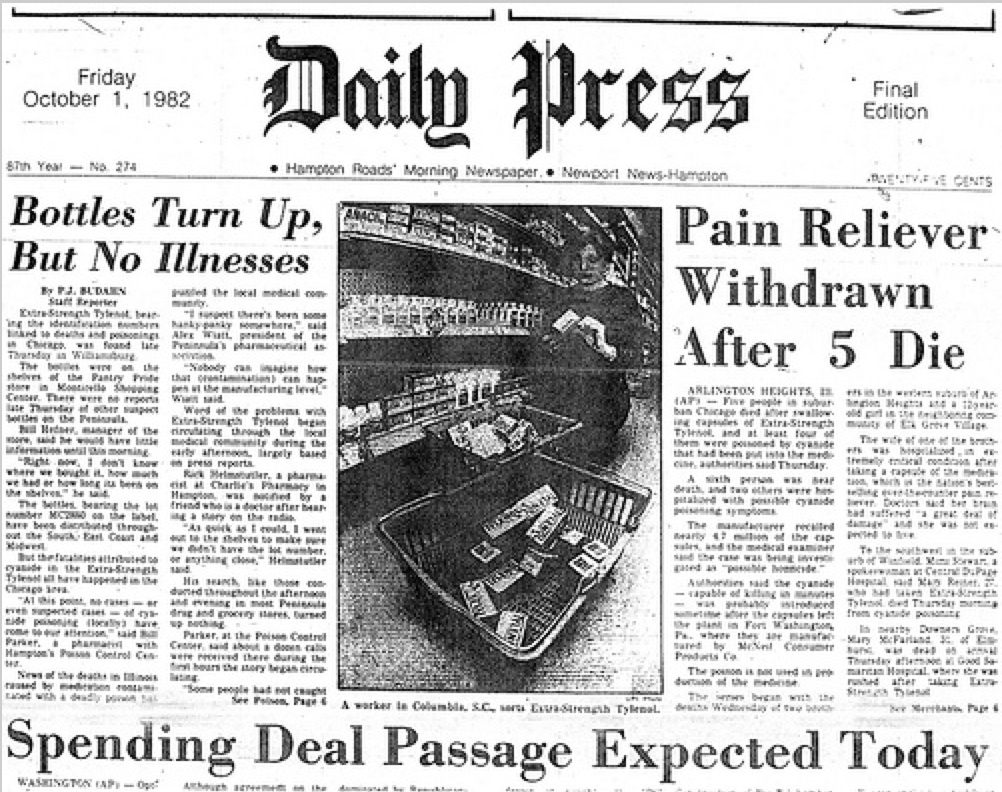
Through no fault of their own, Tylenol found themselves facing an unimaginable nightmare when a crazed person tampered with products and killed people.
For those who don’t know the story: In 1982 Chicago, people started dying of cyanide poisoning. Random people with no connection with each other, except that officials quickly discovered someone was lacing Tylenol with cyanide. It induced panic in the community to the degree that police and rescue vehicles were driving through neighborhoods announcing to people to toss out their Tylenol.
Think about that for a moment: police and rescue vehicles were driving through neighborhoods announcing to people to toss out Tylenol. Samsung went through a recall in 2016 when their Galaxy Note 7 products generated too much heat and the products caught on fire or exploded. At the time, in every airport gate in the U.S., gate attendants announced that Samsung Galaxy products were prohibited from the planes. It’s one thing for a product to perform badly. It’s another thing for a product to perform so badly that airlines make announcements against your brand prior to every U.S. flight for three months.
The Tylenol problem was worse, still.

Through no fault of their own, Tylenol had a major crisis on their hands. In all, 7 people died.
Johnson & Johnson, Tylenol brand owners, decided to pull all Tylenol products from the shelf. ALL of it, or 31 million bottles, since they didn’t want anyone else to die, and no one could be sure what products were affected.
Then they went to work, as resilient brands do.
Adjust Based On The New Reality
The buzz word these days is “pivot”. But companies have been adapting and adjusting for years without having a buzzword.

What I love about the Tylenol story is that the brand found themselves in a situation far beyond their control—and gained control again by sheer force and creativity. Most companies would have withered under these circumstances. But J&J put their best people to work on the challenge.
A short while later they reintroduced the world to Tylenol. To make sure people knew Tylenol was a safe brand, they launched with innovations consumers could see. Innovations that are so common today that new generations just accept that their products will be “Safety sealed three ways!”:
Glued boxes so consumers could tell at a glance if someone had gotten in first.
Bottle caps wrapped in plastic. So even if the box had issues, the plastic was a quick indicator of tamper-free products.
Foil-sealed lids as the final barrier against bad things happening without your knowledge.
Build On The New Reality
The Tylenol brand hasn’t looked back in ages. It’s mostly people like us who keep bringing up the story—or people who study crisis management. It’s an amazing study in how to deal with a brand collapse that’s beyond your control. But in the end, it’s what a brand chooses to control that makes the difference. J&J had the kind of culture that enabled them to take on a catastrophe head-on and thrive by making tough choices, adjusting in the new reality, acting with purpose, and building on the new reality.
There will always be crises. It’s how brands choose to deal with them that will determine what brands survive and which ones fade away.

Times of crisis call for rethinking top-heavy organizations.
Top-heavy organizations are susceptible to major disruption during stormy market changes.
There's an old story of two trees in a field, one a large, majestic oak with a sturdy trunk and broad branches. Not far away is a small, thin, and wiry willow. The mighty oak boasts of its strength and size and reminds the willow of all the ways the oak is superior to the willow. The willow is quiet. In time a heavy rain starts. The oak boasts of its ability to absorb so much water. The willow is quiet. After a while the winds pick up and grow in intensity, howling through the night. It's so dark and loud that the willow can't see or hear anything as it is battered in the wind. Eventually, the wind dies down and the sun rises. The willow looks around to see the once-mighty oak has been toppled in the storm. What made it such a formidable being in good weather led to its demise in the bad. The willow stretches to the sun. The oak is quiet.
In good times, it's easy for top-heavy organizations to rationalize their imbalance and boast of the number of vice presidents and executives in the system. As COVID-19 has reminded us, big and rigid isn't always better. Efficiency is.
Efficient organizations are nimble, agile, and flexible. They're able to see challenges and respond quickly to win.
So what should companies do to fix the problem?
Flatten the organization. Managers are not only expensive. If their roles are mostly to manage people and processes, they move further away from understanding the customers and adding value that can be directly connected to sales.
Increase the staff-to-manager ratio. It’s not uncommon to find a ratio of 4–1 or 5–1 in large companies. A big challenge here is that while this can help each employee think they get a lot of personal attention from their boss, this ratio can lead to incredible bloat. And since every level of management earns incrementally more than the people who report to them, senior managers and executives may spend most of their time managing managers. Increasing the ratio to 20–1 or, in some organizations, depending on roles, as high as 100–1, removes a tremendous amount of expense and process creep. Of course, this means every employee won’t get 30 minutes to an hour each week with their manager, but many employees don’t require or desire this level of interaction, anyway.
For more information on this, read “How to identify the right span of control for your organization” by McKinsey & Company.
Trim the number of supervisors. This feeds off step 2 here but becomes a line item in the to-do list. As the ratios are adjusted, some supervisory roles are no longer necessary.
Trim the admin staff. Every executive probably doesn’t need a personal admin, much less a group of administrative people at their direction.

Why You Should Make Better Mistakes
Avoiding mistakes is useless. Making them is human. Owning mistakes and learning from them is where leadership begins.
Avoiding mistakes is useless. Making them is human. Owning mistakes and learning from them is where leadership begins.
As we wrap up one year and head into a new one, I think it’s healthy to reflect on what was tried, what failed and what succeeded over the last 11 to 12 months. It may be a factor of age, but I’ve gotten to a place where one of my biggest fears is not trying enough big ideas to make a difference, in settling for less than what was possible and becoming comfortable with what is versus what could be.
Fear of failure is the term we hear most often. I’ve seen it in brand managers afraid to screw up a brand assignment they just took over. I’ve seen it in corporate executives who were living examples of the Peter Principle who, instead of remaining open to help from others and being vulnerable, fell prey to the idea that they always had to have the winning idea. I’ve seen it in senior managers who killed ideas because they were more disruptive than the manager was willing to fight for, even though disruption was desperately needed to keep the brand alive. When this happens teams eventually fail because the ideas just get smaller and smaller—because small ideas are easier to protect.
This is also a problem with people who haven’t been allowed to fail along the way. The kid who must get straight A’s, who can’t miss a note on an instrument or make a bad throw on a ball field may be doomed to a life of pursuing a goal that doesn’t exist.
Perfectionism Is An Issue
Better by Mistake author Alina Tugend, put it this way: “Experiments showed that those who are always scared to make mistakes—ultra-perfectionists, they are called—perform worse in writing tasks than those who aren’t as worried about being flawless. Experts theorize “superperfectionists” are afraid to practice writing, because to practice means to make mistakes. More importantly, they fear receiving any kind of negative feedback, so they don’t learn where they went wrong and how to get better.”
You Can’t Win Them All
Once you accept that you are going to fail, eventually, you free your mind up to do bigger things. It’s the act of trying that makes the difference. Relax. It’s not like you avoiding mistakes is going to make things any better or worse. Peter Drucker once said, “People who don’t take risks generally make about two big mistakes a year. People who do take risks generally make about two big mistakes a year.” If you accept that you’re probably going to make two big mistakes a year, wouldn’t you rather make those two mistakes on something that has a chance to change your world? Or change the world?
There are stories out there of people who made it big without putting themselves or their ideas on the line. Personally, I think most of these are just scrubbed to remove any blemishes in the pursuit of perfection. When you aim high you may achieve great things. But even if you don’t win, you find out what you’re made of when you get back up again.
Consider these examples:
Triathlete Mark Allen, in the seven years before he won his first of six Ironman Championships in Kona, Hawaii, did not finish, placed 3rd, placed 5th, did not compete, placed 2nd, placed 2nd, and placed 5th.
John William Lindsey, who played first base for the LA Dodgers, spent 16 years in the minor leagues, the most by any player, before being called up to the Bigs.
Post-it Notes came to life when Art Fry heard of colleague Spencer Silver’s low-tack adhesive and figured he could use it to help him mark his place in his hymnals because his bookmarks always fell out. It only took 10 years or more for the formula to find a home.
The inventors of Bubble Wrap started out with a concept for wallpaper, then moved to greenhouses, then to packaging.
Silly Putty was discovered during the pursuit of a rubber substitute for World War II. Though it wasn’t suitable for tires or boots, it was suitable for fun. Okay, this one probably shouldn’t go in the great examples category, but I like Silly Putty, so here it stays.
So You Blew It. So What?
I’ve been in bands and played guitar and sung on stage for years. One of my worst moments became one of my favorite memories. Standing in front of an audience of a couple hundred people in a church in Mississippi one night I played and sang a song I had performed dozens of times. Yet on this night as I finished the chorus and started the second verse I couldn’t for the life of me remember the words. Not one. And since I didn’t have lyrics with me I was stuck.
Rather than try to fake my way through the rest of the song and limp back to my seat I stopped, kind of chuckled nervously and said, “Have you ever had one of those moments when you forget a song? Yeah, me too. But I’m not leaving this stage until I finish a song for you, so if it’s okay with you I’d like to try a different option.” The audience laughed with me, which helped calm my nerves and ease the uncomfortable silence in the room. I sang my second song without any issues and got a standing ovation at the end. I figured I had just survived the worst nightmare a performer could have on stage. And I haven’t forgotten the lyrics in a song on stage since that night some 25 years ago.
Failure Has its Benefits
Evolutionary psychologist Nigel Barber, Ph.D., wrote, “People who fail repeatedly develop persistence in the face of difficulties … only people with extensive histories of failure could survive the difficulties that (some) individuals endured. Such dogged persistence is not a universal trait, of course.
With success, people keep on doing the same thing. When they fail, they are forced to adapt and change. That is not just a human characteristic but constitutes a basic feature of how the mammalian brain works.
If a lab rat no longer gets rewarded for pressing a lever that had yielded food pellets before, it gets visibly upset. As its frantic efforts fail, it resorts to all manner of strange, or novel, reactions from grooming itself to biting the lever, or leaping into the air. It is learning that the world has changed and its brain is getting rewired, so to speak.
When one combines emotionalism with originality, that is fairly close to what most people think of as artistic creativity. Artists are not necessarily frustrated people but tend to be dissatisfied with what they have accomplished previously and try to do something better, or something new.
The magical power of failure is not restricted to the arts, or to political leadership. It applies to all fields of human endeavor, including the crass activity of financial money grubbing. Anyone who bought Apple stock over most of the past decade made wads of money but learned nothing. Those who bought at the peak and lost 40 percent of their stake are still scratching their heads. Like the rat in the experiment, they are learning something.”
Failure Helps:
Discover what didn’t work
Fuel your creativity (I won’t compare you to the lab rat example above)
Inspire new energy
Warn you off of a dangerous approach further down that path
Uncover your own strengths
Humble the bold
Five Tips for Making Better Mistakes
Start with the idea that most people truly want you to succeed, so they want to support you versus try to break you down. The mind space you use to worry about what’s chasing you could be better spent looking forward and considering options. If you fail, those same people want you to get back up and win.
Surround yourself with people who embrace the chaos, accept that mistakes will happen and know the team will grow as a result. Building a healthy team culture enables you to keep the right kind of positive mindset you’ll need to try, fail, pick yourself up and try again. And again. And again.
Consider both sides of the results of your efforts. Life is rarely lived in the extremes, so the goods may not be as good as you dream and the bads are rarely as dismal as you fear. Unless you’re Nik Wallenda and walking tightropes between high-rise office buildings, failure will probably not be life threatening. And as long as you’re alive, you can try again.
Live and learn. Failure is rich in information, which you need so you can build your way to success. Stay open to the data, learn from your stumbles and keep moving.
Share your stories. The school of hard knocks is a tough way to learn, but necessary on the way to greatness. Learning principles would seem to indicate that you will get more out of your experiences, both good and bad, if you will teach others the lessons you learn. Your students will benefit as well.
Embrace your blunders. Learn to love them, then move on.
Now get out there and try. I kind of hope you fail, just a bit, so you can go on to do something amazing.

Be Thankful for Every Bad Manager You’ve Ever Had
… getting stuck with a bad manager isn’t all gloom and doom, because most of us learn more from bad experiences than good, and those bad experiences can create tectonic shifts in how you work with others as you grow in your career.
In spite of all the material out there on what it takes to be a good manager—a quick Google search as I started writing this provided 166 million options—unfortunately, most of us are more likely to spend time working under a bad manager than one that matches our ideals. But getting stuck with a bad manager isn’t all gloom and doom, because most of us learn more from bad experiences than good, and those bad experiences can create tectonic shifts in how you work with others as you grow in your career.
Lions, Tigers and Bad Managers, Oh My!
The human brain is hardwired to learn and hang on to lessons learned in extreme moments, especially ones that evoke fear. If you’re a caveman walking alone and a lion jumps out from behind a bolder (if you survive) you’re going to remember specifics about that event—where you were, what you did, where the lion came from, etc.—so you don’t repeat that experience. If you're in the office and a particularly lousy manager jumps all over you and blindsides you with accusations and acrimony, you’re likely to remember that experience and try to minimize the chances of that happening again.
There is even science that says negative experiences may push the good ones to the back in our memories. So you can thank every bad manager you’ve ever had for setting the examples of what NOT to do for the rest of your career.
The Rules Don’t Apply to Them
As I mentioned earlier, there is no shortage to tips and tricks for being a good manager. Back in 1970 Robert Townsend wrote one of the first and great guides for organizational management and health in Up the Organization: How to Stop the Corporation from Stifling People and Strangling Profits. There is enough practical and timeless information in this one book to wonder why bad managers still exist today. I recommend you add this book to your personal library.
The same is true of First, Break All The Rules by Marcus Buckingham and Curt Coffman. If the guides have been written, and all the tools are there for the taking, why do bad managers still terrorize the landscape? I think it comes down to one simple idea: the rules don’t apply to them.
Buckingham and Curtis distinguish four core activities and the different views of traditional managers versus great managers:
“Conventional wisdom says:
• Select the person … based on her experience, intelligence and determination
• Set expectations … by defining the right steps
• Motivate the person … by helping her identify and overcome her weaknesses
• Develop the person … by helping her learn and get promoted
“By contrast, great managers:
• Select for talent
• Define the right outcomes
• Focus on strengths
• Find the right fit
Seems easy enough, right? Why then do so many people get this so horribly wrong?
Newton’s Third Law, in Management
Newton’s third law of motion says that for every action there is an equal and opposite reaction. The same can be applied to management. When working with companies to define core values and better understand what’s working in the organizational culture, we typically interview managers and line employees. It becomes clear pretty quickly which traits the best employees embody and what the worst employees do consistently. The best employees often act in the exact opposite manner of the worst. If this is the case, then it may be easier to look at the traits the worst managers share and do just the opposite.
Don’t: Be a jerk—Your lack of integrity and brutish behavior may unfortunately be permitted by the organization, but the people beneath you will hate you. They may follow because they have no choice, but they won’t respect you and may quietly pray for a way out.
Do: Live authentically—Vulnerability in leaders has been proven time and again to be a key driver in building strong teams and company cultures. No one expects the people at the top to have all the answers, so take the pressure off yourself and be real and human and reachable.
Don’t: Try to be the brightest star in the constellation—It isn’t possible, anyway, and the best employees will find a way to leave your constellation.
Do: Share the spotlight with the people doing the heavy lifting—Make it a habit to make sure your best people get time in the spotlight. Help others see the valuable contributions of your team. When your team earns the credit, dole it out in extra large portions.
Don’t: Focus on people’s weaknesses—The weaknesses will only improve slightly (they’re weaknesses for a reason) and you’re likely to have bitter, resentful employees who hate the fact that you only point out what’s wrong.
Do: Focus on people’s strength—All the science proves this is where you can realize exponential growth, have happier employees and achieve greater goals. As a bonus, learn to say thank you. People like to hear that they do well from time to time. Be gracious and authentic in your praise.
Don’t: Micromanage the process—As a manager you should have better things to do than staying neck deep in the minutiae. Chances are good that if you’re mired in the details, you’re also encouraging the internal spin that destroys company culture.
Do: Focus on the outcomes and embrace multiple paths to success—Hire good people, get out of their way and help them succeed more wildly than you or they could ever achieve as individuals.
Don’t: Point fingers and place blame—Some managers misinterpret accountability as their job in holding everyone else accountable. Wrong. Build a healthy culture and the team will hold themselves accountable to each other. If people only act responsibly when the boss is around you have some serious issues just waiting to break the surface.
Do: Keep your feet on the ground—Error increases with distance. Stay relevant. The further you are away from the people who make your company great and the work getting done on the front lines, the greater the likelihood that that you become a caricature rather than an actual leader.
Don’t: Isolate people, skills and processes—Insecure managers like to put people on islands and make them feel like they're always on shaky ground.
Do: Build communities and help people find their tribe—Help your people feel welcomed as part of a broader community. Build a stable environment that reduces fear and encourages every person to bring their very best idea to the job every day. When that happens you have a chance to create jobs with meaning for talented people who want to change the world.
If you’re currently working under a bad manager take notes so you can apply what you learn later and throughout your career. If you think this list is incomplete, add to them here. Remember we want to focus on our strengths and build better managers, not try to rehab every bad one. Healthy corporate cultures the world over will help weed out the bad and keep the good ones going. Good luck out there.

7 Reasons Why You Should Fire Yourself
Don’t wait for someone else to evaluate your performance. Do it yourself. Then either make the necessary changes or fire yourself and improve your life.
Don’t wait for someone else to evaluate your performance. Do it yourself. Then either make the necessary changes or fire yourself and improve your life.
Too many people want to blame their issues on the system, on a manager who is out of touch, on a company that just doesn’t understand them or have programs that meet their needs. If this is you, do the world a favor and fire yourself. Quit and go do something you know and love. Use all your energy to have a positive impact on the world and make a difference somewhere. Go ahead, the world will be a better place for it and no one will miss your whining at the place you left. Trust me on this.
Not ready to take that step?
Let’s do a little personal inventory on whether you should stay or go.
1. You don’t take your work seriously.
This is an easy one. Have a blast at work. Be happy. But do your work. Harvard Business School professor Teresa Amabile and independent researcher Steven Kramer, noted in their heavily researched book The Progress Principle, that happy employees do, in fact, work harder, do better work and create what the authors call a “positive spiral.” If you’re on the downward slide and it’s affecting your work, you should seriously consider a change of heart or workplace.
2. You complain. A lot. And often.
No one likes a whiner. It’s a toxic trait, it’s contagious and habit forming. So, if you’re the first one to complain about every little thing in the office, especially while never being part of any solution, it’s time for you to go.
3. You don't contribute to the company culture.
We’ll consider that you’ve already addressed the issues in number 2 so you’re no longer a whiner. But what else have you done for the culture? Those company values you like to make fun of ... how many of those have you embraced and brought to life? And what about helping your teammates achieve their goals? Zig Ziglar made a career out of helping people see how “you can get everything in life you want if you will just help enough other people get what they want.” All you have to do is keep in mind that this world is not about you. You're important, but so are the others around you. Don’t agree with me? Fire yourself.
4. No one is dying to have you in the room for the big challenges.
Are you a problem solver? Someone who rolls up their sleeves and tackles the hard challenges? Didn’t think so. Those big challenges require taking risks and calculated jumps. You don’t like to do that. But that’s what the company needs right now. If you’re not going to be one of the people willing to do what it takes to get us to where we need to go, you’re taking up precious space. It might be time to fire yourself and go find an easier job. We’d love to have you here, but that’s your choice.
5. If there’s a problem, somehow your name is always attached, and never in a good way.
Yeah, I know, you’ve just had an incredible streak of bad luck. I get it. I also know that you need to fix that or you won’t be here to extend your streak. Refer to the previous issues and become a positive force in the company, someone known for solving problems and getting stuff done. If you do this, you won’t have to fire yourself.
6. You’re not accountable to anyone, including you.
Pointing a finger is fine as long as you point one at yourself first, make the change and then move around the room. Do like Michael Jackson and start with the man in the mirror. Hold yourself accountable for your thoughts, words and actions. Be an adult. If this is hard for you and you’re unwilling to grow up, hand yourself a pink slip, if you can.
7. You have nothing to show for your time at the company.
This is a company built on results—positive results and, well, you don't have any of those that we can find. That means you are probably coasting and picking up a pay check. We don’t really need those kinds of people here because we’re looking to make a difference in the world. We believe you have it in you but if you don’t believe that as well it’s probably best if you move on.
Or ... hire yourself every day
Do you remember how you felt on your first day at your new job? Chances are you were filled with excitement, with all kinds of energy and ideas on how awesome this job was going to be. You didn’t join to be a slug. You didn’t set out to coast. No, you were going to make it to the top.
That’s a choice you get to make every day. So start with a good, hard look at who you are, where you are, and what you want to be. If you’ve drifted, get back on track. If you’ve slipped into a funk, get back on solid ground. If you can't get back on your own seek help ... and then get out there and make a difference.
What do you think? What did I miss?