


7 Ways Resourceful Companies Navigate Turbulence
In turbulent times, companies must discover what kind of adjustments are right for them to stay relevant. It can seem overwhelming. But there are a few ways to think about resourcefulness to help companies of any size manage through stressful environments.
In turbulent times, companies must discover what kind of adjustments are right for them to stay relevant. It can seem overwhelming. But there are a few ways to think about resourcefulness to help companies of any size manage through stressful environments.
In our Dandelion Strategy model, resourcefulness is key. Dandelions send down a taproot first and go deep so the plant can hang out all winter and wait for the perfect time to emerge. This foundation gives them some stability for the battle ahead. By the time you see what's going on the dandelion is way ahead of you. The dandelion has a plan for survival—but it also looks out for the surrounding ecosystem. They bring up nutrients that help surrounding plants. They loosen and aerate the soil in some places and hold on to it in others to fight erosion. They even fertilize the ground around them ... and people rave about the iron and Vitamins A, C and K, Folate, Calcium, and Potassium dandelions add to salads.
How would you rate your brand on resourcefulness? How do you take advantage of the opportunities around you? How are you using what you learn?
Dial up your resourcefulness with these seven steps:
Embrace the chaos. Business and life are rarely linear. When you plan for the chaos and build teams that can adjust on the run, challenges are just puzzles to be solved. And you can hire good puzzle solvers.
Computer programmers and mathematicians use chaos theory, instead. This says that instead of keeping to a predictable pattern, we’d be better off—and find solutions faster—by moving in non-linear ways. The author and economist Tim Harford put it this way: “When everything is perfect, when everything is tidy, we're on autopilot. And we're not necessarily living in the moment, we're not necessarily paying attention. And that's a problem for us.” Embrace the chaos, live in the moment, and thrive in the turbulence.
Listen to the people on the front lines. That’s where people are making real-time adjustments to the market and customer and supply chain issues to keep things rolling.
Plenty of companies put up posters or engage in employer branding campaigns to motivate staff or remind employees that their ideas matter. Those can be effective. They can also be vacuous and empty. What we’re talking about here is really listening to the people who see and hear the needs, frustrations, wishes every day. I’m always surprised at how many amazing—and amazingly simple—solutions come out of conversations with the teams on the ground. Management can’t see it all and should never think it is their job to solve every issue. Get on the ground, listen, and act on the information provided.
Expand your market. You may need to change your game a bit. Some say if your organization is not evolving, it is dying! How are you evolving to meet new, emerging demands?
Uber launched UberEats in 2016 in mostly large markets. By 2018 they were expanding into smaller markets and competing with challengers like DoorDash and GrubHub. Adoption wasn’t hitting the numbers everyone wanted in part because consumers saw food delivery as a solution to a problem they didn’t have, and restaurant owners saw the costs as too high. Then the pandemic happened and restaurants were effectively shut down. This put UberEats, DoorDash, GrubHub, and the rest of the delivery industry in the spotlight as viable and necessary solutions to both consumer demand and restaurants staying in business. To put this expansion into perspective, consider that Uber made $10.4 billion in 2019 from its legacy business, but only $7.3 billion in 2021. Over that same time, Uber Eats grew from $1.9 billion to $8 billion in revenue.
Consider new ways to deliver your product or service. If customers can’t get to you, how do you get to them? How can you meet them halfway? If you can’t stock what you had before, how can you still deliver delight and surprise for your customers?
For example, there are all kinds of rumblings about looming toy shortages this Christmas. That’s going to be a problem but it’s not top of mind yet. It will be. If Christmas is part of your game, how could you change the game and be the hero?
Partner with other businesses. Dandelions don’t just look out for themselves. And neither should you. Who else could help you thrive? How could you help them? How could you link arms with companies offering adjacent services so your combined services solve even more challenges for your customers?
During a past recession I worked with a company that specialized in community waste services dominated by mom and pop operations. We found their customers couldn’t afford to take a week off to attend elaborate trade shows in Vegas. We interviewed a number of these business owners and found they wanted the information and exposure to new ideas, but all of that had to be more convenient for them. Our solution was to partner with adjacent companies and conduct regional shows so customers could drive over—not fly—get the information they needed and get back home the same day. It solved a number of issues for the manufacturers and their customers.
Stay connected with your customers. What’s your feedback loop? Who’s keeping their finger on the pulse? Make sure the person or people you put in charge of monitoring customer feedback are in the right seat. Look for someone who thrives on collecting information (good and bad), mining for insights that can make a difference, and then turning those insights into actionable data.
I once worked with a start-up company that had a senior leader in charge of monitoring customer response. According to reports inside the company, customers were in great shape and loved everything about the brand. By contrast, a little social listening indicated the company was far behind on deliveries, didn’t return phone calls, and was quickly building a reputation for bait and switch. It turned out that the executive was only responding to good news from customers. He was ignoring the complaints. And those complaints were piling up. The company had to put another exec in place fast to save and rebuild the company’s reputation.
Celebrate the lessons. I encourage you to build a learning culture, not just a good news culture. In good news cultures, executives make it clear that all they want to hear is what worked, the good news. Bad news is punished as are the people responsible for it. As a result, people learn to avoid risk because taking chances means you might fail. And failure of any type could get you fired. That’s never the case in resourceful and innovative companies. They stretch, they stumble, they bump into things. Take 3M, for example. Scotch tape and Post-it Notes are just two of the many products that came to life because 3M empowered their people to tinker outside of their box. Scotch added adhesive to cellulose strips for an auto body paint masking solution while Post-it repurposed a light adhesive that didn’t have a reason to exist into a tool used all over the world.
Resourceful companies do exactly that. Like 3M, they give people permission to try new things and stray from their normal course of work. Sure, some of those things won’t work, some will underperform, and some might take off into outer orbit.
That’s why it’s important to celebrate the lessons learned and share the highs and lows as a group. Google’s former Head of People Operations Laszlo Bock stated in his book, Work Rules!, “it’s also important to reward failure” so as to encourage risk-taking. Scott Cook, co-founder of Intuit, said, “At Intuit, we celebrate failure. Literally: Intuit has a Greatest Failure Award. Because every failure teaches something important that can be the seed for the next great idea.”
Resourcefulness requires being able to imagine solutions that don’t exist yet. That kind of thinking happens best when people feel safe from prosecution within the company. Build a culture that enables courageous thinking and exploration. Celebrate what you learn and grow from them.
What ways have you found to be resourceful in these turbulent times? Let us know by commenting below.

How Resilient Brands Thrive in Challenging Times
Every generation has to face its own rounds of brand challenges related to the economy, public attitudes, world events, and more. Especially when things go bad, it’s easy to think that in the crisis of the moment there are no parallels to reference for a way forward. This is where despair sets in. But there are almost always examples we can look to for how to thrive in challenging times.
“He who is best prepared can best serve his moment of inspiration.”
― Samuel Taylor Coleridge
Every generation has to face its own rounds of brand challenges related to the economy, public attitudes, world events, and more. Especially when things go bad, it’s easy to think that in the crisis of the moment there are no parallels to reference for a way forward. This is where despair sets in. But there are almost always examples we can look to for how to thrive in challenging times. Let’s take a look back at the 1980’s Tylenol recall.
Deal With The Challenge Directly
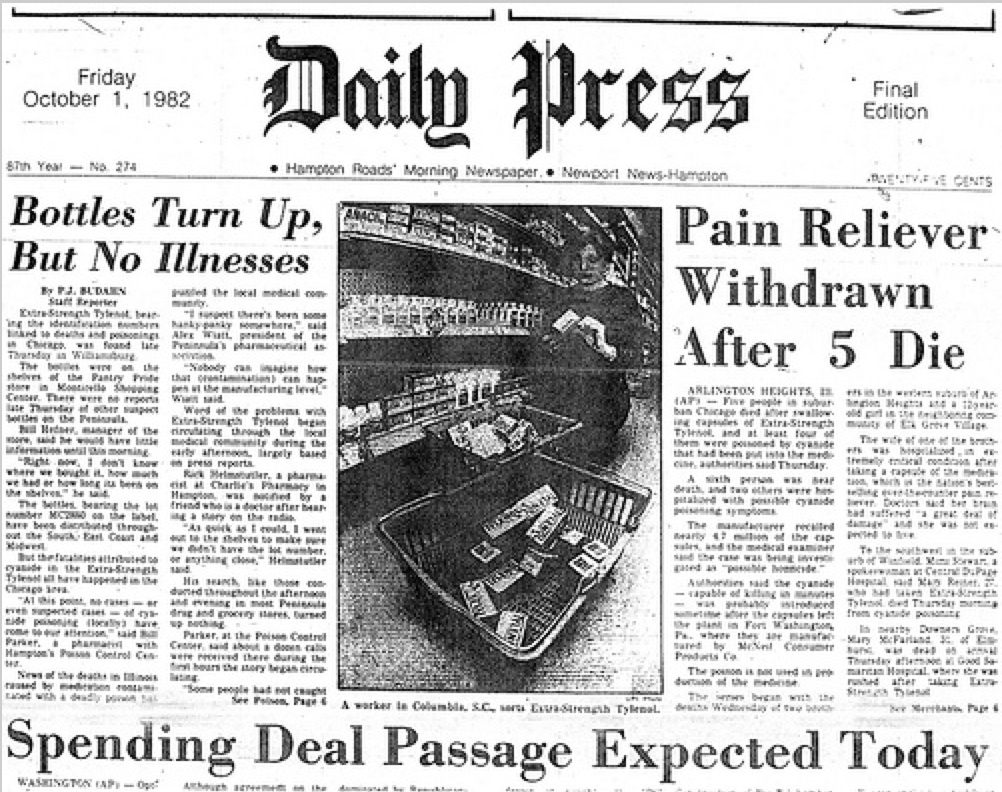
Through no fault of their own, Tylenol found themselves facing an unimaginable nightmare when a crazed person tampered with products and killed people.
For those who don’t know the story: In 1982 Chicago, people started dying of cyanide poisoning. Random people with no connection with each other, except that officials quickly discovered someone was lacing Tylenol with cyanide. It induced panic in the community to the degree that police and rescue vehicles were driving through neighborhoods announcing to people to toss out their Tylenol.
Think about that for a moment: police and rescue vehicles were driving through neighborhoods announcing to people to toss out Tylenol. Samsung went through a recall in 2016 when their Galaxy Note 7 products generated too much heat and the products caught on fire or exploded. At the time, in every airport gate in the U.S., gate attendants announced that Samsung Galaxy products were prohibited from the planes. It’s one thing for a product to perform badly. It’s another thing for a product to perform so badly that airlines make announcements against your brand prior to every U.S. flight for three months.
The Tylenol problem was worse, still.

Through no fault of their own, Tylenol had a major crisis on their hands. In all, 7 people died.
Johnson & Johnson, Tylenol brand owners, decided to pull all Tylenol products from the shelf. ALL of it, or 31 million bottles, since they didn’t want anyone else to die, and no one could be sure what products were affected.
Then they went to work, as resilient brands do.
Adjust Based On The New Reality
The buzz word these days is “pivot”. But companies have been adapting and adjusting for years without having a buzzword.

What I love about the Tylenol story is that the brand found themselves in a situation far beyond their control—and gained control again by sheer force and creativity. Most companies would have withered under these circumstances. But J&J put their best people to work on the challenge.
A short while later they reintroduced the world to Tylenol. To make sure people knew Tylenol was a safe brand, they launched with innovations consumers could see. Innovations that are so common today that new generations just accept that their products will be “Safety sealed three ways!”:
Glued boxes so consumers could tell at a glance if someone had gotten in first.
Bottle caps wrapped in plastic. So even if the box had issues, the plastic was a quick indicator of tamper-free products.
Foil-sealed lids as the final barrier against bad things happening without your knowledge.
Build On The New Reality
The Tylenol brand hasn’t looked back in ages. It’s mostly people like us who keep bringing up the story—or people who study crisis management. It’s an amazing study in how to deal with a brand collapse that’s beyond your control. But in the end, it’s what a brand chooses to control that makes the difference. J&J had the kind of culture that enabled them to take on a catastrophe head-on and thrive by making tough choices, adjusting in the new reality, acting with purpose, and building on the new reality.
There will always be crises. It’s how brands choose to deal with them that will determine what brands survive and which ones fade away.

How Do Resilient Companies Thrive?
There are winners and losers in every economy. Some people and companies collapse under the weight of changes and uncertainty while others seem to thrive. Same conditions, similar circumstances, but one group withers away while others not only survive the challenge but go on to do great things. What makes the difference?
There are winners and losers in every economy. Some people and companies collapse under the weight of changes and uncertainty while others seem to thrive. Same conditions, similar circumstances, but one group withers away while others not only survive the challenge but go on to do great things. What makes the difference?
What is Resilience?
Before we break down what resilient people and companies do differently, it might be helpful to define what we’re talking about. What does it mean to be resilient? According to Merriam-Webster, resilience means “able to become strong, healthy, or successful again after something bad happens.”
Seems simple enough. But being able to bounce back when bad things happen is largely related to the foundations laid prior to those bad things happening … and then building on the foundations as needed.
So what do healthy organizations do that help them survive the crises that take down their competitors?
Prepare: Build a Healthy Company Culture
Just as a healthy person is better able to fight off illness and injury, healthy organizations give themselves the upper hand in both good and bad times. In his excellent book “The Advantage”, organizational health guru, Patrick Lencioni, outlines four disciplines of healthy companies:
Build a cohesive leadership team—the people at the top understand why the company exists, what challenges are top priority, their roles and responsibilities, and how to work together to make things happen;
Create clarity—the leadership team is intellectually aligned and committed to the same fundamental values and actions. There can be disagreements at the top, but not dissension.
Over-communicate clarity—healthy organizations make sure everyone is on the same page, working together from top to bottom to accomplish their goals. People know why the company exists, how they’re changing the world, and how their particular role factors into that goal.
Reinforce clarity—“in order for an organization to remain healthy over time, its leaders must establish a few critical, non-bureaucratic systems to reinforce clarity in every process that involves people. Every policy, every program, every activity should be designed to remind employees what is really most important.”
Just being in business isn’t good enough to withstand real economic challenges. Companies that know what they’re about, why they exist, have leaders who are aligned and able to guide employees to the future, and help people link arms in the struggle give themselves incredible advantages in the marketplace.
Act with Discipline and Purpose
Discipline is key to resiliency at personal, brand, and organizational levels. Healthy organizations move with a sense of purpose in good times and bad. Because they establish their foundations early and understand why the exist, they can align their teams on disciplined pursuits of their goals.
In his book, “Great by Choice”, author Jim Collins details the 20-mile march concept used by explorer Roald Amundsen to successfully reach the South Pole. To summarize: “Enterprises that prevail in turbulence self-impose a rigorous performance mark to hit with great consistency—like hiking across the United States by marching at least 20 miles a day, every day. The march imposes order amidst disorder, discipline amidst chaos, and consistency amidst uncertainty.”
Does preparation build resiliency? In many ways, yes. Because it helps people not collapse when faced with uncertainty.
To quote Collins again, “Having a clear 20 Mile March focuses the mind; because everyone on the team knows the markers and their importance, they can stay on track. Financial markets are out of your control. Customers are out of your control. Earthquakes are out of your control. Global competition is out of your control. Technological change is out of your control. Most everything is ultimately out of your control. But when you 20 Mile March, you have a tangible point of focus that keeps you and your team moving forward, despite confusion, uncertainty, and even chaos.”
Collaborate or Die
There are many advantages to creating a collaborative work environment for organizations, from attracting better employees, and retaining your best people, to improving productivity and getting better ideas out of everyone involved. So why isn’t every company already committed to collaboration?
It starts with leaders—but it isn’t just leaders by title. I like the way Liz Wiseman’s talks about a better grade of leaders. In her book “Multipliers”, Wiseman defines multipliers as “genius-makers who bring out the intelligence in others. They build collective, viral intelligence in organizations.”
It’s important to make the distinction between leaders who are multipliers and people who are what Wiseman calls “diminishers”, or those who “are absorbed in their own intelligence, stifle others, and deplete the organization of crucial intelligence and capability.”
The multipliers in your organization help foster the kind of environment where people feel they are free to collaborate and share their best ideas because they feel valued, energized, challenged in positive ways, and therefore enthusiastically lean into helping the team and organization thrive.
How people feel is really important here. Organizations that post empty values about empowerment and authenticity, and then run people over when they express those values, are doomed to having an empty staff—people who come to work to get paid, not to give 110% of who they are.
Multipliers worry less about getting people in the right seats and accountability charts. They instill a sense of ownership, “provide the necessary resources for success, and hold people accountable for their commitments.”
By bringing out the best in everyone in the company, and leveraging a collaborative culture, organizations gain flexibility, agile work styles, become more adaptable and seem to have the ability to see around corners—not because their people are better or smarter than any other work force, but because every employee is fully engaged and fully utilized.
Worry About What You Can Control, Not About What You Can’t
Resilience is largely focused on companies controlling the right things and getting the right people and processes in place so they can capitalize on opportunities or shift away from issues faster. Success isn’t guaranteed, but resilient companies give themselves a better shot at success than their less prepared counterparts.
In their HBR article “A Guide to Building a More Resilient Business”, co-authors Martin Reeves and Kevin Whitaker identified four significant benefits of resilience at a corporate level:
Anticipation—the ability to recognize threats faster.
Impact—the ability to better resist or withstand the initial shock. This can be achieved through better preparation or a more-agile response.
Recovery speed—the ability to rebound from the shock more quickly by identifying the adjustments needed to return to the prior operating level and implementing them swiftly and effectively.
Outcomes benefit—increased fitness for the new post-shock environment.
In summary, resilient companies prepare for the days ahead and give themselves the advantage of a healthy culture, act with a sense of purpose and move at a steady pace, encourage collaboration in, around, and through their people and bring out the best in every individual, and take care of what they can control.
As a result, healthy companies are better prepared to enjoy the fruits—even in a down economy or turbulent environment—when their competitors struggle to survive.
Tell us your thoughts on what resilient companies are doing better and differently than others.