


How a Backyard Treehouse Can Teach Us to be Better Leaders
Remember when you were eight years old and wanted a treehouse in your backyard more than anything in the world? You pleaded with your dad, your mom, your grandfather, your uncle, and anyone who would listen. You had seen one at a friend's house, or on the television, and a ‘fort’ was the answer to all of your dreams.
Now if you grew up in a solidly middle-class or lower family, you knew there was no custom-built treehouse in the budget. If, after much pleading and all the sales acumen a preteen could offer, you got approval for said treehouse, you got to work. You would start scrounging the neighborhood for scrap 2X4s, milk crates, old plywood, anything that could be used to build your dream. You promised that you would do a myriad of chores to make as much money as possible: clean your room, feed and walk the dog, take out the neighbor’s trash each week, leave your sister alone, not fight with your little brother … whatever it would take.
When the day finally arrived for the building to start, you were there for every nail, helped with every measurement, sometimes even twice, and tried to cut every board. You and your father/grandfather/mother/uncle spent countless hours, countless weekends making sure your treehouse was just the way you wanted. It might not have been the best treehouse ever built, but it was yours and you helped build it.
As you played with friends in your treehouse over the next few weeks, fighting mock battles, sleeping below the stars, or just enjoying the wind blowing and the tree swaying back and forth, you first understood what it meant to make a dream come to life.
The lessons you learned in the building of that treehouse apply to your business life.
Dream big. Jim Collins called it the BHAG, or Big Hairy Audacious Goal. Treehouses are big dreams. Kids can dream big. Get back in touch with that ability.
Do your research. Find out what else is out there that you can model. Once you knew you were getting a treehouse you looked at every treehouse-related concept you could find and made notes on what you liked about some, and what didn’t work about others. You learned early on what you could live with and without.
Plot your plan of action. As with the building of the treehouse, this is about bringing your dream to life. What supplies do you need? Who do you need to help you make it happen? What are your biggest barriers and how can you overcome them?
Choose your team. No one wants to be in a treehouse by themselves. It takes a crew to make a treehouse come to life, hoist the baskets of snacks, defend against intruders, and keep watch over the area. Your treehouse crew was made up of friends you could trust. They watched out for you, you watched out for them, and everyone was better off for it. You need the same in business: people you can trust and who share your passion for achieving and living your dream.
Build and adjust along the way. When you were a kid building a treehouse you built the best you could at the time. You didn’t build the perfect treehouse. That would have taken too long and cost money you didn’t have. You built and adjusted as you learned what worked for you. The same holds true in business. Don’t let perfection get in your way. Build and adjust.
Celebrate the lessons and successes. Treehouses are easy to enjoy. Sometimes we forget that business can be enjoyable as well. Once you’re done, even if just done with a stage, celebrate the progress, invite others to the party, and keep the positive energy going.
As kids, we’re hardwired to use our imaginations and chase dreams that seem too big. Somewhere along the way many of us learn to tamper our creativity and keep our ideas to ourselves. Maybe it’s time for you to get back in touch with that kid with the imagination and the willingness to fight to make the dream a reality. Chances are you’ll be a better leader, a better teammate, and have things you’re proud to share as a result.
How is your treehouse these days? Let’s start a conversation.

Foundations are Critical for Resilient Companies
Dandelions put out a taproot from the very beginning to give themselves every advantage possible in journey ahead—because they don’t know if that journey will be easy or tough.
Unfortunately, too many companies don’t operate with the basic principles of dandelions and as a result, start with weak foundations, don’t plan for adversity ahead, and falter when the economic winds change. If we’ve learned anything from history it should be that change is inevitable. It can be sudden and unpredictable or like a slow-moving glacier.
Dandelions put out a taproot from the very beginning to give themselves every advantage possible in journey ahead—because they don’t know if that journey will be easy or tough.
Unfortunately, too many companies don’t operate with the basic principles of dandelions and as a result, start with weak foundations, don’t plan for adversity ahead, and falter when the economic winds change. If we’ve learned anything from history it should be that change is inevitable. It can be sudden and unpredictable or like a slow-moving glacier.
What are you doing to give yourself a shot at success even against all odds?
Establishing Your Organizational Foundations

At Thinkhaus, we work with companies to build strong foundations. Depending on where you are as a company, this may be defining your purpose, vision, mission, values. You might use all of these or only a couple. These are your taproots.
Some companies never bothered to write these down, or maybe they did but the language was off. Some companies discovered that somewhere in the pandemic their foundations shook loose and didn’t hold up that well. One of my personal favorites here was created by the brilliant writers for the show The Office and their fictional Dunder Mifflin Paper Company. Their Mission Statement reads:
“Dunder Mifflin Incorporated provides its customers quality office and information technology products, furniture, printing values, and the expertise required for making informed buying decisions. We provide our products and services with a dedication to the highest degree of integrity and quality of customer satisfaction, developing long-term professional relationships with employees that develop pride, creating a stable working environment and company spirit.”
The statement is purposefully packed with corporate babble that is neither clear nor differentiating. It worked great for a comedy show, but you can find similar statements in organizations across the globe.
Generalizing foundational language can also lead to shaky cultures. For example, all those companies that promised their employees that they worked like a family had some soul searching to do when things got tough and they laid off half the “family”. Because that’s not really what we do to family. We don’t push our kids out the door when things get tough. We tighten our belts a little, maybe cut back on extracurricular activities, take fewer trips, etc. But the family stays the family.
It's one thing to say you want a culture that treats people equitably and does everything possible to maintain a collegial environment, but a little clarity goes a long way, especially in difficult discussions and markets.
In mid-2022, Netflix sent out a memo to their staff saying they are not like a family. They are like a high-performance team. And they evaluate based on performance, move people in and out as needed, and optimize to keep the machine performing.
“The thing we most value is working with talented people in highly creative and productive ways,” the statement read. “That’s why our core philosophy is people over process, and why we try to bring great people together as a dream team. Of course, any growing business requires some process and structure. But with our people-first approach, we can be more flexible, creative, and successful in everything we do.”
Further, Netflix went on to say, “As employees, we support the principle that Netflix offers a diversity of stories, even if we find some titles counter to our own personal values. Depending on your role, you may need to work on titles you perceive to be harmful. If you’d find it hard to support our content breadth, Netflix may not be the best place for you.”
It’s a much more honest approach: You matter to us. You bring a lot to the table. But don’t forget what we all agreed to build together when we joined.
You don’t have to agree with Netflix. And that’s exactly the point. If their foundations aren’t right for you, choose another place to work that matches who you are.
Is it time for you to take another look at what your company stands for?
Clarifying Brand Foundations
Maybe for you it’s at the brand level. In brand strategy, we use the equity pyramid as a framework to clarify the elements of the brand. The model itself isn’t that important. I want to focus on the bottom two sections for a minute: Points of Parity and Points of Difference. Points of Parity are those things you need to do to be seen as credible in your category but aren’t all that unique. Points of Difference are things that only you do and a fast follower would have a tough time matching within six months.

Something we run into all the time is companies that are shouting their Points of Parity and wondering why people don’t understand what makes them unique. Dandelions do NOT do this. The dandelion doesn’t worry whether they’re like everyone else. They are not. They know their purpose and what makes them unique, what separates them from the competition, and they go on to proudly do their own unique thing.
Why Worry About Foundations?
If you were to construct a building and didn’t quite finish the foundation before putting up the walls, you would expect things to get shaky when it came time to build the second floor. It makes logical sense when talking about a physical space. But companies launch on shaky business principles every day and wonder why they can’t hold on when times get tough.
Establishing a dandelion strategy and getting the foundations right from the start won’t keep recessions, pandemics, or competitors away. But they will help you be best prepared to weather the storms when they happen.
Tell us your thoughts on building strong foundations.

How Resilient Brands Thrive in Challenging Times
Every generation has to face its own rounds of brand challenges related to the economy, public attitudes, world events, and more. Especially when things go bad, it’s easy to think that in the crisis of the moment there are no parallels to reference for a way forward. This is where despair sets in. But there are almost always examples we can look to for how to thrive in challenging times.
“He who is best prepared can best serve his moment of inspiration.”
― Samuel Taylor Coleridge
Every generation has to face its own rounds of brand challenges related to the economy, public attitudes, world events, and more. Especially when things go bad, it’s easy to think that in the crisis of the moment there are no parallels to reference for a way forward. This is where despair sets in. But there are almost always examples we can look to for how to thrive in challenging times. Let’s take a look back at the 1980’s Tylenol recall.
Deal With The Challenge Directly
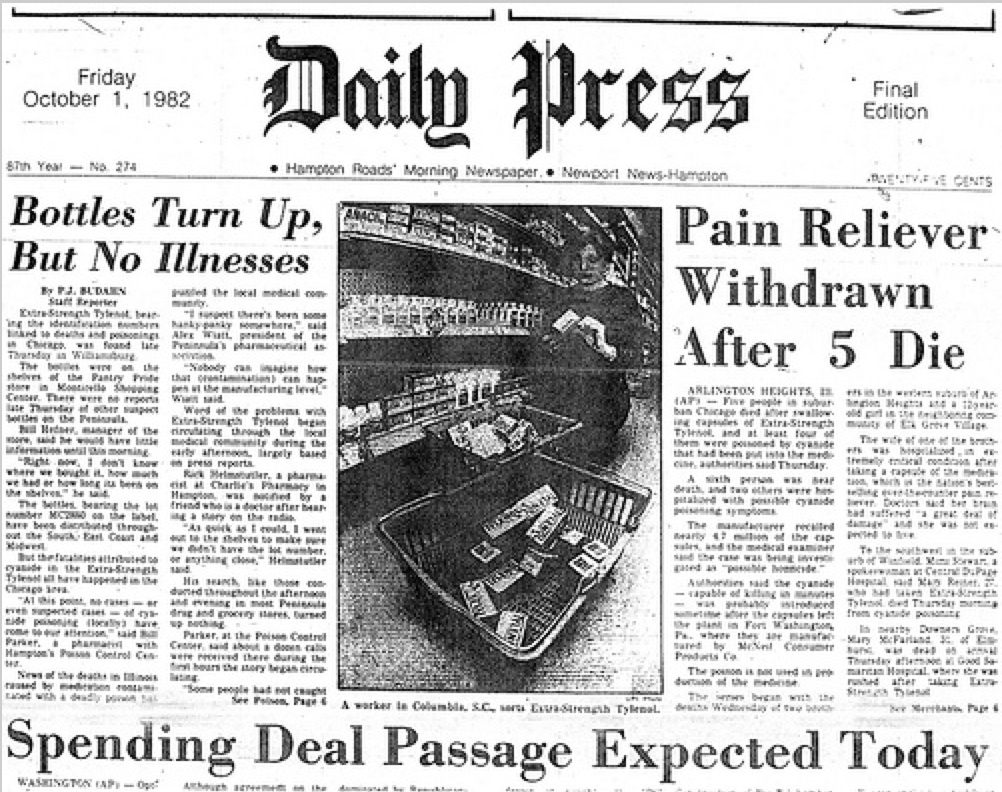
Through no fault of their own, Tylenol found themselves facing an unimaginable nightmare when a crazed person tampered with products and killed people.
For those who don’t know the story: In 1982 Chicago, people started dying of cyanide poisoning. Random people with no connection with each other, except that officials quickly discovered someone was lacing Tylenol with cyanide. It induced panic in the community to the degree that police and rescue vehicles were driving through neighborhoods announcing to people to toss out their Tylenol.
Think about that for a moment: police and rescue vehicles were driving through neighborhoods announcing to people to toss out Tylenol. Samsung went through a recall in 2016 when their Galaxy Note 7 products generated too much heat and the products caught on fire or exploded. At the time, in every airport gate in the U.S., gate attendants announced that Samsung Galaxy products were prohibited from the planes. It’s one thing for a product to perform badly. It’s another thing for a product to perform so badly that airlines make announcements against your brand prior to every U.S. flight for three months.
The Tylenol problem was worse, still.

Through no fault of their own, Tylenol had a major crisis on their hands. In all, 7 people died.
Johnson & Johnson, Tylenol brand owners, decided to pull all Tylenol products from the shelf. ALL of it, or 31 million bottles, since they didn’t want anyone else to die, and no one could be sure what products were affected.
Then they went to work, as resilient brands do.
Adjust Based On The New Reality
The buzz word these days is “pivot”. But companies have been adapting and adjusting for years without having a buzzword.

What I love about the Tylenol story is that the brand found themselves in a situation far beyond their control—and gained control again by sheer force and creativity. Most companies would have withered under these circumstances. But J&J put their best people to work on the challenge.
A short while later they reintroduced the world to Tylenol. To make sure people knew Tylenol was a safe brand, they launched with innovations consumers could see. Innovations that are so common today that new generations just accept that their products will be “Safety sealed three ways!”:
Glued boxes so consumers could tell at a glance if someone had gotten in first.
Bottle caps wrapped in plastic. So even if the box had issues, the plastic was a quick indicator of tamper-free products.
Foil-sealed lids as the final barrier against bad things happening without your knowledge.
Build On The New Reality
The Tylenol brand hasn’t looked back in ages. It’s mostly people like us who keep bringing up the story—or people who study crisis management. It’s an amazing study in how to deal with a brand collapse that’s beyond your control. But in the end, it’s what a brand chooses to control that makes the difference. J&J had the kind of culture that enabled them to take on a catastrophe head-on and thrive by making tough choices, adjusting in the new reality, acting with purpose, and building on the new reality.
There will always be crises. It’s how brands choose to deal with them that will determine what brands survive and which ones fade away.

How Do Resilient Companies Thrive?
There are winners and losers in every economy. Some people and companies collapse under the weight of changes and uncertainty while others seem to thrive. Same conditions, similar circumstances, but one group withers away while others not only survive the challenge but go on to do great things. What makes the difference?
There are winners and losers in every economy. Some people and companies collapse under the weight of changes and uncertainty while others seem to thrive. Same conditions, similar circumstances, but one group withers away while others not only survive the challenge but go on to do great things. What makes the difference?
What is Resilience?
Before we break down what resilient people and companies do differently, it might be helpful to define what we’re talking about. What does it mean to be resilient? According to Merriam-Webster, resilience means “able to become strong, healthy, or successful again after something bad happens.”
Seems simple enough. But being able to bounce back when bad things happen is largely related to the foundations laid prior to those bad things happening … and then building on the foundations as needed.
So what do healthy organizations do that help them survive the crises that take down their competitors?
Prepare: Build a Healthy Company Culture
Just as a healthy person is better able to fight off illness and injury, healthy organizations give themselves the upper hand in both good and bad times. In his excellent book “The Advantage”, organizational health guru, Patrick Lencioni, outlines four disciplines of healthy companies:
Build a cohesive leadership team—the people at the top understand why the company exists, what challenges are top priority, their roles and responsibilities, and how to work together to make things happen;
Create clarity—the leadership team is intellectually aligned and committed to the same fundamental values and actions. There can be disagreements at the top, but not dissension.
Over-communicate clarity—healthy organizations make sure everyone is on the same page, working together from top to bottom to accomplish their goals. People know why the company exists, how they’re changing the world, and how their particular role factors into that goal.
Reinforce clarity—“in order for an organization to remain healthy over time, its leaders must establish a few critical, non-bureaucratic systems to reinforce clarity in every process that involves people. Every policy, every program, every activity should be designed to remind employees what is really most important.”
Just being in business isn’t good enough to withstand real economic challenges. Companies that know what they’re about, why they exist, have leaders who are aligned and able to guide employees to the future, and help people link arms in the struggle give themselves incredible advantages in the marketplace.
Act with Discipline and Purpose
Discipline is key to resiliency at personal, brand, and organizational levels. Healthy organizations move with a sense of purpose in good times and bad. Because they establish their foundations early and understand why the exist, they can align their teams on disciplined pursuits of their goals.
In his book, “Great by Choice”, author Jim Collins details the 20-mile march concept used by explorer Roald Amundsen to successfully reach the South Pole. To summarize: “Enterprises that prevail in turbulence self-impose a rigorous performance mark to hit with great consistency—like hiking across the United States by marching at least 20 miles a day, every day. The march imposes order amidst disorder, discipline amidst chaos, and consistency amidst uncertainty.”
Does preparation build resiliency? In many ways, yes. Because it helps people not collapse when faced with uncertainty.
To quote Collins again, “Having a clear 20 Mile March focuses the mind; because everyone on the team knows the markers and their importance, they can stay on track. Financial markets are out of your control. Customers are out of your control. Earthquakes are out of your control. Global competition is out of your control. Technological change is out of your control. Most everything is ultimately out of your control. But when you 20 Mile March, you have a tangible point of focus that keeps you and your team moving forward, despite confusion, uncertainty, and even chaos.”
Collaborate or Die
There are many advantages to creating a collaborative work environment for organizations, from attracting better employees, and retaining your best people, to improving productivity and getting better ideas out of everyone involved. So why isn’t every company already committed to collaboration?
It starts with leaders—but it isn’t just leaders by title. I like the way Liz Wiseman’s talks about a better grade of leaders. In her book “Multipliers”, Wiseman defines multipliers as “genius-makers who bring out the intelligence in others. They build collective, viral intelligence in organizations.”
It’s important to make the distinction between leaders who are multipliers and people who are what Wiseman calls “diminishers”, or those who “are absorbed in their own intelligence, stifle others, and deplete the organization of crucial intelligence and capability.”
The multipliers in your organization help foster the kind of environment where people feel they are free to collaborate and share their best ideas because they feel valued, energized, challenged in positive ways, and therefore enthusiastically lean into helping the team and organization thrive.
How people feel is really important here. Organizations that post empty values about empowerment and authenticity, and then run people over when they express those values, are doomed to having an empty staff—people who come to work to get paid, not to give 110% of who they are.
Multipliers worry less about getting people in the right seats and accountability charts. They instill a sense of ownership, “provide the necessary resources for success, and hold people accountable for their commitments.”
By bringing out the best in everyone in the company, and leveraging a collaborative culture, organizations gain flexibility, agile work styles, become more adaptable and seem to have the ability to see around corners—not because their people are better or smarter than any other work force, but because every employee is fully engaged and fully utilized.
Worry About What You Can Control, Not About What You Can’t
Resilience is largely focused on companies controlling the right things and getting the right people and processes in place so they can capitalize on opportunities or shift away from issues faster. Success isn’t guaranteed, but resilient companies give themselves a better shot at success than their less prepared counterparts.
In their HBR article “A Guide to Building a More Resilient Business”, co-authors Martin Reeves and Kevin Whitaker identified four significant benefits of resilience at a corporate level:
Anticipation—the ability to recognize threats faster.
Impact—the ability to better resist or withstand the initial shock. This can be achieved through better preparation or a more-agile response.
Recovery speed—the ability to rebound from the shock more quickly by identifying the adjustments needed to return to the prior operating level and implementing them swiftly and effectively.
Outcomes benefit—increased fitness for the new post-shock environment.
In summary, resilient companies prepare for the days ahead and give themselves the advantage of a healthy culture, act with a sense of purpose and move at a steady pace, encourage collaboration in, around, and through their people and bring out the best in every individual, and take care of what they can control.
As a result, healthy companies are better prepared to enjoy the fruits—even in a down economy or turbulent environment—when their competitors struggle to survive.
Tell us your thoughts on what resilient companies are doing better and differently than others.

Brand Building Fundamentals: Brand Personality
Brands can be fun, free willed, playful, studious, a work horse, etc. But those attributes don't drive much energy into the brand. Worse, your interpretation of "fun" may be decidedly different than mine. So we could work on the same brand using "fun" as the brand personality and end up in vastly different areas.
Every brand has a brand personality. Not every brand chooses to manage that personality. That's a mistake.
Brand personality has been defined as the human characteristics that embody the brand or brand experience. Helpful? Didn't think so. Let's rethink this.
Brands can be fun, free willed, playful, studious, a work horse, etc. But those attributes don't drive much energy into the brand. Worse, your interpretation of "fun" may be decidedly different than mine. So we could work on the same brand using "fun" as the brand personality and end up in vastly different areas. I think that's an issue.
I recommend people start with analogies (cars, famous people, bands, etc.) and then unpack what makes them work for the brand.
You might start with mountain climber Reinhold Messner. But everyone might not recognize that name. Unpacking that might get you to: Courageous, personable mountain guide: skilled, knowledgeable, engaging, with an intense desire to help others succeed.
It can be short or long. Just help people get on the same page and visualize the potential so internal and external audiences connect with the same powerful personality.

Branding Should Be Logical
Logical branding doesn't mean overly simple. It means people can easily understand the path from one end of the communication spectrum to the other, whether that's in the portfolio strategy, equity, architecture, Web site or customer service rep responses.
Over the last 15 years+ I've dug into and created branding programs for start ups to global conglomerates in almost every category and channel imaginable. What has become abundantly clear is that the strongest brands, and companies with zealous employees and brand fans, are crazy simple and logical.
Logical. Sounds almost too easy, right?
In the market I think it's a combination of vision and purpose—very few companies set out to confuse their audiences and make it difficult for them to find the products and services they want.
Logical branding doesn't mean overly simple. It means people can easily understand the path from one end of the communication spectrum to the other, whether that's in the portfolio strategy, equity, architecture, Web site or customer service rep responses.
Behind the scenes it involves the kind of brand building tools people inside those companies will use to bring the brand to life. It's been my experience that too many agencies promote complicated tools and "proprietary methodologies" that are hard to explain and harder still to use, and therefore end up in a drawer. The brand spends money on the agency but doesn't improve the experience or the brand.
I think logical is better.

10 Steps to Creating a Personalized In-Store Experience
The in-store experience is critical to the success of any retailer. It is especially important to small retailers and mom-and-pop operations. It is your chance to prove to your customers that you have their best interests in mind and that you are truly focused on helping them succeed.
The in-store experience is critical to the success of any retailer. It is especially important to small retailers and mom-and-pop operations. It is your chance to prove to your customers that you have their best interests in mind and that you are truly focused on helping them succeed.
That means first impressions count. It means how you address them and their interests matters. It means they are your number one focus for the entire time they are in the store, and you will give them every reason to return—as well as give them reasons to tell their friends how amazing your store is.
1) Engage the customer within the first 30 seconds of their entry into the store. Thirty seconds isn’t much time, but it feels like an eternity to someone visiting who sees you not connecting with them.
Avoid the gauntlet! There is plenty of research that shows a rise in heart rate and stress as consumers enter some retail shops—because they know they are going to be assaulted by commissioned sales people. When this happens, consumers naturally put up their defenses and say no to ANY help offered.
So, when you engage with your customer, it MUST be in an approachable manner and CANNOT be confused as an attack by a money-hungry salesperson.
2) Introduce yourself by name and thank them for coming in to the store. Then ask if there is a specific question they came in the store to answer. This may include shopping for a distinct event, room, person or item. You offering your name makes this a personal experience, not just a trip into someone else’s club.
Technology exists today that allows consumers to scan QR and other codes in-store and receive real-time information on the range of options available. Consumers can even link to an online shopping cart while in the store and do their shopping virtually while browsing the real thing. This kind of technology enables the floor personnel to stay connected to customers without chasing them throughout the store.
What I love about this approach is it enables the customer to stay in control of as much of the information gathering and sharing as SHE wants, and removes an uncomfortable barrier between pushy salespeople who ask too many questions at the wrong times.
3) If they say NO: give them room while providing information on the layout of the store. For example, point out how the store is arranged, where to find particularly popular items, showcase what’s new or different.
Tell them you will check back with them in a few minutes—and let them shop on their own. But make sure you check back with them.
Keep your promises, even little ones made in the moment. These may seem small to you, but your customer uses them to judge your credibility.
4) If they say YES: obviously you want to address that need. This is where customer segmentation comes into play. The more you know about the type of customer you are dealing with, the better prepared you are to provide the right kind of information they want and how they like to receive the information.
For example, if you’re in a specialty business like a guitar or bike shop, you need to be able to determine whether you are talking with someone who considers him or herself an expert, or whether you have a newbie on your hands. The expert may be able to cut to the chase and sort through all the technical details of the product. The newbie will likely be lost by the jargon and turned off by their perception of you acting like a know-it-all.
5) Offer ideas: People like to buy; they just hate to be sold. So offer ideas and reasonable suggestions. Start small and work your way up.
Keep in mind that your online retail competitors have all of this built into their software. So instead of personal assistance and suggestions your customers get pop-ups and banner ads. You being there in person should be a better option to online, if you want your customer to return.
6) NEVER PATRONIZE YOUR CUSTOMERS! If they don’t know what questions to ask, it is your job as the expert to help them get to a great solution while allowing them to save face. Most people do not like to admit that they don’t know the answer to a question. You proving they don’t know what they’re talking about may make you feel better but it will almost always guarantee a lost sale plus a social media wildfire.
Retail is hard. Dealing with living, breathing customers in person every day can be crushing to the spirit—on the bad days. But that never gives you the right to belittle your customers. The customer is NOT always right. By the same token, they are not always wrong, or stupid, or lazy or ... you get the idea. Use the Golden Rule here.
7) Be the expert: Most of your customers want you to know what you’re doing, and expect you to know more about your category and channel than they do. So feel free to offer tips and share anecdotes based on your personal experience. Chances are good that you have more experience in your category (especially if you’re in a specialized category) than a fair number of your walk-in customers. Your excitement for your store, variety, options, potential and more will rub off on them—and improve your chances for a sale.
8) Think long-term: You are building a relationship one visit at a time. Some of your customers will walk into the store having done their homework and knowing exactly what they want. For them, you will likely serve as the resident expert who shows them what they want to see and verifies the details.
Many more customers will want to browse and ask questions, especially for larger ticket items. Be patient with them. Give them a reason to come back, which starts with liking the in-store experience and the person helping them—that’s you.
9) Get them into the system and into events: Every in-store visit is a chance to connect long-term. So get their name and contact details while pointing them to your Web site, Facebook page, app and more. Let them know the kind of information you post online (tips, videos, styles, upcoming shows, etc.) so they have a reason to check in. Ask if they would like to receive follow up reminders and updates.
10) Give them a reason to return: Remind them of your name and show them that you remember something about their interests, which proves you were listening to them. Offer to help personally on their next visit.
For consumers to continue to frequent brick and mortar retailers, the experience in-store simply must offer options beyond making product available and available locally. Those arguments are wasted when consumers can have virtually any items shipped directly to them overnight in most cases and free of charge.
In-store experiences offer an excellent opportunity to build lasting relationships between real people and provide the emotional connection many say is increasingly missing from the equation. If you can’t win on price, and many boutique stores cannot begin to win a price war, then emotion and personal interaction must overcome the difference. You can do it.

Six Critical Factors in Winning Against Private Label
When private-label brands can match, or claim to match, national-brand quality standards, it’s time to recognize their power and plan accordingly.
In the not-too-distant past, private-label products were discussed in the same hushed tones reserved for topics not suitable for public consumption. Consumers didn’t really want to tell anyone they bought private label, the generics of the retail world, and let on that they were willing to compromise. National-brand managers relegated private-label products to the bottom of the category shelf set, allowing a tiny portion of share to be taken by this awkward cousin—but never really took them seriously.
But in the economic crash of 2007–2009, the world of private label changed dramatically. Retailers like Tesco, Sainsbury’s and Morrisons led the way by developing private-label brands instead of individual products. By some reports, as much as 54% of Sainsbury’s sales, and 41% of Tesco’s sales, come from these owned brands.
These retailers also recognized that (in many cases) using a national brand equivalency (NBE) strategy, where one simply knocks off the aesthetics of the best-selling national brands in each category and places their product to the immediate right of said brand with a price 40% lower, wasn’t gaining any loyalty.
The private-label trend caught on globally, from Loblaws of Canada to Walmart, Target, Kroger, Aldi, Wegmans, H-E-B, The Home Depot, Lowe’s … the list goes and grows on. A 2013 Nielsen Homescan study showed private-label brands in the US make up an average of 23% of total dollar share in supermarkets, 20% in club, and 18% in dollar. And now, Amazon is actively building its own private-label group, with plans to offer a considerable amount of owned, branded products across hard and soft goods.
A 2013 Nielsen Homescan study showed private-label brands in the US make up an average of 23% of total dollar share in supermarkets, 20% in club, and 18% in dollar.
So what can national brands do to compete in a world where they don’t control the retail space, shelf set or pricing structures? It’s a tough question to answer, but there are a few opportunities out there for brands willing to take on the challenge.
1. RECOGNIZE THE QUALITY OF PRIVATE LABEL
Sometimes we run into brand managers who scoff at the idea that private label might be a real competitor. Or, perhaps even worse, relegate private label to the lowest tier of the category set and figure that only consumers looking for a cheap product at a cheap price will choose it.
This line of thinking is horribly flawed. Private-label products and brands have made huge strides in quality over the last 10 years, with many of the manufacturers who support private label proudly touting the superiority of their products versus national brands. First Quality Enterprises of Great Neck, New York regularly conducts independent tests to certify that their diapers and incontinence products perform as well as or better than any national brand. Aldi recently ran an ad calling out Pampers in a head-to-head comparison with their Mamia brand.
When private-label brands can match, or claim to match, national-brand quality standards, it’s time to recognize their power and plan accordingly.
2. GET TO KNOW YOUR BUYERS AND CONSUMERS
Most retailers build their private-label brands through in-store conversion. They spend few resources educating consumers on the values of their brands or trying to build relationships with consumers before they enter the store. This is where national brands hold the first advantage.
National brands must know the people who shop for and consume their brands and products very, very well! I’ve worked with brand managers that noted their consumer audience as “builders” or “homeowners” or “moms.” That kind of vague reference won’t get you anywhere. You must dig to understand not just the demographics of the people buying and using your products, but also the psychographics behind why they make their choices. To do this, I recommend getting out and talking with people face to face, in homes, in stores, wherever they gather or shop for or use your products. Sending out an online survey will never get you into the hearts and minds of your consumers. You must engage them personally.
3. CREATE STRONG BRAND EQUITIES
Make it easy for your brand zealots to discover, locate, purchase and recommend your brand and products to other like-minded fans.
I’ve been playing acoustic guitar for more than 35 years. Around 20 years ago, I came across the Taylor guitar brand out of El Cajon, California. I was drawn to the quality of the guitars they made, and the distinctive headstock made it easy to spot others playing the brand from a distance. The brand published a newsletter that looks and reads like a high-end magazine, and shipped it free to everyone who owned a Taylor guitar. These newsletters shared stories about how the brand sourced woods, built different guitars, incorporated technology in the building process and more.
They also built their brand community by using popular artists to play at local guitar shops where fans could get their hands on the very guitars being played exceptionally well by these artists. This collection of information and identifiable equity elements has helped Taylor become the number-one acoustic-guitar brand in the US.
4. BUILD EMOTIONAL CONNECTIONS
Studies continually show that consumers trust national brands at a level that far outweighs their private-label counterparts. The power of Coke’s long history of brand storytelling, from unique shape language to the color red, polar bears, Santa Claus and teaching the world to sing, makes it virtually impossible for store brands to compete on anything but the lowest performance measures.
When national brands focus on product function only, they open the door for private label to take away market share. Most consumers want an emotional connection to the brand. Give it to them.
5. INNOVATE AND LEAN FORWARD
Private-label manufacturers by their very nature race to catch up to national brands, which is why national brands must work twice as hard to change the game. This means national brands must stay in touch with consumers and market trends to see what people want now, and how their preferences are changing, so they can anticipate change and get ahead of it whenever possible.
Steve Jobs recognized that anyone could make a phone, but only Apple could make an iPhone. He looked at a category replete with lookalikes and created a new platform that shook up the entire mobile phone universe so much that a once-dominant player like Nokia, which had gotten lazy in its innovation cycle, saw market share fall from a high above 50% in 2007 to just 3.5% by the third quarter of 2012.
Offering new versions, flavors or varieties of the same old products never has and never will be considered innovation. Consumers get confused by too many line extensions and default to the products they know and love anyway, so do yourself a favor and reach beyond the extension into true innovation.
6. USE THE ENTIRE MARKETING MIX TO YOUR FAVOR
Because consumers have an emotional connection to and therefore predisposition to purchase national brands, it is the responsibility of the national brands to do everything in their power to embrace those passionate consumers. This will never happen in one clean, concise manner. It involves strategies in pricing, placement, product assortment and promotion. Finishing this experiential journey with excellent customer service, trade relations and sales support increases the likelihood that your brand will be able to compete against the strongest private-label challenges.