

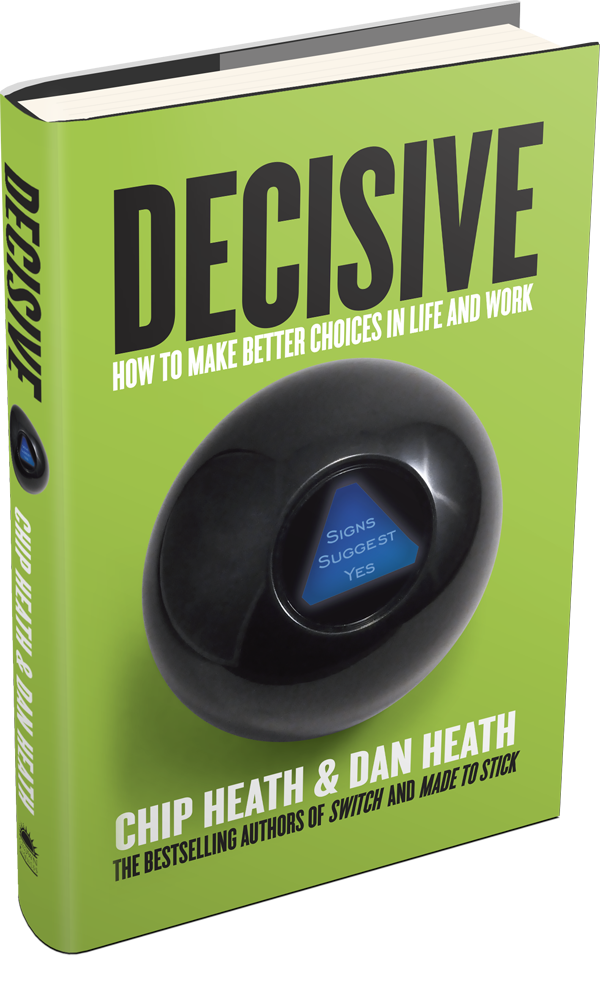
Decisive by Chip and Dan Heath
One of the things I’ve learned in the agency business is that few people have a great framework for making decisions, especially hard decisions. In the creative world, we use design thinking to generate ideas, but most people struggle to pare those ideas down to what has a chance to win. It’s often not a lack of data, it’s a lack of process. And without a process, you’re stuck with flipping a coin, going with the gut, using a Magic 8-Ball, or following the loudest voice in the room.
One of the things I’ve learned in the agency business is that few people have a great framework for making decisions, especially hard decisions. In the creative world, we use design thinking to generate ideas, but most people struggle to pare those ideas down to what has a chance to win. It’s often not a lack of data; it’s a lack of process. And without a process, you’re stuck with flipping a coin, going with the gut, using a Magic 8-Ball, or following the loudest voice in the room.
That’s one reason I like the book Decisive by Chip and Dan Heath so much. It’s an easy book to read, and the Heath brothers do a great job of backing the ideas with examples and stories so it doesn’t come across as an academic study.
There are three key points I use every week in some way for little to large decisions:
First: Stop accepting a binary frame.
If the only options on the table are “do the thing” or “don’t,” you’ve cornered yourself in a binary frame. Instead, consider the vanishing-options test: if neither choice existed, what would we do instead? This forces you (and your team) to move beyond what’s expected, easiest, or even what has momentum, and rethink the options.
Second: Reality-test before you scale.
Confirmation bias is a killer in the creative world. It lets half-cocked concepts make it to market and kill brands and careers. The Heaths push you to look for the information that would prove you wrong, and to run small, cheap experiments instead of betting the full plan on a deck. Jim Collins calls this “firing bullets before cannonballs.” In agency life, that looks like a limited market test, a two-week creative sprint, a pilot with one segment, etc. Some jokes just don’t land. Some product ideas land flat. And sometimes you find a unicorn that makes you look brilliant.
Third: Get distance before you lock in.
When people are screaming for deliverables, the quarter is closing, management needs numbers … it’s easy to go with the idea people love now versus what will last over time. The Heaths recommend a decision model originated by business writer Suzy Welch to help you get some emotional distance. The 10/10/10 rule asks you to consider how you will feel about this in ten minutes, ten months, and ten years. It helps you overcome some of the emotion of the moment and balances perspectives.
There are other tools and techniques in the book that might work for you.
What’s a book on decision-making or a model that you’ve found helpful?

Are Core Values Uncovered or Assigned?
I often get asked by executives when we’re starting the Vision, Mission, and Core Values process how we come up with the words. Or, as one executive asked, “Do you already have this stuff written down somewhere and you’re just making us go through these exercises?”
The short answer is no; we don’t already have predetermined answers. We work hard to uncover and discover the values within each company.
I often get asked by executives how we come up with the words when we start the Vision, Mission, and Core Values process. Or, as one executive asked, “Do you already have this stuff written down somewhere, and you’re just making us go through these exercises?”
The short answer is no; we don’t already have predetermined answers. We work hard to uncover and discover the values within each company.
There are two types of organizational drivers to consider when thinking of crafting core behavior language:
Start-Ups and Assigning Values
It would be a mistake to say you assign values to new companies. You don’t, really, because companies are started by people with prior experience. And that experience is a launching point for the future company’s core behaviors.
If we’re working with executives starting a company, we dig deep to understand their vision for the future and what kinds of people can help them reach their goals. Similar to working with existing companies, we ask founders to describe the best people they’ve worked with in the past. Many founders may have a tough time articulating pithy strategy and value statements, but most can give you an idea of the kinds of behaviors they think will help their company and brand stand out in the marketplace.
Those behaviors rarely sound like, “We’d like people with integrity, who are accountable, and who feel empowered to do smart things.” Why? Because everything I just mentioned is common sense and fairly obvious. Stating the obvious isn’t differentiating.
Many startups need to have a speedboat mentality. They need to be nimble, responsive, able to take action quickly, try new ideas, and adjust on the fly. And so their core behaviors should reflect those needs to help ensure they recruit the kinds of people who embrace that kind of culture.
As a new company grows, founders need to demonstrate the behaviors in how they operate and treat people each day; then, new employees can embrace the core behaviors as simply part of the operating system. The key here is demonstration. If it’s just leaders telling people how to behave, that’s worst case assigning (imposing) values … and it rarely goes well.
Uncovering Values in a Change Initiative
Vision, Mission, and Core Values are standard fare in many organizational change initiatives. A trick here is understanding what’s driving the company to change. Are you fixing a problem? Restructuring? Changing business strategy? Coming out of a merger or acquisition?
If we’re starting from a positive position, uncovering the positive values can be a simple experience. We unpack the behaviors of the best employees, compare those to the behaviors of the worst employees, factor in executive goals and company vision, and articulate the values already present in the company.
If we’re starting from a negative position, we first have to understand how broken the culture is. Some cultures need to be healed before the new language can be introduced. If negative behaviors have been the norm for a while, no amount of positive thinking and well-crafted attributes will stand a chance. So, we fix the culture while talking about the behaviors that would set the company up for success.
In this case, it can be helpful to get the employees involved in discussions of the kind of culture they want to be a part of, how they’d like people to act, and how they’d like to be treated. By engaging employees and not just executives, people at varying levels within the organization can play a role in the change initiative.
Then, when the new core behaviors are introduced to the company, they won’t feel like something assigned to everyone out of the blue. It’s worth saying again: if the company culture has been broken, it MUST be mended before new language can be introduced. Otherwise, management is asking for a rebellion.
Values aren’t something to be assigned or imposed—they emerge from the lived experiences, aspirations, and demonstrated behaviors within an organization. Whether working with a speedboat company needing values that enable rapid innovation, or an established tanker organization, the key is uncovering and articulating authentic behaviors that will drive success. This requires careful attention to context and alignment between stated values and demonstrated behaviors, between leadership actions and company culture, and between the organization’s past experiences and future aspirations. When this alignment is achieved thoughtfully and authentically, values become a powerful force for positive change.

Core Values or Core Behaviors. What's the difference?
A 2020 MIT Sloan Review study found that more than 80% of large companies published their core values online. Other studies place the number of companies with stated core values as high as 92%. This simply says that companies embraced the concept of stated core values.
But employee satisfaction scores tell a story of broken cultures. A Fond study of HR execs found that "only 22% responded that 60% or more of their employees know their company’s core values." A Gallup poll found that "just 23% of U.S. employees strongly agree that they can apply their organization’s values to their work, and only 27% strongly agree that they “believe in” these values." And a Leadership IQ study showed that "only 20% of respondents say their company always hires people who fit well with their company values."
Back in 1994, Jim Collins and Jerry Porras identified core values as fundamental beliefs and guiding principles that helped the best companies keep everyone on the same page. But did they really?
A 2020 MIT Sloan Review study found that more than 80% of large companies published their core values online. Other studies place the number of companies with stated core values as high as 92%. This simply says that companies embraced the concept of stated core values.
But employee satisfaction scores tell a story of broken cultures. A Fond study of HR execs found that "only 22% responded that 60% or more of their employees know their company’s core values." A Gallup poll found that "just 23% of U.S. employees strongly agree that they can apply their organization’s values to their work, and only 27% strongly agree that they “believe in” these values." And a Leadership IQ study showed that "only 20% of respondents say their company always hires people who fit well with their company values."
If people can’t articulate what the values are, how can they be expected to be influenced by those values?
If leaders don’t demonstrate the desired behavior, why would they expect employees to act any differently?
This is why I believe that one-word values don’t resonate with people. They’re empty words. No one needs another poster with an eagle soaring over a canyon with the word “Respect” in giant Times New Roman. I’m pretty certain that no one has ever walked down a hall thinking disrespectful thoughts, seen a poster, and then changed their way of thinking.
Random statements don’t help, either. One company I worked with had a core value of “Fly Your Freak Flag.” What they meant, I think, was for everyone in the company to be themselves, uniquely, and build a better culture through intellectual diversity. That’s not what they got. When they asked employees to write their “freak flag” on large cards that could be hung outside offices, one male leader wrote, “I like to pee sitting down.” Another wrote, “I can burp in three different languages.” Funny, but I’m sure HR couldn’t use any of that for cultural enrichment.
Here are some examples of companies that have gone beyond one-word core values to create more nuanced and actionable core behaviors:
Zappos:
Deliver WOW Through Service
Embrace and Drive Change
Create Fun and A Little Weirdness
Be Adventurous, Creative, and Open-Minded
Pursue Growth and Learning
Build Open and Honest Relationships With Communication
Build a Positive Team and Family Spirit
Do More With Less
Be Passionate and Determined
Be Humble
Google:
Focus on the user and all else will follow
It’s best to do one thing really, really well
Fast is better than slow
Democracy on the web works
You don’t need to be at your desk to need an answer
You can make money without doing evil
There’s always more information out there
The need for information crosses all borders
You can be serious without a suit
Great just isn’t good enough
Zillow:
Customers Are Our North Star
Turn On the Lights.
Do the Right Thing.
Own It.
ZG Is a Team Sport.
Include and Empower.
Think Big, Move Fast.
Deliver Quality on Time, Every Time.
Tesla:
Do the impossible
Constantly innovate
Reason from “first principles”
Think like owners
We are all in
These examples stand out in their simplicity and ability to inspire while clarifying the kind of culture the company wants. Employees can understand what the company wants from them. Executives can model the behaviors. HR can recruit individuals who WANT to live these values.
If you’d like help discovering the core behaviors within your organization and crafting the language, let’s talk.

What’s wrong with your core values?
One-word values can be ambiguous and interpreted differently by different people. When that happens, you get inconsistent applications across the organization.
They're also hard to represent in hiring and firing decisions. Would you hire someone who doesn't act with integrity? Of course not. Do you want your employees to feel empowered? Probably. But empowered to what degree?
Thinkhaus Idea Factory works with companies each year to define their vision, mission, and core values. Almost immediately, someone steps forward with a list of one-word values they found after a quick Google search.
You've seen them: integrity, accountability, empowerment, inclusion, passion, teamwork, respect ... the list can go on for a while. What's wrong with these?
For starters, they're vague. How do you define when someone has made an integrity breach? You'd have no problem firing an employee who padded their expense report by $500. But would you fire another employee for taking a couple of company legal pads and pens home for their kids? Both are technically stealing from the company. If you'd fire one but not the other, "integrity" is on a sliding scale at your company.
One-word values can be ambiguous and interpreted differently by different people. When that happens, you get inconsistent applications across the organization.
They're also hard to represent in hiring and firing decisions. Would you hire someone who doesn't act with integrity? Of course not. Do you want your employees to feel empowered? Probably. But empowered to what degree?
Let me give you a quick example of why one-word values are challenging. Enron, one of the poster children for organizational dysfunction, unethical practices, and accounting fraud, had four simple core values: Communication; Respect; Integrity; and Excellence. You could argue that some people in the company used these as behavior guides. But leadership clearly didn't.
A method I was taught early in my career is still one of my favorites: working with leadership, unpack the behaviors of the best people in the company. You know, those you'd hire in bunches if they were available. What do they do that makes them stand out? How do they act? How do they treat clients and teammates? Conversely, do the same exercise on the behaviors of the worst employees. What gets them on the bottom of the list? Why?
When you go through this exercise, you rarely end up with single-word answers. Instead, you'll hear things like, "I can count on her to do the right thing even when no one else is around," or "He lifts others up around him so the team becomes stronger," or "She's action-oriented and gets things done."
All of these can be used to represent Core Behaviors that will help with recruiting and evaluations and will ultimately help the organization stand out among its competition.
What do you think? What's your favorite example of a core value statement? Which one stands out as the worst?

Are You Solving the Right Problem?
In the fast-paced world of business and brand management, it’s easy to feel trapped in a cycle of addressing symptoms rather than root causes. As leaders, it’s crucial to step back and ask: “What problem are we really solving?”
In the fast-paced world of business and brand management, it’s easy to feel trapped in a cycle of addressing symptoms rather than root causes. As leaders, it’s crucial to step back and ask: “What problem are we really solving?”
Are you creating a better band-aid or addressing why the wound occurred in the first place? Both approaches have merit, but understanding which one you’re pursuing is critical for strategic alignment. This dilemma isn’t new. In 1919, Edward Bullard invented the hard hat to prevent head injuries from falling objects. This addressed the root cause, revolutionizing workplace safety. In contrast, others were focused on the symptomatic solutions of creating better bandages and painkillers.
Sometimes, addressing symptoms can be lucrative. The pharmaceutical industry often focuses on creating faster-acting, more effective painkillers rather than tackling the underlying causes of pain. As a brand manager, you might develop the best meal-replacement shakes while another team addresses poor eating habits. You might create a better energy drink while another team focuses on the issues of sleep deprivation. While challenging, both strategies can coexist within the same company, targeting different aspects of the same overarching issue.
Here are some steps to consider on your innovation journey:
Start by clearly defining whether you’re addressing symptoms or root causes. This clarity will guide your innovation strategy and resource allocation.
Consider developing parallel approaches—one for immediate relief (symptom) and another for long-term solutions (cause).
Regularly engage with your audience to understand their underlying needs, not just their immediate wants.
Foster partnerships between teams focused on short-term solutions and those working on long-term innovations. This cross-functional collaboration can yield powerful insights and more comprehensive strategies.
Develop KPIs that reflect both immediate results and progress towards solving fundamental issues, ensuring you’re measuring impact holistically.
Finally, future-proof your approach by regularly reassessing your problem-solving strategy. Ensure it aligns with evolving market needs and technological advancements.
Remember, there’s no one-size-fits-all solution. The key is to be intentional about your approach and ensure it aligns with your brand’s vision and values. By thoughtfully considering whether you’re putting out fires or preventing them, you’ll position your brand for sustainable success and meaningful impact. In doing so, you're not just solving problems—you’re creating a legacy of innovation that addresses both immediate needs and long-term challenges.

Do you suffer from the "better mousetrap" syndrome?
It's easy to get laser-focused on creating things. But those ideas need to be grounded in something more than personal preference. Before launching your next big idea, your better mousetrap, ask yourself: Does your audience even realize they have a mouse problem?
Here are six steps to consider to make sure your concepts are grounded in insights so you increase your chances for success in the marketplace.
I've dealt with many brands through the years that had interesting ideas and products and yet couldn't imagine why people weren't beating down their doors to get to those amazing ideas.
It's pretty easy to get laser-focused on creating things. Thinkhaus Idea Factory does plenty of innovation and strategy workshops to help companies develop new ideas to take to market. In some ways, this is where better mousetraps are born. But those mousetraps need to be grounded in something more than personal preference.
Before launching your next big idea, your better mousetrap, ask yourself: Does your audience even realize they have a mouse problem?
Here's a simple way to approach the issue:
1. Start by gathering consumer insights to drive innovation. This doesn't have to be some exhaustive study. It can be some simple engagements where the team turns observations into actionable insights that the innovation team can leverage for better ideas. Consumers are lousy at telling you what product they need.
The average house is filled with products people love today but would have never asked for prior to invention. No consumer said they needed a microwave oven before they were introduced to microwave ovens. People didn't ask for refrigerators, televisions, dishwashers, or even lightbulbs, either. The insights around convenience are what led to the breakthrough ideas.
This is why I make the distinction between observations and insights. You could observe someone washing dishes by hand. That's a task getting done. The insights come from the dishwasher's frustration with the soap, sponge, scrub brush, volume of dishes, dirty water, and more. From those insights, you can create solutions that will have an audience.
2. Check out the marketplace in the areas you're considering. What are you going to be competing against? For blue ocean strategies, you're looking for holes you can fill where there are no competitors.
3. Ideate freely.
4. Engage with your target audience to validate your concept and make necessary refinements.
5. Refine, iterate, and keep checking.
6. Solve the mouse problem.
Need help with your better mousetrap? Let's talk.

Forget About Age. Just Stay Relevant. Why Companies and Careers Now Pivot on Continued Relevancy
The business world loves stereotypes, where old-line companies (we call them tankers) boast about their age, stability, and staying power while young startups (we call them speedboats) scream about their pace, out-of-the-box thinking, and innovation. Seasoned workers at tanker organizations get cast as rigid and resistant while their speedboat counterparts are hailed as adaptable and tech-savvy.
There is a need for both tanker and speedboat organizations. But let’s be clear here: the only thing you get with age is older. Age isn’t an indication of wisdom, sophistication, or savvy. Age alone does not determine ability to deliver.
The business world loves stereotypes, where old-line companies (we call them tankers) boast about their age, stability, and staying power while young startups (we call them speedboats) scream about their pace, out-of-the-box thinking, and innovation. Seasoned workers at tanker organizations get cast as rigid and resistant while their speedboat counterparts are hailed as adaptable and tech-savvy.
There is a need for both tanker and speedboat organizations. But let’s be clear here: the only thing you get with age is older. Age isn’t an indication of wisdom, sophistication, or savvy. Age alone does not determine ability to deliver.
Companies and employees of all vintages must constantly prove their relevance. Those who remain vitally engaged in evolving buyer needs, marketplace shifts, and emerging best practices can thrive across generations.
Why? As disruption accelerates, customer loyalty and industry standing mean less and less on their own. Brand trust must be re-won daily through execution—and expertise constantly recharged as new challenges arise.
In this environment, the question is not "how long has this company been around?" but rather "how are they innovating right now?"
The key is nurturing a culture and ethos of perpetual relevance across the enterprise.
For companies, this includes:
Evaluating and optimizing their product/service mix based on real-time customer data, not legacy assumptions
Maintaining an innovation pipeline to continually improve and pilot future offerings
Tracking shifts in demographics, attitudes, and industry dynamics to get ahead of changes
Breaking down outdated bureaucracy and silos slowing responsiveness
Ensuring branding and messaging aligns with emerging buyer preferences
Forging win-win partnerships with those driving disruption
Empowering all levels to rapidly sense changes and solve problems
For individuals, it requires:
Clearly understanding your differentiating value—where your strengths and passions intersect with critical problems to solve
Proactively acquiring skills and knowledge that will retain relevance as the field evolves
Expanding your network to gain new perspectives and potential collaborations
Demonstrating adaptability and quick-study abilities that reduce the perceived risk of irrelevance
Mastering new tools, processes, and systems before they go mainstream
Establishing thought leadership by sharing forward-thinking insights
Quantifying your impact through measurable contributions to goals
Staying curious and engaged as the fresh face, not jaded or change-averse
In essence, continued relevance must be earned, not assumed—regardless of age or experience level. This holds true across disruptive startups and legacy giants, seasoned veterans and emerging talent.
The companies and careers that will thrive are those taking a relevance mindset into the future. One that embraces flexibility, innovation, and delivering enduring value as the only path to sustained success.