

How a Backyard Treehouse Can Teach Us to be Better Leaders
Remember when you were eight years old and wanted a treehouse in your backyard more than anything in the world? You pleaded with your dad, your mom, your grandfather, your uncle, and anyone who would listen. You had seen one at a friend's house, or on the television, and a ‘fort’ was the answer to all of your dreams.
Now if you grew up in a solidly middle-class or lower family, you knew there was no custom-built treehouse in the budget. If, after much pleading and all the sales acumen a preteen could offer, you got approval for said treehouse, you got to work. You would start scrounging the neighborhood for scrap 2X4s, milk crates, old plywood, anything that could be used to build your dream. You promised that you would do a myriad of chores to make as much money as possible: clean your room, feed and walk the dog, take out the neighbor’s trash each week, leave your sister alone, not fight with your little brother … whatever it would take.
When the day finally arrived for the building to start, you were there for every nail, helped with every measurement, sometimes even twice, and tried to cut every board. You and your father/grandfather/mother/uncle spent countless hours, countless weekends making sure your treehouse was just the way you wanted. It might not have been the best treehouse ever built, but it was yours and you helped build it.
As you played with friends in your treehouse over the next few weeks, fighting mock battles, sleeping below the stars, or just enjoying the wind blowing and the tree swaying back and forth, you first understood what it meant to make a dream come to life.
The lessons you learned in the building of that treehouse apply to your business life.
Dream big. Jim Collins called it the BHAG, or Big Hairy Audacious Goal. Treehouses are big dreams. Kids can dream big. Get back in touch with that ability.
Do your research. Find out what else is out there that you can model. Once you knew you were getting a treehouse you looked at every treehouse-related concept you could find and made notes on what you liked about some, and what didn’t work about others. You learned early on what you could live with and without.
Plot your plan of action. As with the building of the treehouse, this is about bringing your dream to life. What supplies do you need? Who do you need to help you make it happen? What are your biggest barriers and how can you overcome them?
Choose your team. No one wants to be in a treehouse by themselves. It takes a crew to make a treehouse come to life, hoist the baskets of snacks, defend against intruders, and keep watch over the area. Your treehouse crew was made up of friends you could trust. They watched out for you, you watched out for them, and everyone was better off for it. You need the same in business: people you can trust and who share your passion for achieving and living your dream.
Build and adjust along the way. When you were a kid building a treehouse you built the best you could at the time. You didn’t build the perfect treehouse. That would have taken too long and cost money you didn’t have. You built and adjusted as you learned what worked for you. The same holds true in business. Don’t let perfection get in your way. Build and adjust.
Celebrate the lessons and successes. Treehouses are easy to enjoy. Sometimes we forget that business can be enjoyable as well. Once you’re done, even if just done with a stage, celebrate the progress, invite others to the party, and keep the positive energy going.
As kids, we’re hardwired to use our imaginations and chase dreams that seem too big. Somewhere along the way many of us learn to tamper our creativity and keep our ideas to ourselves. Maybe it’s time for you to get back in touch with that kid with the imagination and the willingness to fight to make the dream a reality. Chances are you’ll be a better leader, a better teammate, and have things you’re proud to share as a result.
How is your treehouse these days? Let’s start a conversation.

How Resilient Brands Thrive in Challenging Times
Every generation has to face its own rounds of brand challenges related to the economy, public attitudes, world events, and more. Especially when things go bad, it’s easy to think that in the crisis of the moment there are no parallels to reference for a way forward. This is where despair sets in. But there are almost always examples we can look to for how to thrive in challenging times.
“He who is best prepared can best serve his moment of inspiration.”
― Samuel Taylor Coleridge
Every generation has to face its own rounds of brand challenges related to the economy, public attitudes, world events, and more. Especially when things go bad, it’s easy to think that in the crisis of the moment there are no parallels to reference for a way forward. This is where despair sets in. But there are almost always examples we can look to for how to thrive in challenging times. Let’s take a look back at the 1980’s Tylenol recall.
Deal With The Challenge Directly
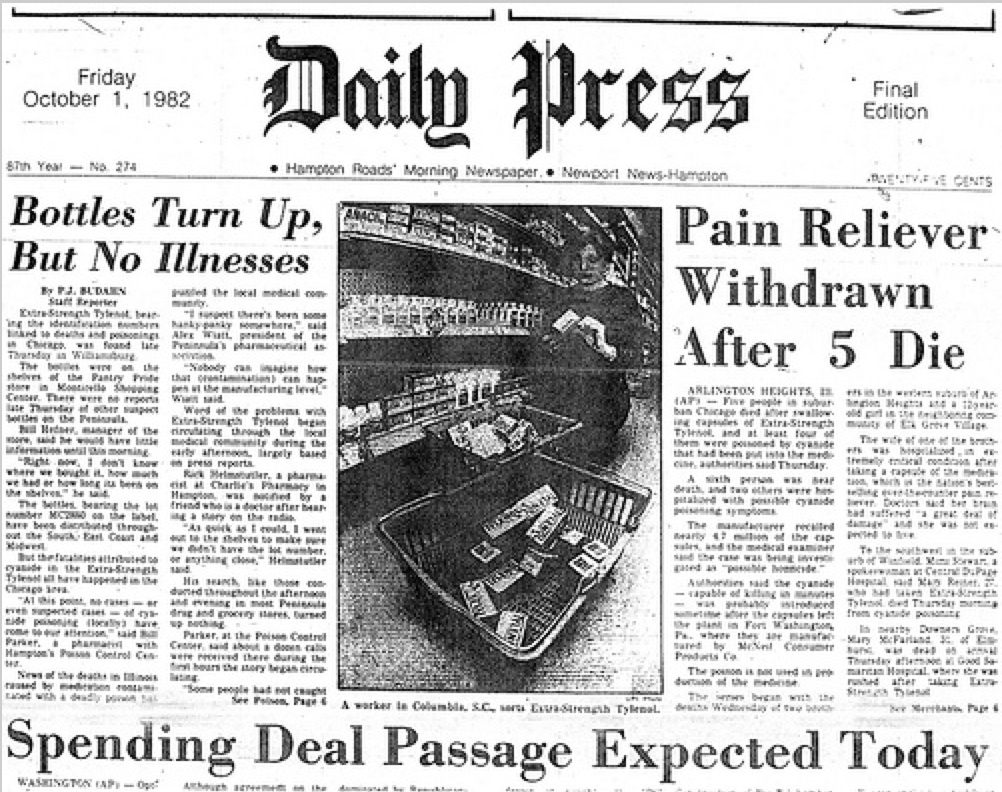
Through no fault of their own, Tylenol found themselves facing an unimaginable nightmare when a crazed person tampered with products and killed people.
For those who don’t know the story: In 1982 Chicago, people started dying of cyanide poisoning. Random people with no connection with each other, except that officials quickly discovered someone was lacing Tylenol with cyanide. It induced panic in the community to the degree that police and rescue vehicles were driving through neighborhoods announcing to people to toss out their Tylenol.
Think about that for a moment: police and rescue vehicles were driving through neighborhoods announcing to people to toss out Tylenol. Samsung went through a recall in 2016 when their Galaxy Note 7 products generated too much heat and the products caught on fire or exploded. At the time, in every airport gate in the U.S., gate attendants announced that Samsung Galaxy products were prohibited from the planes. It’s one thing for a product to perform badly. It’s another thing for a product to perform so badly that airlines make announcements against your brand prior to every U.S. flight for three months.
The Tylenol problem was worse, still.

Through no fault of their own, Tylenol had a major crisis on their hands. In all, 7 people died.
Johnson & Johnson, Tylenol brand owners, decided to pull all Tylenol products from the shelf. ALL of it, or 31 million bottles, since they didn’t want anyone else to die, and no one could be sure what products were affected.
Then they went to work, as resilient brands do.
Adjust Based On The New Reality
The buzz word these days is “pivot”. But companies have been adapting and adjusting for years without having a buzzword.

What I love about the Tylenol story is that the brand found themselves in a situation far beyond their control—and gained control again by sheer force and creativity. Most companies would have withered under these circumstances. But J&J put their best people to work on the challenge.
A short while later they reintroduced the world to Tylenol. To make sure people knew Tylenol was a safe brand, they launched with innovations consumers could see. Innovations that are so common today that new generations just accept that their products will be “Safety sealed three ways!”:
Glued boxes so consumers could tell at a glance if someone had gotten in first.
Bottle caps wrapped in plastic. So even if the box had issues, the plastic was a quick indicator of tamper-free products.
Foil-sealed lids as the final barrier against bad things happening without your knowledge.
Build On The New Reality
The Tylenol brand hasn’t looked back in ages. It’s mostly people like us who keep bringing up the story—or people who study crisis management. It’s an amazing study in how to deal with a brand collapse that’s beyond your control. But in the end, it’s what a brand chooses to control that makes the difference. J&J had the kind of culture that enabled them to take on a catastrophe head-on and thrive by making tough choices, adjusting in the new reality, acting with purpose, and building on the new reality.
There will always be crises. It’s how brands choose to deal with them that will determine what brands survive and which ones fade away.

In the marketplace of COVID-19, company leaders need to think like founders.
Much has been written about the difficulty of successful companies thriving in the second and third generations. The same logic holds true for the age of COVID-19. Companies would do well to revisit the founder mentality and get back to their entrepreneurial roots.
Much has been written about the difficulty of successful companies thriving in the second and third generations. The same logic holds true for the age of COVID-19. Companies would do well to revisit the founder mentality and get back to their entrepreneurial roots.
Many successful founders intuitively reinvent their business as they grow. They work crazy long hours to make their ideas come to life. They sacrifice of themselves. They're scrappy and scramble to take advantage of changes in the marketplace. And they jettison ideas that don't work in order to focus on what does.
Second and third generation leaders are often not scramblers. They focus on managing versus growing, they try to cut their way to profit when things get bad and, worse, believe that the one or two big clients that saved them in years past will save them forever. They feel a sense of entitlement to the spoils of success and blame others for the lack of growth or development. Soon enough the company crashes, fades away, or capitulates to a buyout.
In these days of quarantines, company leaders need to think like founders. Because we're all reinventing the future in real-time.
If you need help rethinking your future, let's talk.

The executives who got you here might not be able to get you out.
Leaders who excelled in guiding the company along historic routes can struggle with change. Agile organizations are the ones who are able to weather the storm and redefine their paths forward while fixed companies struggle with the change.
As this pandemic has taught us, agile organizations are the ones who are able to weather the storm and redefine their paths forward while fixed companies struggle with the change. Why?
In psychological terms it's called plan-continuation bias or, as the American Psychological Association defines it, "the tendency of people to continue with an original course of action that is no longer viable."
It's the kind of mindset that leads ship captains to run into icebergs, and airline pilots to crash in storms they should avoid. People who feel intense pressure to get the job done or who feel social stresses to not appear weak make stupid choices even when there is every indication that staying the course will end badly.
I meet executives with this tanker mentality. They believe their role is to keep the machine rolling on the course they set long ago. They argue that staying the course has always worked in the past, so why change now? Why? Because the world has changed and so, very likely, should the company.
This may call for new executives who can flex in the moment and guide the company to new types of success. They may not be tankers, but speedboats.
If you need help with company or brand change, let's talk.

Times of crisis call for rethinking top-heavy organizations.
Top-heavy organizations are susceptible to major disruption during stormy market changes.
There's an old story of two trees in a field, one a large, majestic oak with a sturdy trunk and broad branches. Not far away is a small, thin, and wiry willow. The mighty oak boasts of its strength and size and reminds the willow of all the ways the oak is superior to the willow. The willow is quiet. In time a heavy rain starts. The oak boasts of its ability to absorb so much water. The willow is quiet. After a while the winds pick up and grow in intensity, howling through the night. It's so dark and loud that the willow can't see or hear anything as it is battered in the wind. Eventually, the wind dies down and the sun rises. The willow looks around to see the once-mighty oak has been toppled in the storm. What made it such a formidable being in good weather led to its demise in the bad. The willow stretches to the sun. The oak is quiet.
In good times, it's easy for top-heavy organizations to rationalize their imbalance and boast of the number of vice presidents and executives in the system. As COVID-19 has reminded us, big and rigid isn't always better. Efficiency is.
Efficient organizations are nimble, agile, and flexible. They're able to see challenges and respond quickly to win.
So what should companies do to fix the problem?
Flatten the organization. Managers are not only expensive. If their roles are mostly to manage people and processes, they move further away from understanding the customers and adding value that can be directly connected to sales.
Increase the staff-to-manager ratio. It’s not uncommon to find a ratio of 4–1 or 5–1 in large companies. A big challenge here is that while this can help each employee think they get a lot of personal attention from their boss, this ratio can lead to incredible bloat. And since every level of management earns incrementally more than the people who report to them, senior managers and executives may spend most of their time managing managers. Increasing the ratio to 20–1 or, in some organizations, depending on roles, as high as 100–1, removes a tremendous amount of expense and process creep. Of course, this means every employee won’t get 30 minutes to an hour each week with their manager, but many employees don’t require or desire this level of interaction, anyway.
For more information on this, read “How to identify the right span of control for your organization” by McKinsey & Company.
Trim the number of supervisors. This feeds off step 2 here but becomes a line item in the to-do list. As the ratios are adjusted, some supervisory roles are no longer necessary.
Trim the admin staff. Every executive probably doesn’t need a personal admin, much less a group of administrative people at their direction.

Does grace have a place in business?
I've found that in healthy business cultures, people work hard to do the right thing most of the time. And in pushing forward they make mistakes for all the right reasons. When those mistakes are made, management owes it to their teams to have some grace.
Grace isn't something people talk about in the office. It's the kind of touchy-feely emotional connection executives can't quantify and therefore don't want to address. Yet it's exactly the kind of connection more executives could learn to use to transform their organizational culture.
I run into the fundamental attribution error in executives in all kinds of companies. If you're not familiar with the term, it's when we assign someone else's actions as tied to their core personality when we give ourselves a pass for the same actions. It's easy for us to say someone else is stupid or irresponsible when they make a mistake and without even thinking about it excuse our own similar actions as being influenced by factors like schedule, stress, distractions, etc.
We give ourselves grace for our issues but quickly blame others as fundamentally flawed for the same issues. Even worse is when we blame others for problems we've caused them.
I've found that in healthy business cultures, people work hard to do the right thing most of the time. And in pushing forward they make mistakes for all the right reasons. When those mistakes are made, management owes it to their teams to have some grace. We could all use a lot more grace.